


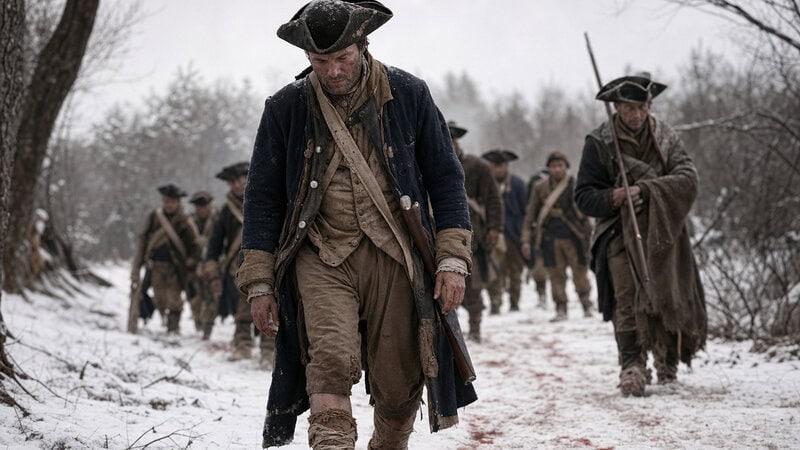

The footprints in the snow were red. At Valley Forge in the winter of 1777-78, soldiers too poor for boots wrapped their feet in rags, and the evidence of their march stained the frozen ground behind them. The most powerful military empire on earth was waiting them out — and by every rational calculation, the Continental Army was already finished.
The War That Shouldn’t Have Been Won

And yet here we are. The American Revolution succeeded through a series of events so strange, so improbably timed, and so dependent on accidents of personality and geography that even serious historians sometimes pause mid-sentence to marvel at their own sources. This isn’t the marble-statue version of events — it’s the documented, stranger-than-fiction account of how a ragged collection of colonies defeated the British Empire. The real story is considerably more terrifying and thrilling than any textbook ever let on.
The Enemy Soldiers Who Weren’t Quite the Enemy
A substantial portion of the British fighting force in America wasn’t British at all. They were Hessians — German soldiers whose princes essentially rented them out to the Crown as a revenue stream. Approximately 30,000 of these mercenaries served during the war, and their presence reveals something important about how the British Empire actually functioned in the eighteenth century: it was a contracting operation as much as a military one.
Washington understood exactly what that presence meant strategically. His famous Christmas night crossing of the Delaware River in December 1776 — boats pushing through ice-choked water in the dark, soldiers miserable and half-frozen — was specifically timed to strike the Hessian garrison at Trenton while it was off-guard after the holiday. The surprise was total, the victory decisive, and the psychological effect on both sides was enormous at a moment when the Revolution desperately needed proof it could still land a punch.
What almost nobody knows is what happened next. The Continental Congress attempted to poach those same Hessian soldiers. Pamphlets printed in German promised generous land grants to any Hessian who deserted and settled in America. The pitch worked on some of them. A number of former mercenaries stayed after the war, put down roots in Pennsylvania, and became farmers — men who had crossed the Atlantic to fight the Revolution quietly became part of the country it created. The conflict was a multinational affair on American soil long before historians framed it that way.
Benedict Arnold Was, Briefly, America’s Greatest Hero

The name Benedict Arnold has become so synonymous with betrayal that it’s almost impossible to remember what came before. Before he switched sides, Arnold was arguably the most effective battlefield commander the Continental Army possessed.
His furious, almost reckless leadership at the Battle of Saratoga in October 1777 is credited by historians as the single most important turning point of the entire war. It was Saratoga that convinced France — watching carefully from across the Atlantic — that the Americans might actually be worth backing. French entry into the war transformed a colonial uprising into a global conflict Britain could not easily contain. Without Saratoga, the argument goes, France stays home, the money and naval power never arrive, and the Revolution collapses.
Arnold was wounded in the leg at Saratoga — the same leg he had injured earlier at the Battle of Quebec in 1775. There is, in fact, a monument at the Saratoga battlefield that honors the wound: a carved boot, commemorating the injury without ever displaying Arnold’s name. The traitor’s heroism may have saved the very nation he later tried to sell.
The Founders Were Shockingly Young — and Old — at the Same Time

The sheer age range of the people who pulled off the Revolution is one of its most vivid and underappreciated features. James Monroe, who would eventually become the fifth president of the United States, was just 18 years old when he crossed the Delaware with Washington on that icy Christmas night. Alexander Hamilton was 21 when he became Washington’s chief aide-de-camp, effectively serving as the general’s brain and pen during some of the war’s most critical moments. The Marquis de Lafayette — the French aristocrat who became one of Washington’s most trusted commanders — arrived in America at 19, having defied his own government to get there.
And then there was Benjamin Franklin, who was 70 years old when the Declaration of Independence was signed in 1776. He was already one of the most famous scientists and public intellectuals in the Western world before most of the other Founders had finished their educations. While young men bled in the snow, Franklin worked the drawing rooms and dinner parties of Paris with the practiced ease of a man who had spent decades studying how power actually moves between people. His diplomatic campaign in France was as strategically decisive as any battle. The Revolution was simultaneously a young person’s uprising and an old man’s masterwork — and it needed both.
Britain Nearly Won It Twice Before It Truly Began

One of the most sobering facts about the Revolution is how thoroughly Britain almost ended it before it gained momentum. After catastrophic American defeats in New York during the summer and fall of 1776, Washington’s army shrank from roughly 20,000 men to fewer than 3,000 fit for duty within a matter of months. The situation was dire enough that Thomas Paine, retreating with the army, wrote what became “The American Crisis” — the pamphlet that opens with the famous line about times that try men’s souls — specifically as emergency propaganda to prevent mass desertion from dissolving the army entirely.
Here is where the story turns strange. British General William Howe had multiple opportunities during this period to encircle the Continental Army and destroy it. He chose not to. Howe believed a negotiated peace was more strategically valuable than annihilation — that obliterating Washington’s force might only harden American resistance without resolving the underlying political problem. Military historians have debated ever since whether this was calculated restraint or the single greatest blunder of the entire war.
The Revolution, in a very real sense, wasn’t lost by Britain on American battlefields. It was lost in British decision-making rooms on the other side of the Atlantic — in miscalculations about what kind of war this actually was.
The Revolution’s Global Ripples — and Its Accidental Aftershocks

Most people know France entered the war on the American side after Saratoga. Fewer know that Spain and the Netherlands also joined the conflict against Britain, transforming what had started as a colonial tax dispute into a war stretching from the Caribbean to the Indian Ocean. The British weren’t just fighting in Pennsylvania and Virginia — they were stretched across multiple theaters simultaneously, their resources pulled in directions that had nothing to do with colonial grievances over representation and taxation.
And then there is the fact that sits at the end of the story like a lit fuse. The financial cost of French support for the American Revolution contributed directly to the bankruptcy of the French crown. The French treasury, already under severe strain, could not absorb the expense of a transatlantic war. That fiscal crisis accelerated the political collapse that became the French Revolution — which began just six years after the Treaty of Paris ended the American war in 1783.
America’s founding, in a very real sense, helped topple the monarchy that saved it. The consequences rippled outward in ways the Founders could never have predicted, igniting a new age of revolution that reshaped Europe and the world for generations.
Why the Real Story Is Better Than the Myth
The sanitized version of the American Revolution flattens what was actually a desperate, chaotic, multinational gamble that succeeded by improbably thin margins. Understanding how close it came to failure — how much depended on a Hessian garrison sleeping off Christmas, or a British general’s decision not to press his advantage, or an aging diplomat charming a skeptical French court — makes the achievement more impressive, not less.
Myths make history comfortable. The real facts make it vivid. The soldiers at Valley Forge weren’t symbols; they were cold and hungry and they stayed anyway. Benedict Arnold was a genuine hero before he was a traitor. The French Revolution that America accidentally helped ignite would consume the very ideals the Declaration of Independence proclaimed. None of that appears in the textbook version, and all of it is true.
If this kind of narrative history appeals to you, it’s worth knowing that the strategic complexity of the Revolution — the multinational coalitions, the impossible logistics, the command decisions that changed everything — translates remarkably well into interactive form. Games like Ultimate General: American Revolution put you in command of those exact decisions, letting you feel the weight of the choices that commanders like Washington, Howe, and Arnold faced. The player consensus on the game is that it captures the period’s strategic texture with genuine care, and an in-depth review at Remap Radio breaks down what it gets right. You can explore the broader community discussion on the Steam community hub, or learn more about the series at the Ultimate General official site.
History isn’t less exciting when you get it right. In the case of the American Revolution — the myths stripped away, the surprising facts confirmed, the full strange story finally told — getting it right makes it considerably more terrifying, more human, and more worth knowing than the legend ever was.

 English
 Arabic
 French
 Spanish
 Portuguese
 Deutsch
 Turkish
 Dutch
Dutch
 Russian
 Romaian
 Portuguese (Brazil)
 Greek
Greek