


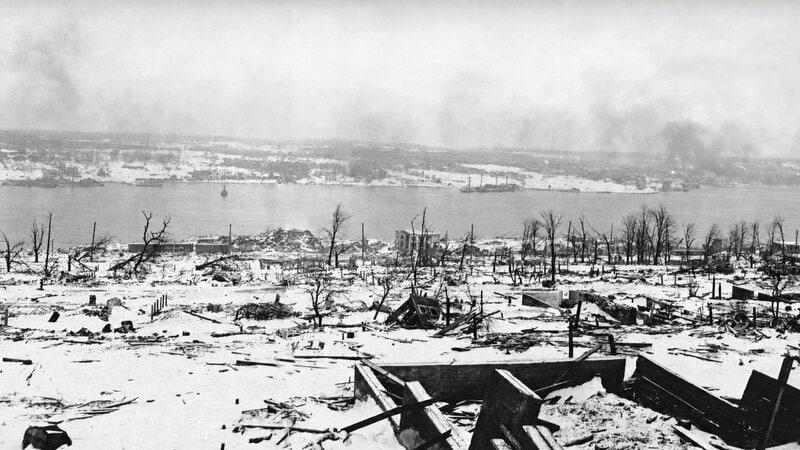

On the morning of December 6, 1917, children pressed their faces against frosted schoolroom windows in Halifax’s north end, watching a spectacular fire dance across the hull of a burning ship in the harbour below. They had no idea they were looking at the last seconds of their world as they knew it.
A City at War: Halifax Harbour in 1917

By late 1917, Halifax was the beating heart of Canada’s contribution to the Allied war effort. The harbour — one of the deepest ice-free ports on the Atlantic seaboard — was choked daily with munitions ships, troop transports, and supply convoys feeding the insatiable Western Front. Every week, vessels loaded with artillery shells, high explosives, and tens of thousands of soldiers funnelled through the Narrows, the slim channel connecting the outer harbour to the sheltered expanse of Bedford Basin. It was a wartime operation performed at close quarters, with very little margin for error.
Just metres from that dangerous shipping lane sat a working-class residential district of factories, churches, schools, and terrace houses. The people who lived there — factory workers, fishermen, their wives and children — understood in the abstract that a war was being fought across the ocean. They had sent their sons and brothers to Vimy Ridge and Passchendaele and absorbed the grief that came back in telegrams. But the home front, they assumed, was safe. Halifax was a city at war, yes, but the violence was somewhere else. It was always somewhere else.
That assumption was about to be shattered more completely than anyone could have imagined. In the context of Canada’s wartime tragedies, nothing that came before or after would approach what happened that morning.
The Floating Bomb: SS Mont-Blanc and Her Deadly Cargo

The SS Mont-Blanc was a French freighter of modest size — nothing about her outward appearance suggested danger. But her holds told a very different story. Loaded in New York and bound for Bordeaux to supply the war effort in France, she carried approximately 2,300 tonnes of picric acid, 200 tonnes of TNT, 35 tonnes of benzol fuel, and 10 tonnes of gun cotton. By any measure, she was among the most lethally loaded vessels ever to enter Halifax Harbour. Any experienced harbour pilot who stepped aboard that morning was boarding a ship more dangerous than anything that had sailed those waters before.
Wartime secrecy protocols meant the Mont-Blanc flew no flags or markings indicating she was a floating munitions depot. She was, to any observer, just another freighter. She had departed New York on Monday, December 3, 1917, arriving at the Halifax harbour entrance on the evening of December 5, where regulations required her to wait outside the anti-submarine nets overnight rather than enter after dark. So she sat, patient and invisible, brimming with devastation, waiting for morning.
Two Ships, One Fatal Miscommunication

The SS Imo was a Norwegian vessel under charter to the Belgian Relief Commission, making her way out of Halifax Harbour on the morning of December 6. She was running late, and she was moving faster than harbour rules permitted. In the Narrows, the two ships caught sight of each other and began a fatal sequence of course corrections — signals exchanged, intentions misread, each manoeuvre meant to open space instead closing it. It was the maritime equivalent of two people trying to step around each other on a footpath and mirroring every move.
The collision happened at approximately 8:45 a.m. — a glancing blow, almost underwhelming in appearance. The Imo’s prow scraped along the Mont-Blanc’s hull, ruptured it, and knocked barrels of benzol fuel into open holds. Sparks found the benzol. A fire started, small at first, then hungry, climbing toward tonnes of high explosives packed into the ship’s belly.
The Mont-Blanc’s crew knew exactly what was coming. They abandoned ship and rowed with every ounce of strength they had toward the Dartmouth shore, screaming warnings that the wind and distance swallowed whole. On the Halifax waterfront, hundreds of curious onlookers — dock workers, residents, those schoolchildren at their classroom windows — gathered to watch the spectacle of a burning ship. It was, by the standards of an ordinary morning, an extraordinary sight. Nobody ran.
9:04 A.M. — The World Comes Apart

At 9:04 a.m., the Mont-Blanc detonated.
The Halifax Explosion released the equivalent energy of roughly 2.9 kilotons of TNT — producing a white flash visible some 80 kilometres away, a pressure wave that shattered windows across Halifax and in Dartmouth on the opposite shore, and a column of smoke and debris that rose kilometres into the Nova Scotia sky. A massive surge of displaced water rolled toward shore and swept up streets. The Mont-Blanc itself was simply gone; its anchor shank was later found approximately four kilometres away.
The numbers that follow are almost too large to hold in the mind. More than 1,800 people were killed. Around 9,000 were injured. Among those injured, approximately 200 people were permanently blinded — many by flying glass at the precise moment they stood at windows watching the burning ship. The north end of Halifax was obliterated: roughly 1,600 homes destroyed outright, some 12,000 more damaged, and an estimated 25,000 people left without adequate shelter in a Canadian December. Schools, a chocolate factory, a rail yard, a newspaper office — the ordinary institutions of ordinary life — were erased in under a second.
It was, and would remain for nearly 28 years, the largest man-made explosion in recorded history.
The Aftermath: Blizzard, Relief, Blame, and Rebuilding

The city was still smouldering when the weather turned. Less than 24 hours after the explosion, a major blizzard buried the rubble under tens of centimetres of snow, transforming rescue operations into a simultaneous battle against hypothermia. Survivors who had endured the blast now faced freezing to death in the ruins of their homes.
Relief came from across Canada and the United States. Most notably, Boston mobilised with extraordinary speed — emergency medical supplies and personnel were on trains heading north within hours of news reaching the city. It was an act of solidarity that Nova Scotia did not forget. Since 1971, the province has sent a ceremonial Christmas tree to Boston every year as a token of enduring gratitude, a tradition that quietly carries one of the most poignant origin stories in North American civic life.
The legal reckoning was messier. A formal inquiry initially assigned blame to the Mont-Blanc’s pilot and captain, though subsequent appeals complicated those findings considerably. The deeper institutional question — why a vessel carrying extraordinarily dangerous cargo had been routed through a busy civilian harbour with no special precautions — was never fully and satisfactorily resolved. It was the kind of question that bureaucracies, in the aftermath of catastrophe, find easier to set aside than to answer honestly.
From the wreckage, something unexpected emerged. Within months, a new north end neighbourhood was being constructed from scratch, designed with wider streets and more robustly built housing — a planned district born directly from catastrophe. It stands today as a rare, melancholy silver lining in an otherwise unrelieved story of loss. For a thorough account of the explosion and its place in Canadian wartime history, the Canadian War Museum’s detailed history of the Halifax Explosion remains essential reading.
Individual Stories Within the Catastrophe

Statistics of this scale risk obscuring the human texture of the disaster. The north end communities that bore the full force of the blast were tight-knit working neighbourhoods, where families had lived alongside one another for generations. Entire households were killed at breakfast. Rescue workers — many of them survivors themselves, working with shattered hands — pulled bodies from collapsed homes for days. Temporary morgues were established in public buildings across the city. Families searched for missing children and parents through lists posted on church doors and railway station walls. The scale of collective grief had no precedent in Canadian experience and no adequate institutional framework to contain it.
Among the many acts of individual heroism that day, train dispatcher Vincent Coleman is particularly remembered. Having learned from a Mont-Blanc crew member that the burning ship was a munitions vessel, Coleman stayed at his telegraph key long enough to warn incoming trains of the danger before the explosion killed him. His message almost certainly saved hundreds of lives. He was 46 years old.
Why Halifax 1917 Still Matters: Legacy and the Atomic Shadow
The Halifax Explosion held its grim distinction for a very long time. From December 6, 1917, until August 6, 1945 — a span of nearly 28 years — it was the largest man-made explosion the world had ever recorded. Then the atomic bomb fell on Hiroshima, releasing energy thousands of times greater, and reset the scale of human destructive capacity so completely that Halifax, for a generation, receded somewhat in public memory. It became a before in a story whose after was almost incomprehensibly larger.
But Halifax left its mark on that later chapter too. The explosion was studied by scientists and military planners — including some who would later be involved in research connected to the Manhattan Project — as one of the few available real-world data sets for understanding how a massive conventional blast behaves in an urban environment: how pressure waves move through streets, how structures fail, how fire spreads through rubble. The tragedy of 1917 contributed, in ways its victims could never have imagined, to a body of knowledge that would shape the most consequential weapons program of the following century.
The disaster also drove lasting changes in maritime safety. New protocols for marking, routing, and separating ships carrying hazardous cargo were developed in the explosion’s wake — regulations that, in evolved forms, continue to govern dangerous cargo shipping today. For deeper reading on the explosion’s full historical context, scholarly treatments of the event have continued to deepen our understanding of its causes, conduct, and consequences, and accessible historical accounts provide strong entry points for readers encountering the story for the first time.
What endures most powerfully, though, are not the kilotons or the casualty statistics or the legal findings. It is the image of a city going about a perfectly ordinary morning — workers walking to the docks, children settling into their seats, a burning ship putting on an unscheduled show in the harbour — and the thin, almost invisible line between routine and annihilation that the Halifax Explosion of 1917 made so terrifyingly visible. Two ships failed to get out of each other’s way. No bomb was dropped. No weapon was fired in anger. And more than 1,800 people were dead before the smoke reached its peak.
History has no shortage of deliberate horrors. What makes Halifax 1917 so haunting — and so persistently worth understanding — is how completely accidental it was. A city full of people who believed themselves safely removed from the war discovered, in a single blinding second, that danger has no interest in staying where you put it.

 English
 Arabic
 French
 Spanish
 Portuguese
 Deutsch
 Turkish
 Italiano
 Russian
 Romaian
 Portuguese (Brazil)
 Greek
Greek