


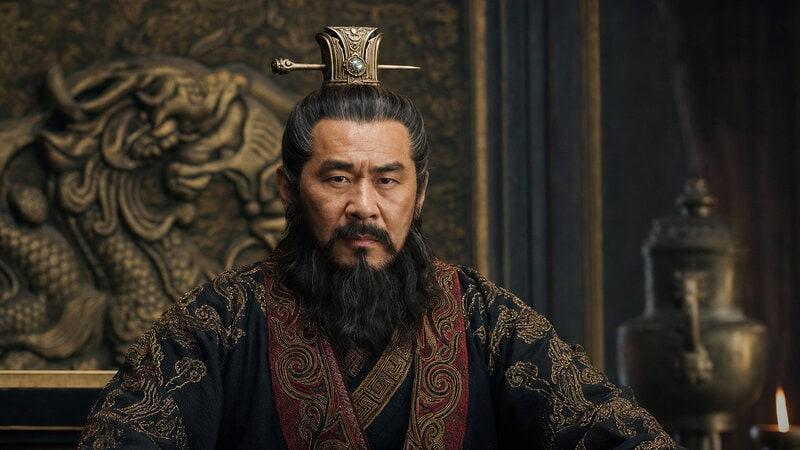

In traditional Chinese opera, you know him the moment he steps onstage: the white-painted face, slanted eyes, and exaggerated sneer that signal, in the visual grammar of Peking Opera, a man not to be trusted. For nearly eighteen centuries, that mask has been the face of Cao Cao — warlord, chancellor, and the great villain of the Three Kingdoms era. But the man who actually lived left behind poems, military commentaries, and administrative edicts that tell a strikingly different story, if anyone bothers to read them.
The Man Behind the Mask

Chinese speakers still invoke Cao Cao’s name as shorthand for scheming treachery. There is even a proverb — “Speak of Cao Cao and Cao Cao arrives” — a rough equivalent of “speak of the devil.” The cultural staying power of that association is almost without parallel in world history. Here is a man dead since 220 CE whose reputation remains so vivid, so theatrically fixed, that his name functions as a synonym for villainy across generations and media.
The central irony is this: the historical Cao Cao was also a poet of genuine sensitivity, a military thinker whose annotations on Sun Tzu’s Art of War were considered so authoritative that later dynasties standardized them as the definitive commentary, and an administrator who issued edicts promoting agricultural recovery and recruiting officials on the basis of talent rather than birth. These are not the résumé items of a pantomime villain. They are the legacy of someone far more complicated — and to understand Cao Cao honestly is to confront how thoroughly a compelling story can reduce an imperfect but genuinely complex man to a single, convenient face.
The villain problem has a clear origin point: Luo Guanzhong’s fourteenth-century novel Romance of the Three Kingdoms, which cemented a moral universe in which Liu Bei represents virtuous Han loyalty and Cao Cao represents usurpation and cunning. That novel is magnificent literature. It is also historical fiction, and the distance between its Cao Cao and the documented one is vast enough to constitute biography-by-erasure.
Born Into the Wrong Family at the Wrong Moment

To understand what Cao Cao was up against — from birth, before he ever drew a sword — you need to feel the texture of the late Han dynasty in its final, convulsing decades. The Han had ruled China for four centuries, but by the latter half of the second century CE, the machinery of empire was failing catastrophically. Floods and famines rolled across the north China plain. The Yellow Turban Rebellion of 184 CE sent peasant armies surging through the countryside. Boy emperors sat on the throne while whichever faction held the palace that particular season — eunuchs, consort clans, aristocratic generals — exercised real power. Central authority existed mostly on paper.
Into this world, Cao Cao was born around 155 CE carrying a social liability that would define his entire career. His father, Cao Song, was the adopted son of Cao Teng, a powerful chief eunuch of the imperial court. Eunuchs wielded enormous practical influence in the late Han, but they were despised by the Confucian scholarly aristocracy as a corrupting presence in imperial government. That taint attached to their families. Cao Cao’s background was prestigious enough to open doors but suspect enough to ensure those doors were never fully open.
The consequence was formative: Cao Cao could never simply inherit power the way the great aristocratic clans could. He had to earn it, justify it, and defend it continuously — which made him simultaneously more ruthless when threatened and more genuinely meritocratic than rivals who coasted on genealogy. By the time he emerged as a military officer in the 180s CE, the Han state was functionally dissolving, and the warlords rising to fill the vacuum were carving up provinces like men dividing a carcass.
The Warlord Who Actually Read Books

Among those warlords, Cao Cao was exceptional in a way that gets consistently lost in dramatic retelling. He was, without question, one of the most capable military commanders of his era — a general who won and lost campaigns across decades of near-continuous warfare against rivals including Yuan Shao, Yuan Shu, and Liu Biao, and who came closer than any contemporary to reunifying a fractured China. But he was also a literary figure of real distinction.
He composed shi poetry that scholars still study, and he anchored a circle that included his sons Cao Pi and Cao Zhi. Together, literary historians refer to this grouping as part of the Jian’an school of poetry — a flowering of Chinese letters that emerged, improbably, in the middle of a prolonged civil war. The quality of that output was not incidental to the chaos around it. The era’s violence and instability gave the poetry its recurring themes: mortality, loss, and the fragility of human achievement.
His poem Duan Ge Xing (“Short Song”) opens with an image of human life as brief as morning dew — a meditation on mortality that carries genuine anguish rather than poetic convention. It then pivots to a longing vision of talented men gathering to restore order and meaning to a broken world. This is not the voice of someone who sees himself as a schemer. It is the voice of a man who understood what was being lost and felt compelled to articulate why it mattered.
His commentary on Sun Tzu’s Art of War is equally revealing. It is precise, practical, and shows a mind that had tested strategic theory against battlefield reality across many campaigns. Later dynasties did not preserve it because Cao Cao was famous — they preserved it because it was the most useful guide to the text then available. That intellectual legacy sits in uncomfortable tension with his theatrical reputation, and it should.
What Reunification Actually Required

The structural problem Cao Cao faced was not simply military. China in the 190s CE was dominated by great aristocratic clans — sometimes called the “powerful families” — who controlled land, private armies, and tax revenues that should have flowed to central government. Any functioning imperial state was impossible as long as these clans operated as autonomous powers within the empire’s nominal borders. Weakening them was a prerequisite for stable government, not merely a power grab — and it made Cao Cao implacable enemies whose descendants happened to be the people who compiled much of the historical record.
His talent-recruitment edicts are among the most remarkable administrative documents of the era. In them, he explicitly called for appointing capable men regardless of family background or conventional moral reputation — a direct challenge to the aristocratic assumption that virtue and birth were the same thing. He redistributed agricultural land, promoted irrigation works in territories he controlled, and worked to rebuild a tax base capable of sustaining central government rather than enriching regional strongmen.
The charge that he reduced Emperor Xian to a puppet is worth examining with some care. Cao Cao did hold the emperor under his effective authority from 196 CE onward — but he never claimed the imperial title himself. He governed as Chancellor and, later, as King of Wei, always nominally in the emperor’s name. The Wei dynasty was only formally declared by his son Cao Pi after Cao Cao’s death in 220 CE. Whether this represents cynical manipulation or genuine constitutional restraint remains a question historians debate seriously, but the documented facts are considerably less straightforward than the theatrical version implies. The historical record on this point rewards closer reading than the novel provides.
The Atrocities Are Real — and So Is the Context

None of the above is a whitewash. Cao Cao ordered massacres. The slaughter associated with his campaigns in Xu Province — undertaken in the aftermath of his father Cao Song’s death, for which he held the provincial leadership responsible — is documented and, by any reasonable standard, indefensible. He executed rivals on thin pretexts; the killing of the brilliant and abrasive official Kong Rong is one of the most troubling cases in the record. He could be vindictive in ways that exceeded any recognizable military necessity. These things happened and they matter.
The historian’s obligation, though, is context. Virtually every major warlord of the era committed comparable or worse violence against civilian populations, and unlike many of them, Cao Cao also issued orders of military restraint, punished soldiers who looted farmland from the peasants whose agricultural labor he needed for economic recovery, and invested systematically in the long-term stability of territories under his control. His violence was instrumental, frequently catastrophic, and morally serious; it was not uniquely sadistic in an era defined by catastrophic violence on all sides.
There is also the question of sources. The accounts most hostile to Cao Cao were written or compiled under the rival Shu Han or the Jin dynasty — both with clear political incentives to darken his memory. The more measured Sanguozhi, compiled by Chen Shou in the third century, acknowledges his achievements alongside his brutality, but even that text is filtered through a world in which Cao Cao’s faction had already lost the legitimacy argument to history. The gap between the historical Cao Cao and the fictional one is substantial, and it was constructed with purpose.
How the Villain Was Manufactured

The mythology was not accidental. By the Song and Ming dynasties, Confucian political theology demanded a clear moral hierarchy for the Three Kingdoms period: Liu Bei as the legitimate Han loyalist, Cao Cao as the usurper who threatened the sacred dynastic line. Luo Guanzhong’s Romance of the Three Kingdoms brilliantly dramatized that hierarchy. It is a masterpiece of narrative construction. It is also advocacy in the form of fiction, and its Cao Cao is a character engineered to serve a moral argument rather than to illuminate a historical person.
Peking Opera then encoded that character into immediate visual shorthand — the white face, the stylized gestures — which millions of Chinese people absorbed across generations without ever encountering a primary source. The fictional version became more culturally real than the documented one. That is precisely what makes the case instructive: it demonstrates how thoroughly theatrical convention can displace the historical record when the convention serves sufficiently powerful ideological purposes.
The consensus, however, has never been as stable as its longevity implies. In the twentieth century, Chinese historians began revisiting the record with more rigorous critical tools. Notably, Mao Zedong openly expressed admiration for Cao Cao as a decisive leader and unifier — a rehabilitation that, whatever one makes of Mao’s own legacy, at minimum signals that the centuries-old verdict was always more contested than it appeared from the outside.
Reading the Man the Record Left Behind
Return, at the end, to the poems. Cao Cao’s recurring images are ravens circling at dawn, old horses still dreaming of distant roads, a realm that is broken and could yet be made whole. These are not the affectations of someone who thinks of himself as a villain. They are the work of a man who understood mortality, who felt the weight of what was being lost in the collapse of the Han world, and who believed — perhaps wrongly, certainly with too much violence in his methods, but genuinely — that he was the person capable of holding something together when no one else could.
He was one of the most capable military and administrative minds of ancient China: an imperfect visionary who came closer than any contemporary to preventing the prolonged fragmentation that followed his death, and a writer whose work has outlasted the propaganda waged against him across eighteen centuries. He was also a man who ordered massacres, executed inconvenient people, and bent law to his purposes. Both things are true, and the discomfort of holding them simultaneously is exactly the point.
The story of Cao Cao is ultimately a story about who writes history, what those writers needed history to say, and how a dramatically satisfying role can consume a real human being across centuries of retelling. The white-painted face is among the most recognizable images in Chinese cultural life — but behind it, in the poems and edicts and military commentaries the man actually left behind, you find someone who understood exactly how history treats those it has decided to make into villains. He wrote the poetry anyway. That, perhaps more than any battle won or lost, is the most human thing about him.

 English
 Arabic
 French
 Spanish
 Portuguese
 Deutsch
 Turkish
 Dutch
Dutch
 Italiano
 Romaian
 Portuguese (Brazil)
 Greek
Greek