


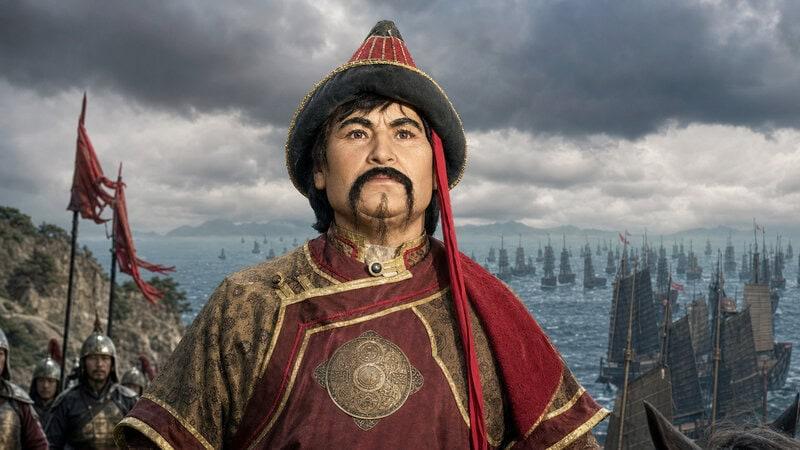

In August 1281, Japanese warriors standing on the cliffs of Kyushu watched something that should have stopped their hearts: a forest of masts stretching to the horizon, nearly four thousand ships carrying the armies of the most powerful ruler on Earth, closing in on their shore. What happened next — twice, separated by seven years — would become one of history’s most extraordinary stories of survival, strategic miscalculation, and the brutal indifference of the weather.
Kublai Khan Sends His Letters — Japan Refuses to Kneel

Throughout the 1260s, Kublai Khan — grandson of Genghis, ruler of the Yuan dynasty, master of an empire stretching from the Pacific coast of China to the plains of Eastern Europe — dispatched a series of envoys to Japan. Each letter was a variation on the same message: submit, pay tribute, or face the consequences. The letters grew sharper and more imperious as years passed and Japan’s ruling shogunate in Kamakura continued to do what no sovereign power had yet dared to do to Kublai Khan — simply ignore him. The shogunate eventually executed several of his ambassadors, a deliberate and extraordinary act of defiance.
Japan at the time was governed by a bakufu, a military government, that was young, internally strained, and acutely aware of what submission would actually mean. It would mean the end of Japanese sovereignty. It might mean the end of the imperial institution that gave the whole political order its legitimacy. The Mongol court, having already absorbed the Song dynasty of China and vast stretches of Korea and Central Asia, found the refusal almost incomprehensible. To Kublai, a small island nation declining his invitation was not defiance — it was ignorance. Eventually, he stopped writing letters and started commissioning ships.
1274 — The First Wave Hits Northern Kyushu

In 1274, the first Mongol invasion of Japan departed from Korea, crossing the Korea Strait as an expeditionary force.
The force moved with terrifying efficiency. The island of Tsushima fell first, its defenders overwhelmed by an enemy unlike anything Japanese warriors had previously encountered. Then the island of Iki. The defenders on both islands were experienced fighters, but they faced tactics that made their training almost irrelevant: disciplined mass formations rather than individual duels, crossbow volleys that could shred a charge before it closed, and explosive projectiles — bronze shells packed with gunpowder — that detonated with noise and fire, sending warhorses into panicked chaos. The psychological shock alone was a weapon.
When the Mongol forces landed at Hakata Bay in northern Kyushu, the cultural collision became acute. Japanese samurai had a deeply ingrained tradition of individual combat — identifying yourself, naming your lineage, challenging a worthy opponent before engaging. The Mongols had no interest in any of that. They fought as machines of coordinated destruction: unit supporting unit, archers creating corridors for infantry, drums and gongs directing movement across the field. Japanese commanders scrambled to adapt in real time.
Then came the night that would define the invasion’s outcome. Mongol commanders pulled their forces back to the ships — accounts differ on whether a storm struck that evening or whether they had already chosen to withdraw before weather scattered the fleet — but the invasion force never returned to shore. Japan remained unconquered. It had been a near thing, and everyone knew it.
Japan Builds a Wall — and Waits

The Kamakura shogunate did not treat the withdrawal as a victory. They treated it as a warning. Almost immediately, the government ordered the construction of a stone defensive wall along the shoreline of Hakata Bay — a barrier stretching for miles, designed to deny the Mongols the easy beach landings that had proved so effective in 1274. It was a rational, practical response, and it cost an enormous amount of money that the shogunate did not really have.
The financial strain produced a deeper crisis. Samurai clans that had fought in 1274 waited for the traditional reward: land redistributed from a defeated enemy. But Japan had not conquered any enemy territory. There were no Mongol lands to parcel out. Warriors who had bled for the defense of Kyushu received bureaucratic certificates of commendation and little else. The resentment this created festered for decades, eventually contributing to the political collapse of the Kamakura regime in 1333. The defense of the homeland was slowly bankrupting the defenders.
Meanwhile, intelligence filtered through Korean traders and diplomatic contacts made one thing clear: Kublai Khan had not given up. Korean shipyards were busy. Chinese ports were active. A second invasion was being assembled on a scale that dwarfed the first. For seven years, temples across Japan held unbroken prayer campaigns. The imperial court performed rituals calling on the gods for protection. Ordinary people lived under the specific, grinding anxiety of knowing that the worst was still coming. The psychological and cultural weight of this period would shape Japanese identity for centuries — in its religious practices, its warrior culture, and its understanding of what it meant to be a people set apart.
1281 — The Largest Seaborne Invasion the Medieval World Had Ever Seen

The 1281 campaign was a different order of magnitude entirely. In spring 1281, Kublai Khan sent two separate forces converging on Japan from different directions: an Eastern Route Army departing from Korea, and a far larger Southern Route Army sailing from ports in southern China. Together, the two fleets represented — by the upper range of scholarly estimates — close to one hundred and forty thousand soldiers and sailors across nearly four thousand four hundred vessels, a logistical undertaking without precedent in medieval history.
But this time the Japanese were ready. The stone wall at Hakata Bay proved its worth immediately. Mongol forces accustomed to driving straight up open beaches found themselves bottled up at the waterline, absorbing casualties while unable to push inland and exploit their numerical advantage. The great invasion stalled in a grinding, bloody stalemate through the early summer months, with neither side able to break the deadlock on shore.
Japanese commanders, recognizing they could not match Mongol forces in open-field battle, turned to the water. Small, fast boats launched night raids against the packed Mongol anchorage. Samurai boarded enemy vessels under cover of darkness, cutting tether ropes to set ships adrift, creating cascading collisions in the crowded harbor. Illustrated scrolls commissioned after the invasions — among the most detailed visual records of medieval Japanese warfare — depict these close-quarters naval engagements with vivid, often grim specificity. The mighty invasion force, carrying the ambitions of the world’s most powerful empire, found itself wedged between a stone wall on shore and samurai raiders at sea, waiting for a breakthrough that never came.
Instead, the sky turned dark.
The Divine Wind — What the Typhoon Actually Did

The typhoon that struck the Kyushu coast in August 1281 was, by any physical reckoning, catastrophic. Late-season storms in the western Pacific generate sustained winds and storm surges capable of destroying modern infrastructure. What they did to a medieval fleet of wooden ships packed tightly together in a coastal anchorage — unable to disperse, unable to run before the wind — was near-total annihilation.
The disaster was compounded by an engineering failure that imperial ambition had created. Many of the vessels in the Southern Route Army, assembled under enormous time pressure in Chinese shipyards responding to Kublai’s urgent orders, were river and coastal craft — flat-bottomed, shallow-drafted boats never designed for open-sea conditions. When the storm surge came, they broke apart. Ships that might have survived in open water, riding the swells, were instead crushed against each other and against the coast. The scale of the naval catastrophe was staggering: Chinese and Korean chronicles suggest that more than half the invasion force perished — drowned, crushed, or killed by Japanese forces hunting survivors on the beaches in the storm’s aftermath. It remains one of the deadliest single military disasters in recorded history.
The Japanese called the storms kamikaze — divine winds — and the name embedded itself permanently in the national consciousness. The storms were not coincidence; they were interpreted as intervention, as proof of something sacred about the islands and the people who inhabited them. This belief in divine protection hardened over the centuries into a cultural bedrock — a conviction about Japan’s special relationship with the heavens that became, in the darkest chapters of the twentieth century, a justification for sending young men to die in aircraft named after the storms that had once saved their ancestors. It could not work twice. The pilots died, and the war ended regardless.
The honest historical question is whether any of this required a supernatural explanation. Both invasions came in autumn, the peak of typhoon season in the western Pacific. Korean and Chinese advisors embedded in Kublai’s military apparatus almost certainly understood this risk. The storms were not improbable — they were predictable. What was remarkable was that the Khan launched massive amphibious operations in typhoon season twice, and that twice the weather delivered the worst possible outcome for his fleets. Poor strategic timing, not divine disfavor, is the more parsimonious explanation.
Why the Invasions Failed — and Why the Story Still Matters

The storms were decisive, but they finished off campaigns that were already in serious trouble. The Mongols’ fundamental problem was one of military geography: their empire had been built on land, by cavalry armies operating across connected terrain. The Korea Strait introduced a kind of friction that the greatest land empire in history had no reliable answer for. Extended supply lines across open water, fleets crewed by conscripted Korean and Chinese sailors with little enthusiasm for Kublai’s Japanese ambitions, the stone wall at Hakata denying the beachhead that had worked in 1274, and relentless Japanese naval harassment — all of these had already turned the 1281 campaign into an exhausting stalemate before the first storm clouds gathered.
The storms did not save Japan at the last moment from certain defeat. They confirmed and accelerated an outcome that the defenders had already worked hard to make possible. The wall, the night raids, the seven years of preparation — these mattered as much as the weather.
Kublai Khan reportedly contemplated a third invasion. He had the resources, and he had the fury — the humiliation of two destroyed fleets was not something a man of his temperament absorbed quietly. But rebellion in Vietnam and Java, the ruinous expense of the two failed campaigns, and the counsel of advisors who had watched ships vanish in storms all argued against it. Kublai Khan died in 1294. No third fleet ever sailed.
What remained was the myth, and myths are often more durable than the events that create them. The kamikaze became a story Japan told itself about its own inviolability, about the invisible shield that the gods held over the islands. That story shaped religious institutions, warrior identity, and — fatally — twentieth-century military ideology. The true lesson of the Mongol invasions may be simpler and stranger than any myth: that two of the most consequential near-misses in medieval history were decided not by generalship alone, not by valor alone, and not by the gods, but in significant part by the utterly indifferent physics of a typhoon arriving in typhoon season. The outcomes we call inevitable are often decided by forces no army has ever learned to command.

 English
 Arabic
 French
 Spanish
 Portuguese
 Deutsch
 Turkish
 Dutch
Dutch
 Italiano
 Russian
 Romaian
 Portuguese (Brazil)