



On a summer morning in 1979, a Soviet amateur archaeologist named Alexander Avdonin moved slowly through a stand of birch trees outside Yekaterinburg, sweeping a metal detector across the forest floor — and the device screamed. Beneath that patch of unremarkable Russian earth, nine skulls lay in a pit that the Soviet state had spent six decades pretending did not exist.
Three Hundred Years of Power, Ended in a Basement

To understand why those bones had to stay hidden, you have to go back to the beginning. The House of Romanov had ruled Russia since 1613 — three centuries during which the dynasty forged an empire stretching across eleven time zones, shaped the fate of continents, and made the very word “tsar” synonymous with absolute power. By the time the last emperor, Nicholas II, ascended the throne in 1894, that power was cracking at its foundations, though Nicholas himself seemed constitutionally unable to see it.
He was, by most accounts, a devoted husband and a tender father — and a catastrophically poor political leader. He clung to autocracy while Russia bled through a disastrous war with Japan, then bled far more grievously through the First World War. Revolution came not as a sudden shock but as the inevitable result of years of famine, military collapse, and a ruling family that had long since lost its connection to the people it claimed to govern. In March 1917, Nicholas abdicated. The Romanov dynasty was over. What came next was something darker.
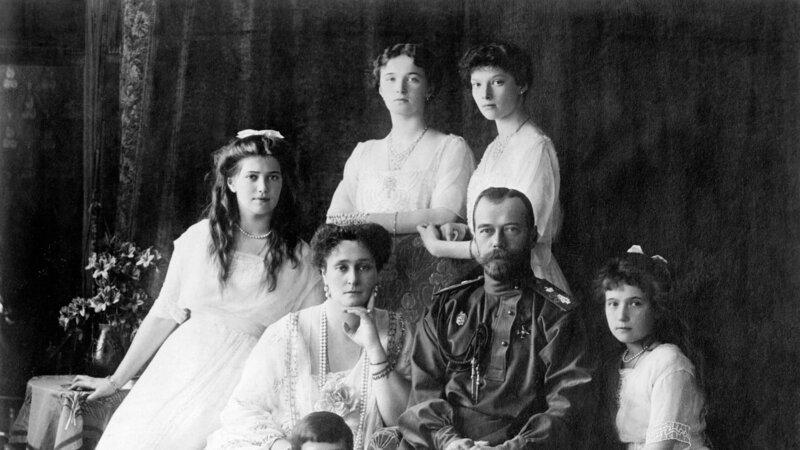
By the summer of 1918, Nicholas, his wife Alexandra, their four daughters — Olga, Tatiana, Maria, and Anastasia — and their son Alexei were prisoners in the Ipatiev House, a merchant’s home in Yekaterinburg that had been repurposed as their cage. On the night of 17 July 1918, Bolshevik guards roused the family from sleep, led them to the basement, and shot them — ending three centuries of Romanov rule in a matter of minutes.
The Night the History Books Struggled to Describe
The family had been told they were being moved for their own safety. They dressed, gathered a few small belongings, and walked downstairs — all except Alexei, whose severe hemophilia left him too weak to walk on his own. He was carried. In the low-ceilinged basement room, eleven armed men were waiting.
What followed was prolonged and brutal. The daughters had jewels sewn into their corsets, and in the chaos of the opening volley, those hidden layers deflected bullets. Some of the children survived the first round of fire. The killing took far longer than the executioners had planned. Afterward, the bodies were driven deep into the surrounding forest, doused with sulfuric acid in an attempt to destroy them, partially burned, and buried in two separate graves — a deliberate act of concealment designed to erase the physical evidence of what had happened and deny history the proof it would spend decades demanding.
The Bolshevik leadership, almost certainly including Lenin, authorized the killings. The local Ural Soviet carried them out. The official silence — meticulous, enforced, and dangerous to anyone who challenged it — began the same night.
What Nicholas II’s Reign Actually Looked Like

It is tempting to reduce Nicholas II to a single image: the doomed father carrying his sick child toward a firing squad. That image is true, and it is not the whole truth. During his twenty-three-year reign, Nicholas presided over the violent suppression of the 1905 revolution, authorized the use of troops against peaceful demonstrators on Bloody Sunday in January of that year, and consistently blocked meaningful constitutional reform. His resistance to sharing power — even in diluted form — made the catastrophe of 1917 far more likely than it needed to be.
Alexandra, too, was a figure of genuine complexity. Deeply devout and fiercely protective of her son, she fell under the influence of Grigori Rasputin, a Siberian mystic whose apparent ability to ease Alexei’s hemophilia gave him extraordinary access to the imperial family. Rasputin’s growing influence over court affairs deepened the isolation of the Romanovs from Russian political and aristocratic society at precisely the moment when they needed allies most. When Rasputin was murdered by a group of nobles in December 1916, it was already far too late to matter.
The Myth of Anastasia Romanov

Because the burial was secret, the world had no confirmed proof of what had happened to the family. Into that uncertainty rushed legend. The most powerful story to take root was that of Anastasia Romanov — the youngest daughter, who, rumor insisted, had somehow survived.
Between the 1920s and the 1990s, at least ten different women came forward claiming to be Anastasia. The most famous, a woman known as Anna Anderson, pursued her claim through European courts for decades and became the subject of books, documentaries, and films. Her story had an almost irresistible emotional logic: the Romanov family had vanished without a public grave, without confirmed remains, and the Bolsheviks had every reason to lie about what they had done. If the state was hiding something, why couldn’t it be hiding a survivor?
The truth, when it finally came, was harsher than any fairy tale. Anastasia had not survived. The myth endured not because of evidence but because of need — humanity’s deep hunger for the story where at least one innocent escapes. DNA analysis eventually proved that Anna Anderson had been a Polish factory worker named Franziska Schanzkowska. The princess she claimed to be had died in a basement in 1918.
The Secret Keepers: How Two Men Found the Grave and Said Nothing

Return, then, to Alexander Avdonin and his collaborator, filmmaker Geli Ryabov, and the extraordinary chain of evidence that led them to that birch forest. Their key document was a copy of a detailed account written by Yakov Yurovsky — the commander of the execution squad — describing exactly how the bodies had been disposed of. This document had been preserved by a Bolshevik insider and quietly passed along through trusted hands until it reached Ryabov. It was the kind of thing that could get a person killed in the Soviet Union.
The Yurovsky account described the burial site with enough geographic precision to be useful. Avdonin and Ryabov spent years cross-referencing it with old maps, pre-revolutionary photographs, and surviving forest paths before they finally broke ground in 1979. When the metal detector sounded and they began to dig, what they found confirmed everything: skulls, bones, the physical remnants of the family that the Soviet state had tried to erase from existence.
They reburied what they found. They told no one. For eleven years, they carried that knowledge alone — Avdonin acutely aware of the risks, Ryabov watching and waiting. It was only in 1989, as Mikhail Gorbachev’s policy of glasnost began to fracture the old silence, that Ryabov hinted at the discovery in a magazine article. In 1991, with the Soviet Union itself collapsing, Avdonin finally led authorities back to the grave. This time, the Romanov remains would be examined not in secret, but by the world.
Science Closes the Case DNA Opens

Russian forensic teams, followed by British and American scientists, extracted DNA from the bones recovered from the first grave. Results confirmed that the remains matched living Romanov relatives, including Prince Philip, Duke of Edinburgh, whose maternal grandmother was a sister of Tsarina Alexandra. Nine individuals were identified — Nicholas II, Alexandra, three of their daughters, and four members of the household staff who had died alongside them. Two bodies were conspicuously absent.
In 2007, a second, smaller grave was discovered nearby. It contained the charred remains of two more individuals. DNA analysis completed in 2008 confirmed what the evidence had long suggested: these were Alexei and one of his sisters, most likely Maria or Anastasia — forensic analysis has not produced a definitive conclusion on which of the two sisters the remains belonged to. Every member of the immediate family was nonetheless accounted for. All five children, including Anastasia, had died on the night of 17 July 1918. One of the twentieth century’s most enduring mysteries — sustained for decades by grief, propaganda, and wishful thinking — was resolved by fragments of mitochondrial DNA.
Why the Romanovs Still Reach Across a Century
The story did not end with the science. In 2000, the Russian Orthodox Church canonized Nicholas II and his family as passion-bearers — saints who, regardless of their earthly failings, had met death with Christian dignity and humility. The decision was and remains controversial. He was simultaneously the last emperor of a brutal autocracy and a father who carried his sick son down a flight of stairs toward a firing squad. Inside Russia, the question of how to remember the last tsar has never been cleanly resolved.
The Ipatiev House where the family spent their final months was demolished in 1977 on the orders of a regional Communist Party official named Boris Yeltsin, who would later become the first president of post-Soviet Russia. In its place now stands the Cathedral on the Blood, a soaring Orthodox church that draws thousands of pilgrims every year, many arriving on the anniversary of the execution to hold candlelight vigils through the night.
What makes the Romanov story so persistently alive is the way it refuses to settle into a single meaning. It is a political tragedy and a ghost story simultaneously — the tale of a dynasty that ruled for three hundred years and ended in a cellar, of a government that tried to make seven people disappear and almost succeeded, and of the strange, stubborn persistence of physical truth. Alexander Avdonin didn’t set out to change history when he walked into those birch trees with a metal detector. He set out to find what a government had buried. He found it. And what had been buried — like the dynasty itself, like the questions it left behind — refused, in the end, to stay hidden.

 Arabic
 French
 Spanish
 Portuguese
 Deutsch
 Turkish
 Dutch
Dutch
 Italiano
 Russian
 Romaian
 Portuguese (Brazil)
 Greek
Greek