


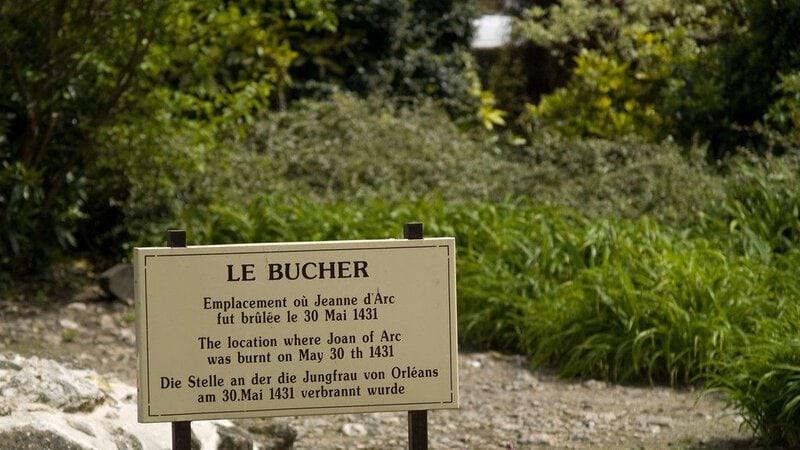

On the morning of May 30, 1431, the English authorities in Rouen built the execution pyre in the Place du Vieux Marché unusually high — not out of spectacle, but out of fear. They were afraid that if the crowd pressed too close, someone might snatch a bone, a lock of hair, a fragment of cloth, and carry it away as a holy relic. What followed was not just an execution but one of history’s most deliberate attempts to erase a person from the physical world entirely.
The Morning They Tried to Erase Her

Joan of Arc was nineteen years old when they chained her to the stake. Witnesses recorded that she called on Jesus and her saints until the smoke rising from the green wood took her voice. The executioner later claimed — and the account was widely repeated — that her heart refused to burn like ordinary flesh even after the flames had done their worst. Whether that detail belongs to history or to legend, it lodged in the memory of everyone who heard it. The English had made a martyr, and they knew it the moment she died.
What happened next was almost without precedent for a public execution of that era, and it explains everything about why the question of Joan of Arc’s tomb leads, ultimately, to a river and an open sea.
Three Fires and a River: How They Destroyed the Evidence

The destruction was methodical. The first burning reduced her body in the manner of any execution by fire. But the English authorities, watching the crowd and calculating what a relic could become — a shrine, a cult, an insurgency wrapped in religious legitimacy — ordered a second burning, specifically intended to incinerate remaining tissue and organs. Then a third, reducing everything to powder. Three fires for one young woman, because one was not enough to satisfy the political necessity of her complete obliteration.
Even then, they were not finished. Her ashes were gathered and carried to the pont Mathilde over the Seine in Rouen and thrown into the river. Whatever the fire had left, the current took. The Seine runs west from Rouen through Normandy to the English Channel, and somewhere in that flow, what remained of Joan of Arc dispersed into the sea.
The political logic was coldly rational. A body creates a shrine. A shrine creates a cult. A cult can become a rebellion. The English had spent years fighting a teenage girl who claimed divine mandate and had broken the siege of Orléans, turned the tide of a war, and escorted a dauphin to his coronation at Reims. They had no intention of letting her accomplish anything further, even from the grave. So they made certain there would be no grave.
The Place du Vieux Marché in Rouen today bears a commemorative plaque recalling what happened to her remains and acknowledging the disposal of her ashes into the Seine. The square records zero interments. There was nothing left to inter.
What “Joan of Arc’s Tomb” Actually Means — and Doesn’t

There is no tomb of Joan of Arc. No church holds her bones. No crypt bears her name. No consecrated ground received her body. For anyone who arrives in Rouen or searches the pilgrimage routes of France hoping to stand before her resting place the way a traveler might stand before the tomb of Saint Francis in Assisi, or descend into the crypt beneath Saint Peter’s Basilica in Rome, or walk the final meters of the Camino to Santiago de Compostela — the answer is the same, and it is an absence.
This sets her apart from virtually every other canonized saint in Catholic tradition. The Church’s theology of relics runs deep, rooted in the conviction that the bodies of the holy are themselves sacred — that holiness leaves a physical residue. Santiago, Francis, Peter, Clare, Thomas Becket: saints are, among other things, bodies in specific locations that draw pilgrims across centuries. Joan of Arc has no resting place on earth.
The closest things to a site are memorials rather than tombs. The Place du Vieux Marché is itself the ground zero of her death, and the Église Sainte-Jeanne-d’Arc, built on that spot in 1979, is one of the more architecturally striking modern churches in France — its roof shaped like an inverted ship’s hull, its windows incorporating medieval stained glass salvaged from an earlier church on the site, its entire presence a deliberate act of memory on the ground where she died. Pilgrims do come to Rouen. But they are visiting a monument and a memory, not a tomb. That distinction quietly separates Joan from almost every major saint of the medieval world.
The Relic Problem: Bones, Ashes, and the Long History of Fakes

In the centuries following her death, relics purporting to be Joan of Arc’s remains surfaced repeatedly. A rib. A lock of hair. Charred bone fragments. The relic trade in medieval and early modern Europe was brisk enough that almost any saint could eventually acquire physical attestation, regardless of what the historical record said about the fate of their body. Joan proved no exception, even though the record in her case was exceptionally clear.
The most scrutinized case came in 1867, when a sealed jar was discovered in the attic of a Paris pharmacy, labeled to indicate it contained remains found beneath the stake of Joan of Arc. The contents — what appeared to be fragments of charred bone, a piece of wood, and a fragment of cloth — were examined provisionally by Church authorities and venerated for decades as authentic relics of the Maid of Orléans.
In 2006, forensic scientists applied carbon dating and chemical analysis to the contents. The results were unambiguous: the bone fragments were from an Egyptian mummy at least two thousand years old, and cat bone had been mixed in. The relic venerated for generations had no connection to Joan whatsoever, and its components predated her by more than a millennium.
The episode is extreme, but it illustrates a broader truth: because the historical record of her destruction is so thorough and so well-documented, any physical fragment attributed to her demands profound skepticism. The search for Joan of Arc’s grave has occupied hopeful researchers and devoted pilgrims for centuries, but the Seine received what the fire left, and the sea received what the Seine carried.
The Nullification Trial and the Paper Trail She Left Instead
Joan left no body. But she left an extraordinary documentary record — arguably the most detailed account of any medieval person’s inner life to survive from that era. The transcripts of her 1431 condemnation trial, and of the 1456 nullification trial that posthumously exonerated her, run to hundreds of pages. In those pages she is vivid, quick-witted, and occasionally sharp in ways that clearly unsettled her interrogators.
One exchange has been repeated for centuries. Asked whether she knew she was in God’s grace — a theological trap, since claiming certainty of grace was heresy, but denying it would undermine her entire mission — she answered that if she was not, she prayed God would put her in it, and if she was, she prayed He would keep her there. The court scribes recorded it. The room reportedly went quiet.
The nullification trial was ordered by Charles VII partly out of political self-interest: his own coronation had depended on a woman now officially condemned as a heretic, and that condemnation reflected badly on his reign. The trial interviewed more than a hundred witnesses and formally declared her original proceedings illegal and her execution unjust. It came twenty-five years too late. It could not reassemble what the Seine had carried away.
Her tomb, in the deepest sense, is this paper archive. The trial transcripts are held today in the French National Archives and the Bibliothèque nationale de France. Words survived where bones could not. The fire intended to erase her produced a documentary record more substantial than most of her contemporaries managed to leave by dying peacefully in bed.
Where Is Joan of Arc Buried? A Geography of Absence

Walk through the sites associated with her death and what you find is a consistent, almost eloquent absence. Rouen’s marketplace: execution site, zero interments, a church and a commemorative marker where a stake once stood. The Seine: ashes dispersed into a river that does not give back what it receives. Domrémy-la-Pucelle, her birthplace village in Lorraine, preserves her family home — a small stone house that has stood since the fifteenth century — but she is not buried there, because she was never brought home.
The Basilica of Bois-Chenu near Domrémy draws pilgrims every May for an annual procession in her honor. It is a shrine to her story, not a sepulcher. Paris’s Notre-Dame Cathedral contains a prominent gilded statue of Joan, and the Panthéon — France’s secular temple to its illustrious dead — has occasionally been proposed as a symbolic resting place. But there are no remains to transfer. The proposal always founders on that fact.
Memorial records for Joan of Arc reflect this reality directly, noting a commemoration rather than a burial — she is remembered at the Place du Vieux Marché in Rouen, with no grave location to record. Some chapels dedicated to her name contain tombs and burial sites connected to later donors and patrons — the stonework and the memory of her name outlasting any physical connection to her body.
The answer to where Joan of Arc is buried is, historically and literally: nowhere. And that nowhere is itself a testament to how completely her enemies feared even her ashes.
Why the Absence Became the Point
Here is the irony the English commanders in Rouen could not have anticipated: by destroying every physical trace, they guaranteed she could never be localized, never be confined to one shrine in one city. Saints with tombs belong, in some partial way, to the places that hold them — Santiago belongs to Compostela, Francis to Assisi. Joan of Arc belongs to no specific place, which means she belongs everywhere. The very completeness of her erasure became the condition of her universality.
Her story spread across dozens of languages within a generation, and into hundreds more across the following centuries. Painters returned to her image repeatedly — Ingres placed her at the coronation of Charles VII, Bastien-Lepage showed her in the garden at Domrémy hearing voices, the Symbolists and the Romantics and successive waves of French nationalists all claimed her in turn. Sculptors put her on horseback in town squares across France. Filmmakers — Carl Theodor Dreyer in 1928 with his devastating close-up study of her face during interrogation, and many others after him — found in her story material that cinema could not exhaust.
She was canonized in 1920, nearly five centuries after her death — an interval longer than almost any other saint had waited for formal recognition. The delay was its own story, tangled in the relationship between the French state and the papacy across multiple centuries. But when canonization came, it ratified something genuinely unusual: a saint with no relics. In a tradition saturated with bones and fragments and threads of cloth pressed to wounds, the Church essentially canonized a story, a documented life, a voice preserved in ink and in the testimony of more than a hundred witnesses who recorded what they had seen and heard.
The Seine still runs through Rouen, past the old city, out through Normandy toward the English Channel and the open sea. It has been running for a very long time. Somewhere in the salt water beyond the mouth of that river is the only answer the world will ever have to the question of Joan of Arc’s tomb — and the river, at least, keeps moving, which is more than her executioners managed to make her do.

 English
 Arabic
 French
 Portuguese
 Deutsch
 Turkish
 Dutch
Dutch
 Italiano
 Russian
 Romaian
 Portuguese (Brazil)
 Greek
Greek