


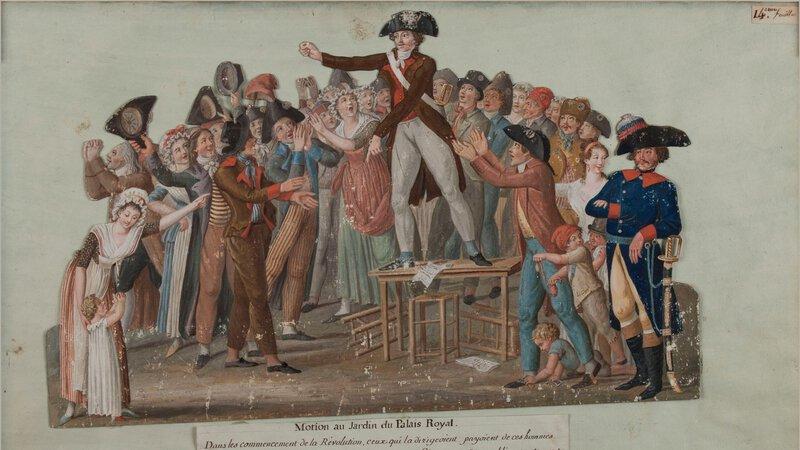

On July 12, 1789, a young journalist named Camille Desmoulins leaped onto a table outside the Café de Foy in Paris, grabbed a green leaf from a nearby tree, pinned it to his hat, and began shouting that the king’s troops were marching on the city. The crowd ignited. Within 48 hours, the Bastille had fallen — and a scrap of improvised greenery had done the work of a battle flag.
What Is a Cockade?

Most people today could not name the object, let alone recognize one, yet the cockade helped ignite revolutions on multiple continents, divided American towns during two separate wars, and still gets pinned to lapels in Budapest every spring. At its simplest, a cockade is a knot of ribbons or a circular badge of distinctive colors, almost always worn on a hat or cap — ornamental in origin, political by destiny.
Its earliest life was purely military and decorative. In the European armies of the 17th century, hat ribbons distinguished one regiment from another the way a modern sports jersey uses colors: function hiding elegantly inside fashion. Soldiers needed to know, at a glance and across a smoke-filled field, who was on their side. A knot of cloth on a hat solved that problem cheaply and instantly. As ornaments go, it was quietly practical: cheap enough for a peasant to make at a kitchen table, visible enough to read from across a market square, and flexible enough to change colors whenever allegiances shifted.
That combination — low cost, high visibility, ease of manufacture and modification — turned the cockade into something no general or king had quite planned for. It democratized political expression before democracy existed. A silk rosette for an aristocrat, a rough wool knot for a foot soldier, a hand-stitched loop of household fabric for a farmer’s wife: all of them communicated allegiance at a glance. In an age when strangers shared no common newspaper, no common broadcast, no social network, that was a remarkable capability.
The American Revolution: Stitching an Alliance Together

By the time American colonists were squaring off against the British Crown in 1775, the cockade had been a military fixture for generations — but it was about to become something more. Washington’s Continental Army was famously ragged in those early years: no unified uniform, mismatched equipment, men from a dozen colonies who barely shared the same political language. On chaotic battlefields and in crowded encampments, cockade colors became one of the few reliable visual signals of rank and allegiance.
The Americans adopted the black cockade as their marker. When the French alliance transformed the war after 1778, officers began wearing a combined black-and-white cockade — black for the Americans, white for their French partners — a literal stitching-together of the coalition that would ultimately win independence. It was a small cloth treaty ratified on every parade ground, a diplomatic arrangement that required no signature and no translation.
The cockade’s reach in revolutionary America extended well beyond military camps. Patriots wore cockades as civilians, marking their politics in a landscape where neighbor was often pitted against neighbor. In a town where nearly everyone wore one, the absence of a cockade was its own statement — a visible gap that loyalists could not easily explain away. These were among the most potent symbols of the era precisely because they required no literacy, no pamphlet, no speech.
Paris, 1789: When a Ribbon Became a Revolution

Desmoulins’ improvised green leaf was quickly superseded. Within days of the Bastille’s fall, a more deliberate symbol emerged: the tricolor cockade, combining blue and red — the colors of Paris — with white for the Bourbon monarchy. It was a forced marriage of crown and city, optimistic and unstable from the start.
The cockade’s power as a loyalty test escalated fast. Within weeks, failing to wear a tricolor cockade on the streets of Paris was enough to attract a dangerous crowd. What had begun as a symbol of enthusiasm had become a survival item. The city read hats the way it might read faces, scanning for the telltale rosette that signaled: I am with you, I am safe, do not stop me.
Beneath the surface, the color wars raged. Royalists wore plain white cockades — the Bourbon color — as quiet acts of defiance. Republican radicals favored red, stripping out the white entirely. The tricolor was always trying to paper over fault lines it could not actually close, and each shift in cockade fashion tracked, with remarkable precision, a shift in who held power and who was about to lose everything. The cockade history of the French Revolution is, in miniature, the revolution’s entire political history.
Napoleon understood the symbol’s power and regularized it. He standardized the tricolor cockade across his armies, exporting it — along with the underlying idea that a small circular badge could carry the full weight of a political identity — across Europe. Where his armies marched, the cockade marched with them, and the nations that rose against him answered with cockades of their own.
Budapest, 1848: A Nation’s Heartbeat in Ribbon

On March 15, 1848, the Hungarian poet Sándor Petőfi stood before a crowd in Budapest and read his “National Song,” a demand for freedom from Habsburg rule that had been building pressure for decades. As his words rang out, red, white, and green cockades spread across the crowd — the colors of Hungary, worn as a declaration that the empire was no longer welcome on its own territory.
The cockade that day was not a fashion choice. As Hungarian historians have described it, it was one of the most significant symbols in Hungarian national life, an object that played a decisive role in the country’s history. The revolution of 1848 was eventually crushed by Habsburg and Russian forces, but the cockade survived — preserved in memory, in family stories, and in the national calendar itself.
Every year on March 15, Hungary’s national holiday commemorating the revolution, schoolchildren and grandparents and politicians still pin tricolor rosettes to their coats. It is one of the longest unbroken cockade traditions in the world, a living link between a crowd in 1848 and the present day. The object itself — a knot of ribbon in three colors — has not changed. What it carries has only grown heavier with time.
The American Civil War: Domestic Acts, Terrible Consequences

The same symbol that had once bound American Patriots together came apart along a different seam in 1861. As Southern states seceded, women across the Confederacy handcrafted cockades in blue and gray, or in state colors, pinning them to the lapels of husbands, brothers, and sons heading off to enlist. Civil War cockades were usually handmade by ladies, though occasionally they were offered by manufacturers and merchants — a detail that reveals how far the cockade had traveled from military regulation to intimate political act.
Union supporters wore their own badge variations, and American towns were once again split by the question of what ribbon you had pinned to your hat. The dark irony is inescapable: a symbol born partly in the American Revolution — the fight to throw off an unjust rule — was now being stitched by women to send men off to war in defense of slavery. The cockade had always carried contradictions it could not resolve. After the Civil War, it faded from American political life, its moment passed, its meanings too tangled to wear comfortably.
The Cockade’s Quiet, Unfinished Legacy

Step back far enough and a pattern emerges that feels almost inevitable. In an age before mass media, before photographs, before any of the tools we now use to broadcast identity, the cockade solved a genuine human problem: how do strangers signal allegiance to one another instantly, cheaply, and unmistakably? Every political movement since has been chasing the same solution with different materials. The campaign button. The flag pin on a politician’s lapel. The colored wristband. The profile-picture filter swapped out overnight during a crisis. All of them are, as the core definition of cockade suggests, variations on the same ancient idea: making the invisible visible, answering the question Desmoulins answered with a leaf on a hat in 1789 — whose side are you on?
What makes the cockade remarkable is not its elegance or its simplicity, though it has both. It is the sheer range of hands that made and wore it — aristocrats and foot soldiers, revolutionaries and the kings they toppled, poets and armies and parlor-bound women who never fired a shot but shaped the wars nonetheless. The same basic object, the same circular knot of cloth, worn on all sides of every argument, carrying every possible meaning.
In Budapest every March 15, the tricolor rosette still goes on. Schoolchildren pin them with the casual ease of ritual. Politicians wear them for the cameras. Grandparents touch them the way you touch something old and serious. It is proof, if any were needed, that some symbols are too useful to die — they simply wait until the next moment of crisis needs them. And somewhere right now, someone is choosing a color, a ribbon, a badge, deciding as Desmoulins did on that café table, that the fastest way to tell the world what you believe might still be to pin something to your hat.

 English
 Arabic
 French
 Spanish
 Portuguese
 Deutsch
 Turkish
 Dutch
Dutch
 Italiano
 Russian
 Portuguese (Brazil)
 Greek
Greek