


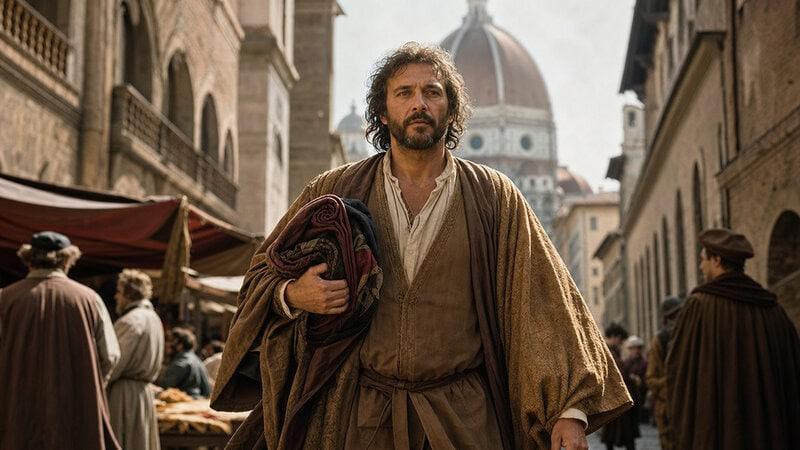

On an ordinary morning in 1401, a Florentine cloth merchant might have risen before dawn, splashed cold water on his face, and set off through the narrow streets toward the market — haggling, praying, arguing over prices, living a life that felt entirely continuous with his father’s life and his grandfather’s before that. He had no idea that historians would one day draw a bright line through his era and call it the opening act of a new world.
The People Inside the Renaissance Had No Idea It Had a Name
The jarring truth at the heart of Renaissance history is this: the people who lived inside it had no idea it had a name. “The Renaissance” is a label invented largely after the fact, pressed like a hot brand onto generations of living, breathing Europeans who simply called it now. There was no announcement, no ceremony, no collective moment when Florence looked up from its counting-houses and declared: the rebirth has begun. The age we now study in textbooks was invisible to the people doing the actual living.
That gap between experience and label raises a question worth sitting with: if the people inside the Renaissance didn’t know it had started, who decided it had — and when do historians actually agree it took place? The answer turns out to be messier, more contested, and far more fascinating than any classroom timeline admits. It is, at its root, a story about how we carve up time — and what those cuts reveal about the people doing the carving.
Who Invented the Word “Renaissance” — and Why That Matters

The concept traces back, in embryonic form, to the Italian artist and writer Giorgio Vasari in the sixteenth century. Writing his celebrated Lives of the Artists (first published in 1550), Vasari described what he saw as a rinascita — a rebirth — of painting, sculpture, and architecture after centuries of what he considered crude, flat, lifeless work. Vasari was already standing inside what he believed was a golden age, and he looked backward at medieval art the way a person might look back at a dark valley from a sunlit ridge. He was not a neutral observer. He was a champion of a particular tradition centered on Florentine artistic achievement, and his narrative was shaped by that loyalty.
The French word Renaissance was popularized much later, most influentially by the nineteenth-century French historian Jules Michelet, who in his 1855 volume of Histoire de France used it to describe an era of discovery, individualism, and liberation. But it was the Swiss historian Jacob Burckhardt whose 1860 work The Civilization of the Renaissance in Italy truly cemented the concept for modern audiences. Burckhardt argued that the Renaissance represented the birth of the modern individual — the moment when human beings first began to see themselves as distinct personalities rather than anonymous members of a collective. His framing was brilliant, sweeping, and enormously influential. It was also, as scholars spent the following century pointing out, heavily romanticized and skewed toward elite male experience in central Italy.
The critical irony is layered: the very concept of the Renaissance was itself partly a Renaissance-era invention, then reinvented by nineteenth-century historians who had their own reasons — Romantic nationalism, faith in progress, the drama of a good story — for wanting a clean break between a dark medieval past and a luminous modern dawn. The label was always more about identity and narrative than about a clean historical boundary. Which is exactly why pinning down precise dates for the Renaissance remains so contested among scholars today.
So When Did the Renaissance Actually Start? The Dates Historians Argue Over

The conventional classroom answer runs something like this: the Renaissance lasted roughly from 1300 to 1600, with the Italian Renaissance beginning somewhere in the fourteenth or early fifteenth century. It sounds tidy. It falls apart almost immediately under scrutiny.
Some historians anchor the start to the poet Petrarch, whose work in the 1330s and 1340s first framed ancient Rome explicitly as a lost golden age and the intervening centuries as a period of darkness and decline. Petrarch was, in a profound sense, both a Renaissance thinker and the inventor of the idea that there had been a dark age to escape from. Without his framing, there may have been no story of rebirth to tell — because no one had yet decided that something needed to be reborn. He was also, notably, a deeply devout Christian operating within medieval intellectual traditions, which complicates any effort to treat him as a clean break from them.
Others place the starting gun in Florence in the early 1400s: Filippo Brunelleschi’s experiments with linear perspective, the fierce competition between Brunelleschi and Lorenzo Ghiberti to design the Baptistery doors in 1401, Donatello’s sculptures that made stone look like thought. These form a cluster of artistic revolutions that, in hindsight, feel like an eruption. But hindsight is doing enormous work in that sentence. Contemporaries often experienced these developments as incremental improvements within existing traditions, not as ruptures with the past.
The honest answer that most modern historians give is uncomfortable: the Renaissance didn’t start on a date. It was a gradual, uneven intensification of ideas — about classical antiquity, about the human form, about the individual’s place in the cosmos — that surfaced at different times in different places, among different groups of people, with no universal switch being flipped. Asking precisely when the Renaissance started and ended may be the wrong kind of question entirely.
The Middle Ages and the Renaissance: Was There Really a Wall Between Them?

Popular imagination has long painted the contrast in stark terms: the Middle Ages as superstitious, static, and artistically crude; the Renaissance as suddenly rational, dynamic, and beautiful. It is a compelling picture. It is also, in large part, a story the Renaissance told about itself — and historians have been carefully dismantling it for decades.
Medieval Europe produced Thomas Aquinas, Dante Alighieri, the soaring engineering of Gothic cathedrals, and rich philosophical traditions that Renaissance thinkers didn’t discard — they built on them, argued with them, and often quietly depended on them. Humanism did not appear from nowhere; it emerged from a world saturated with Christian theology, scholastic philosophy, and a deep reverence for ancient texts that medieval monks and scholars had been preserving and transmitting for centuries. The Florentine humanists who celebrated Cicero were reading manuscripts that Carolingian scribes had copied four hundred years earlier.
Here is the twist that makes the whole picture stranger: the concept of the “Middle Ages” — medium aevum, the middle time — was itself coined by Renaissance humanists to describe the era they wanted to leave behind. Both labels, medieval and Renaissance, are propaganda from essentially the same source. The medieval period was named by people who needed it to be a valley so their own hilltop would look higher. Modern historians increasingly prefer to speak of a long, overlapping transition across the fourteenth, fifteenth, and sixteenth centuries, treating the boundary between eras as a spectrum rather than a cliff edge.
Italy First, Then Everywhere Else — Why the Renaissance Had No Single Starting Line

The Italian city-states — Florence above all, but also Venice, Milan, Ferrara, and Rome — were incubators for a specific set of reasons. Explosive merchant wealth funded patronage on a scale that would have been unimaginable in most of Europe. Intense civic rivalry between cities and powerful families turned art and architecture into competitive sports. The physical ruins of ancient Rome lay literally underfoot, visible reminders of a civilization that seemed worth recovering. And a thriving manuscript culture, turbocharged by Byzantine scholars fleeing the fall of Constantinople in 1453, flooded Italy with Greek texts that Western Europe had largely lost direct access to.
When Renaissance ideas spread northward — into France, England, Germany, and the Low Countries — they arrived later and wore different clothes. In the north, Renaissance thought blended with Gothic artistic traditions and the seismic energy of the Protestant Reformation to produce something genuinely distinct from its Italian parent. An English literature scholar might locate the English Renaissance in the late fifteenth or early sixteenth century, pointing to figures like Thomas More, then later to Marlowe and Shakespeare. An Italian art historian might reasonably respond that by that point, the Italian Renaissance was already mature and beginning its transition toward Mannerism and the Baroque. There is no contradiction in both being right; the disagreement exposes the problem with applying a single label to a continent-wide, multi-century phenomenon.
The printing press — Gutenberg’s movable-type system, developed in the late 1440s and 1450s — is one of the few technological anchors historians broadly agree upon as a powerful accelerant. It allowed ideas to travel faster and farther than any previous medium, collapsing the cost of books and enabling the rapid spread of humanist scholarship, vernacular literature, and eventually Protestant theology. But even the printing press arrived into a conversation already underway, amplifying and spreading Renaissance thought rather than originating it.
When Did the Renaissance End — and Did Anyone Notice That Either?

The conventional endpoint hovers somewhere around 1600, sometimes stretched to 1620 or even 1650 depending on the region and discipline under discussion. The usual markers are the rise of the Baroque in art and architecture, the gathering momentum of the Scientific Revolution, and the profound cultural rupture of the Reformation and its bloody aftermath. These are real shifts, clearly visible in retrospect.
But no one in 1601 woke up and announced that the Renaissance was over. Artists and writers who are now categorized as “late Renaissance” or “early Baroque” did not experience themselves as crossing an era boundary; they experienced themselves as responding to patrons, competitions, theological pressures, and the works of their immediate predecessors. The transition into what scholars now call the Early Modern period was as imperceptible from the inside as the Renaissance’s own beginning had been.
Some historians argue that the Renaissance never truly ended but was absorbed. Its core values — humanism, classical learning, the celebration of individual achievement, the belief that human beings can reshape their world through reason and creativity — flowed directly into the Enlightenment and remain detectable in how Western culture thinks about education, art, and selfhood today. In that reading, asking when the Renaissance ended is like asking when a river ends: the water keeps moving, just under different names and through different terrain.
Why “Early Modern” Is Replacing “Renaissance” in Academic Circles
The term “Early Modern” — covering roughly 1450 to 1800 in most usages — has gained significant ground in university history departments over the past several decades. Its appeal is precisely its neutrality. It makes no claim about rebirth or golden ages. It does not smuggle in Vasari’s aesthetic judgments or Burckhardt’s Romantic ideology. It simply marks a chronological zone defined by structural changes: the rise of the printing press, oceanic exploration and European colonialism, the Reformation, the consolidation of centralized nation-states, and the early stirrings of scientific empiricism.
Critics of the term argue that “Early Modern” is bland to the point of uselessness — that it sacrifices explanatory power for the sake of political neutrality, and that students and general readers still need the emotional and intellectual drama of “the Renaissance” to engage with the period at all. This is not a trivial objection. Narrative matters in how people connect with the past. A label that generates no image generates no curiosity.
The more productive position, increasingly common among historians, is to use both terms deliberately: “Renaissance” when discussing the specific cultural, artistic, and intellectual movements centered on classical revival, and “Early Modern” when discussing the broader structural transformations of the era. Treating them as synonyms obscures as much as it clarifies. Treating them as competitors misses the point that they are doing different analytical work.
What Renaissance Periodization Actually Reveals About How History Gets Made
Historians use periods like “the Renaissance” as tools, not truths. They are necessary fictions — ways of organizing vast, tangled rivers of human change into narratives that the mind can actually hold and work with. Without them, history collapses into an undifferentiated flood of events. With them, we risk mistaking the map for the territory.
The danger arrives when the tool becomes the truth: when students, and sometimes teachers, treat 1300 or 1400 as a hard wall, it erases the continuity of human experience and makes history feel more like mythology than reality. It turns real people — messy, contradictory, embedded in their own overlapping worlds — into extras in someone else’s narrative arc. It also, historically, has erased the contributions of women, of non-Italian Europeans, of enslaved and colonized peoples, and of the Islamic world whose preservation and transmission of ancient texts made much of the Italian humanist project possible in the first place.
The debate over Renaissance periodization is not merely academic pedantry. It is a debate about whose story gets told, where the story begins, and what counts as progress. Every era boundary is a choice, and choices encode assumptions. Recognizing that the Renaissance was partly a nineteenth-century invention does not make the art less beautiful or the ideas less powerful. It makes the history more honest — and more interesting, because it replaces a clean myth with a complicated truth about how human beings construct meaning across time.
The Florentine cloth merchant from the opening of this story didn’t need a label. He rose before dawn, navigated his city, and lived a life of full and unremarkable complexity. The label is for us — the people looking back across the centuries, trying to make sense of the river of time by drawing lines across the water. Those lines are useful. They are also, in the end, imaginary. And knowing that they are imaginary is what separates history from myth.

 Arabic
 French
 Spanish
 Portuguese
 Deutsch
 Turkish
 Dutch
Dutch
 Italiano
 Russian
 Romaian
 Portuguese (Brazil)
 Greek
Greek