


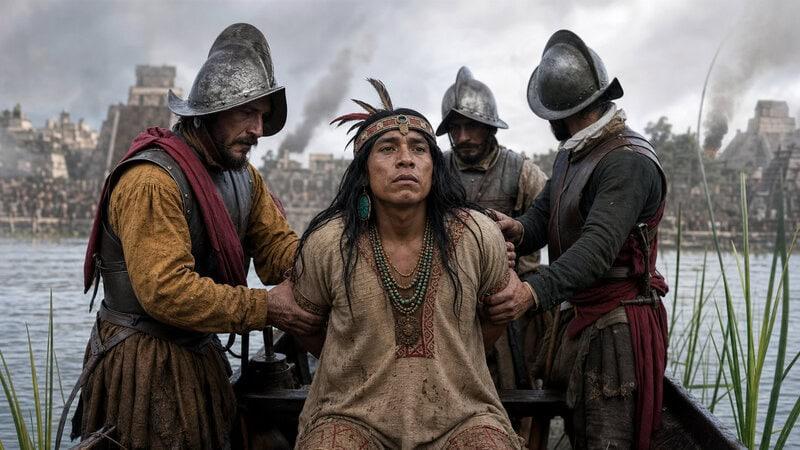

On the morning of August 13, 1521, a canoe slipped across the glittering surface of Lake Texcoco, carrying a young man trying to disappear into the reeds. He didn’t make it. When Spanish soldiers hauled Cuauhtémoc — the last ruler of the Aztec Empire — out of that boat, the smoke from a ruined city already hung over the water, and the greatest empire in the Americas ceased to exist. What brought that empire down, however, was far more complicated than the story most people learned.
The Numbers That Never Made Sense

Hernán Cortés landed on the coast of Mexico in 1519 with roughly 600 soldiers, no reliable supply chain, no reinforcements waiting offshore, and no realistic exit strategy. Two years later, a civilization of millions had collapsed. For centuries, the explanation handed down went something like this: superior European technology, providential timing, and a handful of fearless conquistadors overwhelmed a bewildered indigenous world. It is a clean story. It is also dangerously incomplete.
The real answer to how Spain conquered the Aztecs is not found primarily in Spanish armor or arquebuses. It lives instead in a political catastrophe that predated Cortés by generations — and in the hundreds of thousands of indigenous warriors who looked at this outnumbered foreigner and decided he was exactly the weapon they had been waiting for.
An Empire Built on Resentment

The Aztec Empire was not a unified nation in any modern sense. It was a web of city-states, tribute relationships, and enforced loyalties radiating outward from the island capital of Tenochtitlan — a city so vast and intricate that the Spanish soldiers who first saw it compared it, stunned, to Venice. But the architecture of empire concealed a structure riddled with resentment. Peoples like the Totonacs along the Gulf Coast, the Texcocans in the eastern valley, and above all the Tlaxcalans to the east were not willing participants in Aztec glory. They were its unwilling fuel.
The so-called Flower Wars made this worse. These were formalized, recurring conflicts between the Aztec Triple Alliance and neighboring states, fought not primarily to conquer territory but to harvest living captives for ritual sacrifice. For the Tlaxcalan confederation, which had resisted full Aztec domination for generations, this was not an abstraction. It was a recurring terror. Every cycle of warfare meant more of their people dragged to Tenochtitlan’s temples. The hatred this generated was old, deep, and patient.
This is why the Spanish conquest of the Aztec Empire cannot be understood as a simple European invasion. The roots of the Aztec Empire’s fall stretch back long before any Spanish ship appeared on the horizon. Cortés did not shatter a unified civilization. He lit a fuse that had been laid across decades of grievance, tribute, and blood.
Cortés Meets His Real Army

When Cortés and his men pushed inland from the coast in 1519, they first encountered the Tlaxcalans not as allies but as enemies. The fighting was fierce — Tlaxcalan warriors were seasoned, numerous, and fighting on familiar ground. For a moment, the entire enterprise seemed likely to end in the dust of central Mexico.
Then something extraordinary happened. The Tlaxcalan leadership, calculating with cold political intelligence, reversed course entirely. They had been watching these strangers fight, had seen their horses and their cannon, and had made a decision: the Spanish were a force that could be used. An alliance was struck. It would change everything.
The Tlaxcalans joined for their own reasons, which had nothing to do with European superiority and everything to do with Aztec oppression. They had their own strategy, their own endgame, and their own vision of what a post-Aztec world might look like. What followed was less a European conquest of Mexico than a coalition war in which Spanish soldiers provided particular military technologies and Tlaxcalan warriors provided everything else — numbers, terrain knowledge, intelligence networks, supply lines, and a ferocity born of genuine grievance.
The shift in force composition was staggering. Cortés’s 600 men became the command spine of a coalition that eventually fielded tens of thousands of indigenous fighters. Tlaxcalan leaders sent porters to carry equipment through mountain passes, provided food when Spanish supply lines were nonexistent, and contributed warriors who understood Aztec battlefield psychology in ways no European soldier ever could. The Spanish were not the army. They were, in effect, the officer corps of someone else’s war.
La Noche Triste: The Night the Conquest Almost Died

In late June of 1520, the conquest came within a desperate hour of total collapse. Cortés had entered Tenochtitlan and placed the Aztec ruler Montezuma II into a form of custody — an audacious gamble that briefly held. Then it unraveled. Aztec forces rose against the Spanish occupiers, and on the night of June 30 — remembered ever after as La Noche Triste, the Night of Sorrows — the Spanish and their allies were driven out of the city in a bloody rout. Hundreds of Cortés’s men died in the fighting and in the lake, some dragged down by the weight of gold they refused to abandon. It was a catastrophe by any measure.
The retreating survivors fell back toward Tlaxcala. Here is the moment the standard narrative quietly skips over: the Tlaxcalans, who had just watched their Spanish allies get massacred and had suffered their own casualties, could have abandoned the broken expedition entirely. They could have cut their losses, turned on the survivors, and been entirely justified in doing so. Instead, they sheltered the retreating force. They provided medical care, food, and time to recover. They remained committed to the alliance.
That decision — made by Tlaxcalan leaders, not by Cortés — is the reason the conquest did not end in 1520. The survival of the Spanish expedition was a Tlaxcalan choice. Cortés was a brilliant and ruthless driver of events, but an engine does not move without fuel, and the fuel was indigenous.
The Siege That Erased a City

By May of 1521, Cortés had rebuilt his coalition and added a tactical innovation of genuine ingenuity: a fleet of hand-constructed brigantines, hauled in pieces over the mountains and assembled on the lakeshore, designed to control the causeways and waters surrounding the island city. On May 22, 1521, the Battle of Tenochtitlan began in earnest.
What followed was eighty-three days of siege warfare that destroyed one of the world’s great cities. Spanish soldiers provided firearms, horses, the brigantines, and European siege tactics. The indigenous coalition — Tlaxcalans, Texcocans, Totonacs, and others — provided the overwhelming mass of fighters who took the causeways metre by metre, cut off the city’s freshwater supply from the aqueducts at Chapultepec, and fought block by block through streets that became killing grounds.
Inside Tenochtitlan, the defenders faced compounding horrors. A smallpox epidemic, which had arrived in 1520 with a member of a Spanish relief expedition under Pánfilo de Narváez, had already torn through the population with devastating effect — killing the ruler Cuitláhuac, who had himself succeeded Montezuma, within months of taking power. Starvation deepened as the siege choked off supplies. Cuauhtémoc, who had become ruler after Cuitláhuac’s death, held out with what must have been a ferocious and despairing courage. But the coalition arrayed against him was not 600 Spanish adventurers. It was a vast indigenous army with European artillery at its leading edge.
On August 13, 1521, Cuauhtémoc surrendered. The Aztec Empire, which had dominated central Mexico for roughly a century, ceased to exist. Tenochtitlan — that extraordinary city of canals, temples, and chinampas, the floating garden islands that fed its population — lay in ruins so complete that the Spanish would build their colonial capital directly on top of its remains. That colonial capital is modern-day Mexico City.
Reframing the Fall: What the Traditional Story Gets Wrong

The question of how Spain conquered the Aztecs has, for too long, generated answers built around European exceptionalism. Epidemic disease, steel weapons, and gunpowder — each of these played a role, and it would be dishonest to dismiss them. Smallpox was a catastrophe of almost incomprehensible scale, killing a significant portion of Tenochtitlan’s population before the final siege even began. Steel armor and firearms created real tactical advantages in specific battlefield situations. Horses provided speed and psychological shock. These things mattered.
But they did not conquer the Aztec Empire by themselves. Hundreds of thousands of organized, motivated, and strategically sophisticated indigenous fighters accomplished that. Historian Matthew Restall, in his work on the myths of the Spanish conquest, has argued compellingly that the conquest of Mexico looks less like a European invasion and more like a civil war within Mesoamerica — one in which Spanish forces served as a catalyst and a coalition partner, but not as the primary military force. The Aztec Empire’s fall was, at its core, a story of political fracture exploited by peoples who had been waiting for exactly this kind of opportunity.
It is also worth being precise about what smallpox did and did not do. The epidemic was catastrophic and did weaken Tenochtitlan’s capacity to resist. But the peoples of the surrounding region who joined the coalition against the Aztecs were exposed to the same disease. Smallpox did not selectively spare the Spanish side. What it did do was devastate a city already under siege, compressing a military conclusion that indigenous political calculation had already made likely.
The Tlaxcalans: Victors Who Lost
The most instructive and bitter part of this story belongs to the Tlaxcalans themselves. They entered the alliance as strategic actors pursuing their own liberation from Aztec domination. They fought with skill, sustained enormous losses, and ultimately delivered the military outcome the alliance required. By any reckoning, they were indispensable to the result.
Then they discovered what winning looked like. Not autonomy. Not the political independence they had defended against the Aztecs for generations. Not meaningful reward for their irreplaceable contribution. Instead, absorption into a Spanish colonial system that had uses for subject peoples and very limited interest in honoring the debts it owed to the warriors who had made the whole enterprise possible. The Tlaxcalans did receive certain formal privileges and exemptions under early colonial rule — recognition that the Spanish crown was not entirely indifferent to the alliance — but these protections eroded over time, and the broad outcome was subordination rather than partnership. The liberators became a labor force. It is one of history’s more brutal ironies, and one that deserves to sit at the center of how this story is told.
Who Actually Built the End of an Empire
Return, one last time, to the lake. The smoke rising over the ruins of Tenochtitlan on August 13, 1521. The canoe in the reeds. Cuauhtémoc, the last Aztec ruler, pulled from the water into a history that would spend centuries asking the wrong questions about how he got there.
Cortés was a remarkable figure — calculating, adaptable, willing to take risks that bordered on madness, and ruthless in ways that should not be romanticized. His role in the Spanish conquest of the Aztec Empire was real and consequential. But 600 men do not bring down an empire of millions — not with steel, not with horses, not with any combination of European advantages that historians have assembled across five centuries of explanation.
The fall of the Aztec Empire in 1521 was a story of political fracture, indigenous grievance, and coalition warfare on a scale that the traditional narrative has consistently undersold. It was built from Tlaxcalan fury, from Texcocan calculation, from the accumulated resentment of every city-state that had spent decades feeding Tenochtitlan’s appetite for tribute and sacrificial captives. Cortés understood how to direct that fury. He did not create it.
The real architects of the Aztec Empire’s end were the tens of thousands of indigenous fighters who had their own reasons for wanting it gone — and who made a catastrophic miscalculation about what kind of world would rise from its ruins.

 English
 French
 Spanish
 Portuguese
 Deutsch
 Turkish
 Dutch
Dutch
 Italiano
 Russian
 Romaian
 Portuguese (Brazil)
 Greek
Greek