


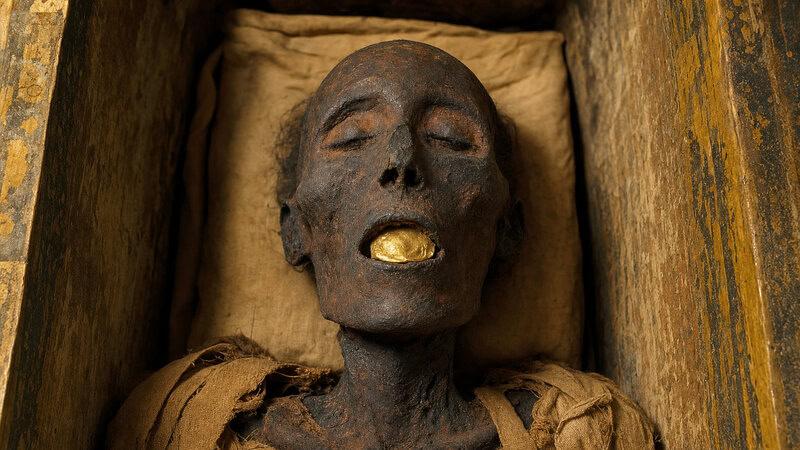

The tomb had been sealed for two thousand years when archaeologists finally eased it open on Egypt’s sunlit Mediterranean coast — and there, inside the darkness, resting in the mouth of a long-dead stranger, was a thin wafer of gold. Not a coin. Not a jewel. Something stranger, more deliberate, more haunting: a golden tongue, shaped and placed with care so that the dead might speak again.
A Hidden City of the Dead at Marina El Alamein

Most people know El Alamein as a name etched into the memory of the Second World War — the scorched desert stretch of Egypt’s northern coast where Allied and Axis forces clashed in one of the conflict’s pivotal turning points. But the coastline holds older secrets than that. Marina El Alamein, a site along Egypt’s Mediterranean shore, has quietly been yielding something extraordinary: an ancient necropolis, largely undisturbed, that offers a window into a world two millennia gone.
Egyptian archaeologists recently uncovered 18 ancient tombs at Marina El Alamein, their sealed entrances intact since antiquity, their contents — offerings, amulets, and human remains — arranged precisely as the people who built them intended. In a field where tomb robbery and the slow damage of centuries routinely strip away context, this degree of preservation is almost unfair in its richness. These were not monuments to kings. They were the graves of ordinary people, prosperous enough to invest in the passage ahead, devout enough to follow traditions stretching back through centuries of Egyptian religious life.
Among the most remarkable objects recovered was a sealed granite sarcophagus — its weight and solidity a kind of promise kept across two thousand years. But it was not the granite that stopped researchers cold. It was the gold found inside the mouths of the dead: delicate sheets of foil, shaped to fit the tongue, placed there with theological precision before the tomb doors swung shut for the last time.
The tombs date to the Greco-Roman period, roughly two thousand years ago, placing them at one of history’s most layered cultural crossroads. By this point, Egypt had absorbed Greek rule under the Ptolemies and then passed into the Roman orbit, and the funerary world reflected that complexity — Roman artistic sensibilities braiding themselves into practices whose roots reached back to the age of the pharaohs. The golden tongue was one of those ancient roots, still very much alive.
The Golden Tongue: A Ticket to Speak Before Osiris

To understand why a civilization would press gold foil onto the tongue of its dead, you have to understand what ancient Egyptians believed happened in the moments — or eternities — after death. The afterlife was not a passive destination. It was a trial, and the stakes were absolute.
At the center of Egyptian cosmology stood the Hall of Two Truths, a vast imagined chamber where the dead were brought before Osiris, god of the underworld and judge of souls. The heart of the deceased was placed on a set of scales and weighed against the feather of Ma’at — the feather of truth, of cosmic order, of moral weight. The jackal-headed Anubis oversaw the weighing with impassive precision. Waiting nearby was Ammit, a creature assembled from the most fearsome animals the Egyptians knew — part lion, part hippopotamus, part crocodile — whose purpose was to devour the hearts of the unworthy. To be devoured by Ammit was not punishment in the conventional sense. It was obliteration: the complete and permanent erasure of a soul.
But before the scales were even brought forward, the dead had to speak. They had to recite what scholars call the negative confession — a long declaration of innocence in which the deceased named specific sins and denied having committed them. “I have not stolen. I have not killed. I have not spoken lies.” Dozens of denials, each aimed at specific offenses, each requiring articulation before specific divine witnesses. The soul had to identify itself, argue its case, and perform a ritual of verbal self-presentation as liturgically precise as anything conducted by a living priest.
In this belief system, speech was not metaphorical. It was literally essential. A dead person who could not speak could not defend themselves. A soul without a voice was a soul without a future. And so the embalmers and priests, understanding exactly what awaited their charges on the other side, did what any practical people might do when faced with an impossible requirement: they engineered a solution.
The gold foil tongue amulet was that solution. Placed inside the mouth before the final wrappings were applied, it was understood to grant the deceased the ability to speak in the afterlife — to give them a voice when their own physical tongue had long since become incapable. It was protective magic of the most purposeful kind: not decoration, not a display of wealth, but a tool designed for a specific, urgent cosmic task. These were amulets in the truest sense of the word — objects of transformative and protective power, engineered for the moment of greatest need.
Osiris, the Scales, and the Engineering of Eternity

There is something deeply human in the image of Egyptian mortuary priests pressing gold to the tongue of the dead, brow furrowed with practical concern over a spiritual problem. The theology was coherent, detailed, and anxiety-producing in the best possible way. It demanded preparation.
The Book of the Dead, which guided generations of Egyptians through this conceptual territory, is in many ways a manual for speaking correctly in the afterlife — a script for the most consequential performance imaginable. Wealthy Egyptians had personalized copies prepared for their burials, their names inserted into the spells and declarations so that Osiris would know exactly who stood before him. Those who could not afford the full papyrus sought other safeguards. The golden tongue was one of the most direct.
What makes the Marina El Alamein finds particularly striking is that this tradition was still alive and operative in the Greco-Roman period, centuries after Alexander the Great had swept through Egypt and fundamentally altered its political landscape. Egyptian religious conviction proved, as it so often did, more durable than empire. People who might have worn Roman-style clothing, spoken Greek in the marketplace, and lived in a world increasingly shaped by Mediterranean cosmopolitanism still believed, when death came, in the Hall of Two Truths, in the weighing of the heart, and in the absolute necessity of giving voice to the departed. These golden tongue amulets were not relics of a fading superstition. They were articles of living faith.
Not an Isolated Find: A Pattern Written Across Egypt

Marina El Alamein is not where this story begins — or where it ends. In 2021, excavations at the Taposiris Magna temple near Alexandria produced a discovery that sent a jolt through the archaeological world: a 2,500-year-old mummy with a golden tongue placed inside its mouth. The BBC reported on the unearthing of mummies with golden tongues in northern Egypt, a discovery that underscored just how widespread and enduring this funerary practice had become. These were not isolated experiments in a single temple complex. They were expressions of a shared theology, practiced across generations and geographies.
Each new find adds resolution to a picture that has been coming slowly into focus: the golden tongue ritual was not exclusively the privilege of pharaohs or high priests. The dead found at Taposiris Magna, and now at Marina El Alamein, appear to have been prosperous but not royal — people of means and faith, drawn from a social stratum that rarely leaves vivid traces in the historical record. Their inclusion in this tradition suggests that the desire to secure a voice before Osiris was broadly shared, crossing the social boundaries that governed so much of ancient life.
What distinguishes the Marina El Alamein site within this growing body of evidence is the condition of the finds. The sealed tombs preserved not just objects but arrangement — the deliberate, intentional order in which burial goods were placed, the spatial logic of a funerary ritual frozen mid-performance. For archaeologists, this is the difference between finding a word and reading a sentence. Context transforms artifact into meaning.
Gold, Offerings, and the World the Living Built for the Dead

Beyond the golden tongues, the Marina El Alamein tombs were furnished with gold artifacts and burial offerings — evidence of families who invested real resources in the moment of departure. This was not casual or perfunctory. It represented a genuine expenditure of wealth and effort, shaped by genuine belief in what would be required on the other side.
The cultural fusion visible in the burial practices of this period is one of archaeology’s most fascinating spectacles. A mummy from the Greco-Roman period might bear portrait features rendered in a distinctly Roman artistic style — realistic, individualized, almost confrontationally present — while the funerary preparations beneath the wrappings followed conventions older than Rome itself. Egyptian religion had always been capacious, able to absorb new elements without surrendering its essential architecture. The judgment of Osiris survived Hellenism. It survived Roman administration. It survived, apparently, into a modernity that is only now learning to read its traces.
For the researchers working at Marina El Alamein, the sealed tombs offer something rare and precious: burial as an intentional text, authored by the living for the benefit of the dead, preserved well enough to be read two thousand years after the last mourner walked away. The gold tongue amulets, the offerings, the granite sarcophagus sitting sealed in the Mediterranean light — all of it is evidence of a civilization that took death as seriously as life, and planned accordingly.
What These 18 Tombs Actually Add to the Record

It is worth pausing on what specifically makes the Marina El Alamein discovery valuable to researchers, beyond the undeniable drama of golden tongues and sealed stone. Archaeologists rarely get to study a necropolis in which multiple tombs have survived intact and unlooted. When they do, the benefit is cumulative: patterns emerge that a single tomb, however spectacular, cannot produce on its own.
Eighteen tombs, all from the same general period, all showing comparable funerary investment, all located within the same coastal community — this is a dataset. It allows researchers to ask questions that go beyond “what was buried here?” and move toward “who were these people, how did they understand death, and how consistently did that understanding shape behavior across a community?” The answers, still being extracted from the site, promise to refine our picture of Greco-Roman Egypt at a granular, human level that historical texts rarely achieve.
The intact arrangement of burial goods is particularly significant. In most excavated tombs, objects have been moved — by robbers, by the slow settling of earth, by the interventions of earlier archaeologists working before modern stratigraphic methods were standard. Here, the spatial relationships between objects retain their original meaning. Where an offering was placed relative to the body, which amulets were positioned at which points, how the deceased was oriented within the tomb — all of this is legible in a way it simply is not when context has been disturbed. The 18 Greco-Roman tombs at Marina El Alamein give researchers a rare opportunity to study funerary ritual as a complete, coherent act rather than as a scattered inventory of survivors.
The Dead Who Finally Speak
There is a thought that lingers after sitting with all of this for a while. Those 18 sealed tombs at Marina El Alamein held people who believed, with profound conviction, that they would speak again — that the gold pressed gently against their tongues would carry their voices into the presence of Osiris, that their words would rise through the silence of death and be heard, and that what followed would be something better than oblivion.
Whether or not the Hall of Two Truths awaited them, something unexpectedly true happened. Two thousand years after their burial, those people have made themselves understood. Their rituals speak. Their choices — the gold, the sealed stone, the carefully arranged offerings — form a kind of declaration that archaeologists are only now fully hearing. These tombs are not simply a remarkable find. They are an answer, carried forward across centuries, to the most human of all questions: what do we do with our dead, and what do we hope for them?
The ancient Egyptians pressed gold to the tongue and hoped for speech. And in a way that no one in the Greco-Roman period could possibly have imagined, it worked.

 English
 Arabic
 French
 Spanish
 Portuguese
 Deutsch
 Turkish
 Dutch
Dutch
 Italiano
 Romaian
 Portuguese (Brazil)
 Greek
Greek