


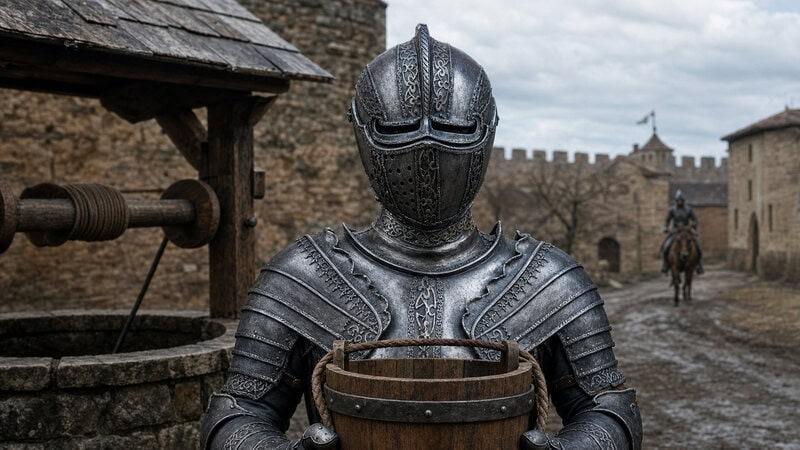

One night in 1325, a group of Modenese soldiers crept into Bolognese territory, located a public well, and walked away carrying a single oak bucket. It was the kind of petty theft that should have ended with a shrug — and instead ended with two thousand men in the ground.
A Bucket, a Well, and the Match That Lit a War

The bucket itself was ordinary. Carved from oak, used to draw water from a communal well in Bologna, it was the sort of object no one would have looked at twice in a marketplace. But the Modenese soldiers who carried it back across the border were not thinking about hydration. They were thinking about humiliation — specifically, how satisfying it would be to display their trophy back home as proof that they had walked into rival territory and walked out again with something that belonged to Bologna.
In the long catalogue of strangest wars in history, the War of the Oaken Bucket holds a near-permanent place near the top. The image of thousands of armored men marching to their deaths over a piece of carved wood carries a quality of dark comedy that is hard to shake. But the absurdity is the entry point, not the whole story. Underneath the bucket was a political pressure system that had been building for decades. The theft did not so much cause a war as release one that was already straining at the seams.
So how, exactly, does a stolen bucket kill two thousand men? The answer begins not with the soldiers who took it, but with the world they lived in.
The World Behind the Wooden Bucket: Emilia-Romagna in 1325

Medieval Emilia-Romagna was a corridor of ambition and grievance stretched across northern Italy — a landscape of flat plains and fortified cities where proximity guaranteed competition. Bologna and Modena sat uncomfortably close to one another. Near enough that each could watch the other’s towers rise, each could feel the economic pull of the other’s market, each could nurse its grudges at close range. They were not merely neighbors. They were rivals in the way that only neighbors can be: intimately, exhaustingly, and with long memories.
Overlaid on this local rivalry was the great ideological fault line of medieval Europe. Bologna aligned broadly with the Guelphs — the faction that backed the political authority of the Pope. Modena leaned Ghibelline, supporting the Holy Roman Emperor. In practice, this meant that every squabble between the two cities resonated outward, touching the continent-spanning contest between papal and imperial power. A dispute about grazing rights or a border market became, in the correct political light, a skirmish in a larger struggle. A stolen bucket became an act of ideological defiance.
Civic wells mattered more than their function alone would suggest. They were communal infrastructure, yes, but they were also communal identity — property held in common by an entire city, maintained by civic funds, used by every household from the wealthiest merchant to the poorest laborer. To steal from a city’s well was to steal from the city itself, from its dignity as a self-governing commune. It was, in the symbolic vocabulary of the 14th century, an act of profound disrespect.
Bologna was also, by any measure, the larger and wealthier of the two cities. It possessed one of the oldest universities in the world, a thriving textile economy, and the political weight that came with both. The natural expectation — Bologna’s expectation — was that Modena would return the bucket quietly, acknowledge the transgression, and spare everyone the trouble of escalation. Modena’s refusal to do exactly that was not an oversight. It was a statement.
The Theft, the Demand, and the Refusal That Made War Inevitable

The details of the raid survive in broad outline rather than fine-grained chronicle, but the shape of it is clear enough. Modenese soldiers entered Bolognese territory, located the well, and departed with the oak bucket as a trophy — an act of deliberate provocation displayed back in Modena as evidence of what their soldiers could do and get away with. The bucket was not hidden. That was precisely the point.
Bologna’s response followed the logic of civic honor: an official demand for the bucket’s return. On the surface it was a reasonable request. Beneath the surface it was a test — a public examination of the balance of power between two cities. If Modena handed the bucket back, Bologna’s dominance was quietly confirmed. If Modena refused, Bologna would have to either accept the humiliation or respond with force. There was no comfortable middle ground.
Modena refused. The refusal was, in the architecture of medieval Italian politics, the real declaration of war. Returning the bucket would have required Modena to concede that the raid was wrong — to retroactively humiliate the soldiers who carried it out, and to signal to every other city-state in the region that Modena could be pushed around by its larger neighbor. The bucket had become a test of whether Modena existed as a genuinely independent political entity or merely as a smaller city in Bologna’s shadow. Given those stakes, the refusal was almost inevitable.
Bologna began mobilizing. The scale of its response — approximately 30,000 foot-soldiers — tells you everything you need to know about how seriously a 14th-century commune took the politics of public face. Thirty thousand men for one oak bucket. The arithmetic is almost theological in its intensity.
30,000 Soldiers March on Modena

The army that Bologna assembled in the autumn of 1325 was enormous by the standards of the era and the region — a combined force of urban militias and mercenaries drawn from the city’s considerable resources, fused together by communal outrage and the practical logic of regional dominance. Marching across the Emilian plain in November, they cut a formidable figure: the full weight of a wealthy, offended city-state brought to bear on a neighbor that had refused to show the minimum expected deference.
Modena’s position was, on paper, dire. Outnumbered and facing one of the more powerful military forces in the region, its soldiers were nonetheless fighting on familiar ground, for a cause that had acquired the symbolic weight of civic survival. This was no longer about a bucket — it had never really been about a bucket — but about whether Modena had the right to exist as a defiant, independent commune without being crushed for the presumption. That kind of fight can produce extraordinary military resolve in even a smaller force.
The two sides converged on a piece of territory between the cities, and the war that had begun with a theft moved toward its single, catastrophic resolution.
The Battle of Zappolino, 15 November 1325

On the morning of 15 November 1325, the forces of Bologna and Modena met near Zappolino, in the contested territory between the two cities. What followed was the kind of medieval infantry engagement that reduces itself, in the memory of survivors, to noise and pressure and sudden violence — the collision of dense formations of men in a compact space, the breakdown of organized maneuver into something closer to a sustained and brutal struggle.
Modena won. Decisively. The far larger Bolognese force was routed in a military upset that added yet another layer of improbability to an already improbable story. Bologna had brought roughly thirty thousand soldiers to this confrontation and lost — not merely ground, not merely a skirmish, but the battle itself. The Battle of Zappolino was a genuine and humiliating defeat for one of northern Italy’s most powerful cities, delivered by the neighbor it had expected to intimidate into submission.
The cost was staggering. Approximately 2,000 soldiers died in the engagement — 2,000 men killed in a single afternoon’s fighting over an oak bucket sitting in a Modenese trophy case. Two thousand lives, extinguished in one day, in one place, in the only pitched battle of a war that began with a piece of wood and a grudge. Zappolino was also the last battle of the war — the entire conflict’s casualty list is the product of a single November afternoon.
It is worth pausing on the tactical reality behind the upset. Modena’s forces were fighting defensively, on ground of their own choosing, with everything to lose. Bologna’s army, though vastly larger, was a coalition force that had marched some distance and may have been poorly coordinated on the day. Medieval battles were frequently decided by morale and terrain as much as by numbers, and Modena’s soldiers appear to have fought with a cohesion that the Bolognese formations could not match. The numbers made the defeat shocking; the circumstances made it explicable.
After the Battle: What Happened to the Bucket?

Bologna never got the bucket back. This is the darkly comic coda to the whole episode, and it deserves to be stated plainly: the city that mobilized 30,000 soldiers, marched them across the Emilian plain, fought a catastrophic and losing battle, and buried 2,000 of its men — that city did not recover the object at the center of the dispute. Modena kept the bucket.
Tradition holds that the bucket was placed in the Ghirlandina tower — the celebrated bell tower of Modena Cathedral, now a UNESCO World Heritage Site — where a bucket said to be the original, or a very close replica, can still be seen by visitors today. It sits there not as a relic of shame but as a trophy: a permanent monument to the day Modena refused to back down and was rewarded for that refusal with a victory.
The war did not end the rivalry between the two cities. It reshuffled the grudges, reordered the humiliations, and gave Modena a symbol it has never entirely let go of. The bucket became shorthand for Modenese defiance — proof that the smaller city had once stared down the larger one and emerged with its prize still in hand.
There is a literary footnote worth adding. In 1622, nearly three centuries after the battle, the Italian poet Alessandro Tassoni published La Secchia Rapita — “The Stolen Bucket” — a mock-heroic poem that satirized the whole episode with gleeful absurdity. That a poet of Tassoni’s era felt compelled to write an entire epic around the war is evidence that even people far closer to the events recognized their essential comedy. The poem helped preserve the story and gave it a cultural afterlife that military histories alone rarely generate. It also cemented the episode’s reputation across Italy as a byword for the folly of outsized pride.
Why the Bucket War Still Matters
It would be easy — and not entirely wrong — to file the War of the Oaken Bucket of 1325 under “bizarre medieval conflicts” and move on, satisfied with the anecdote. But that framing undersells what the story actually demonstrates. The conflict was not irrational — it was a perfectly coherent product of its political system, and that is the detail that should give a modern reader pause.
Medieval Italian city-states ran on honor the way modern economies run on credit — it was the invisible infrastructure that made everything else function. A city that could be humiliated without consequence was a city that could be humiliated again, and again, until it ceased to function as an independent political entity. Bologna mobilized 30,000 men not because its leaders were foolish or unhinged, but because the logic of their political system left them very little choice. The bucket was a symbol, and symbols, in that world, carried consequences as real as territory or treasure.
The Guelph-Ghibelline dimension sharpened this further. When your local rivalry is also a front in a continent-wide ideological struggle, every act of defiance acquires an audience far beyond the two cities involved. Modena keeping the bucket was not merely an insult to Bologna — it was a visible signal to papal and imperial allies alike about which city could hold its ground. The stakes of backing down extended well beyond the Emilian plain.
The uncomfortable mirror the story holds up is not medieval at all. Human beings have always been capable of scaling catastrophic responses to symbolic provocations — of allowing questions of face, pride, and perceived status to drive decisions that a cooler accounting would never sanction. Recognizing that pattern in a 14th-century Italian city-state is one thing. Recognizing it as a pattern, persistent across centuries and political systems, is another matter entirely.
And the bucket itself remains the most durable character in the story — still sitting, or its likeness sitting, in a tower in Modena, still not returned after nearly seven centuries, still the most famous thing ever to emerge from a Bolognese well. The strangest war you have probably never heard of ended with no treaty, no reparations, no restitution — just an oak bucket in a tower, and the long, unresolved argument it represents, patient as wood, outlasting everyone who ever fought over it.

 English
 Arabic
 Spanish
 Portuguese
 Deutsch
 Turkish
 Dutch
Dutch
 Italiano
 Russian
 Romaian
 Portuguese (Brazil)
 Greek
Greek