


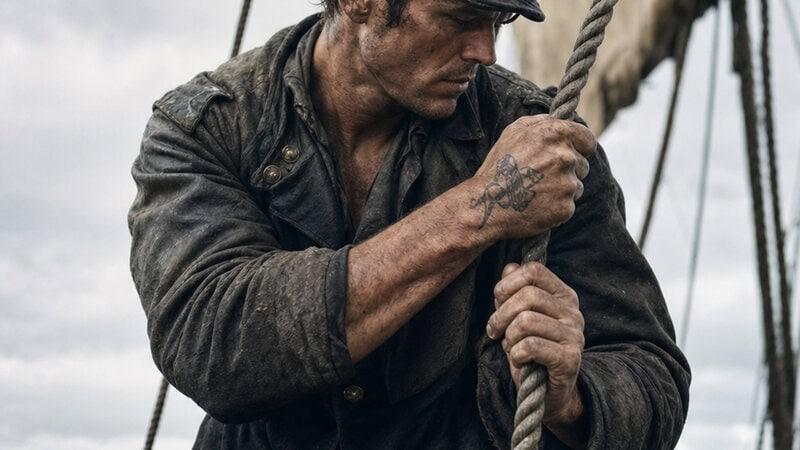

The wave hit before anyone shouted a warning. One moment the deck was tilting at a manageable angle, the next the North Atlantic had decided to remind every man aboard that the ship was a borrowed thing, and the sea intended to take it back. High in the rigging, fingers locked around a rope slick with salt spray and rain, a sailor pressed his knuckles together and read — as he had read a hundred times before, in calmer waters and worse — the two words he had paid a Portsmouth needleman to scratch into his skin: HOLD FAST.
What “Hold Fast” Actually Meant on a Sailing Warship

It was not a motto chosen for elegance. On an eighteenth-century sailing warship, “hold fast” was a command shouted by officers when a squall came up without mercy or when a combat maneuver demanded that every man in the rigging freeze in place and grip whatever rope his hands had found. It meant exactly what it said: stop moving, tighten your grip, do not let go under any circumstances.
The physics of tall-ship sailing made this command a matter of life and death in the most literal sense. Masts on a ship-of-the-line or a Continental Navy frigate could rise well over a hundred feet above the waterline. The ropes — the shrouds, ratlines, and footropes that sailors climbed and balanced on — were perpetually damp, often iced in northern waters, and always moving with the roll of the hull below. A misplaced hand, a moment of inattention during a gust, a sudden lurch when a wave caught the bow at the wrong angle: any of these could send a topman cartwheeling into the sea. Falling overboard in the eighteenth century was rarely a rescue situation. It was more often a burial-at-sea situation, and everyone on deck knew it.
Over time, the phrase grew beyond its immediate nautical function. It appeared in naval orders, in the personal correspondence of officers, and in the unwritten code that governed how a good crew was supposed to behave under pressure. Hold your position. Hold your nerve. Hold the line of men beside you together when everything is trying to shake you loose. “Hold fast” became a philosophy before it became a tattoo — but it was the tattoo that made it immortal.
Ink as Armor: The Superstition Behind the Knuckle Tattoo

The tradition worked like this: a sailor had the letters H-O-L-D tattooed across the four fingers of one hand and F-A-S-T across the four fingers of the other. When he gripped a rope — when both fists closed around a line in the dark at the top of a mast — the full message appeared, readable from below or legible to the man himself when he glanced down during a storm. The tattoo was a reminder and, to the minds of many eighteenth-century sailors, something considerably more powerful than a reminder.
The Age of Sail was an era in which religion, superstition, and practical seamanship existed in easy, unselfconscious company. Sailors who attended Sunday services and could quote scripture also knocked on wood, avoided whistling at sea lest they whistle up a wind, and believed with quiet sincerity that certain marks inked into their skin could protect them from specific dangers. A nautical star on the wrist helped a sailor find his way home. A pig and a rooster tattooed on the feet were said to prevent drowning. “Hold fast” on the knuckles was understood to grant grip strength — to bind the hands to the rope by something stronger than muscle, a kind of supernatural adhesion between the sailor and the thing he needed most to keep hold of.
This was not fringe belief. It was the working theology of the forecastle, shared across nationalities and decades. The broader culture of sailor tattoos in the Age of Sail amounted to a living symbolic vocabulary: anchors for stability, crossed cannons for a fighting man, the full-rigged ship for a sailor who had rounded Cape Horn. “Hold fast” belonged to this vocabulary as one of its oldest and most serious entries — a protective inscription worn where its power could be most directly applied, on the hands, at the point of contact between the man and the rope.
There was also a purely practical dimension that should not be underestimated. A topman aloft in a screaming gale, vision blurred by spray, mind narrowed to the next handhold — glancing at his own knuckles and seeing those eight letters was a mnemonic of the most urgent kind. It said: this is the one thing. Everything else can wait. Do not let go.
The Continental Navy and the Making of an American Naval Identity

When the Continental Congress authorized the creation of an American naval force in the autumn of 1775, the men who answered the call were not building on a long institutional tradition. They were improvising one. The Continental Navy and the privateers who sailed under letters of marque were assembled from whatever human material was available: experienced merchant mariners from the wharves of Boston, Salem, and Philadelphia; fishermen from the Cape Ann coast who had spent their lives reading Atlantic weather; free Black sailors who brought genuine seafaring skill and faced compounded dangers if captured; and landsmen with almost no sea experience at all, pressed into urgent service because the cause needed bodies on a heaving deck.
Many of the experienced hands in these crews arrived already tattooed. Tattoo practice among English-speaking sailors had been established for decades before the Revolution, carried back from Pacific voyages and refined in the port cities of Britain and the American colonies alike. The “hold fast” knuckle tattoo, along with the anchor and the star, was part of the inheritance these men brought aboard Continental ships — a tradition rooted in Royal Navy and British merchant culture that American sailors absorbed and, in absorbing it, began to transform.
Because in the context of a war fought for independence, “hold fast” acquired a layer of meaning that no British sailor had ever needed to supply. For a man sailing under the Continental flag, gripping the rigging of a ship that was outgunned, outmanned, and operating far from any friendly port, the phrase carried a political charge alongside its nautical one. Hold fast to the line. Hold fast to the cause. Refuse to release the thing you came out here to defend, even when — especially when — releasing it would be the easier choice.
Tattoos served another, grimmer purpose during the Revolutionary war at sea: identification. When sailors were killed in action or drowned after a ship went down, bodies recovered from the water could sometimes be identified by their tattoos in an era before any formal military identification system existed. The marks that began as protection and pride also functioned, in the worst circumstances, as a name tag — the last piece of information a man left behind.
The Revolution at Sea: Why Every Grip Mattered

Naval combat in the 1770s and 1780s was not a clean or abstract affair. A broadside from a British warship delivered grapeshot, chain shot, and solid iron cannonballs into a space where men were working at close quarters with rope and canvas and wood. Rigging burned. Spars fell. Decks became treacherous with blood and seawater mixed together. And through all of it, the ship still needed to be sailed — sails still needed to be set or struck, lines still needed to be handled, and men still needed to climb aloft to do things that could not be done from the deck, even while the guns were firing and the air smelled of smoke and sulfur.
In this environment, holding fast was not metaphor. It was the immediate, physical requirement of staying alive and keeping the vessel functional. A sailor who lost his grip during a sudden maneuver was lost. The men who kept climbing, who kept working the lines under fire, who held their positions when every instinct said to find somewhere lower and safer — those were the men who determined whether a ship fought on or surrendered.
The Continental Navy fought at a consistent material disadvantage against British sea power. What it had instead was the cohesion and defiance of men who had chosen this fight and who reinforced their commitment through shared language, shared symbols, and the specific culture of the forecastle. A crew that recognized the same tattoos, repeated the same phrases, and understood the same code of conduct fought with a unity that numbers alone could not produce. The stubborn refusal to release — embodied in figures like John Paul Jones, who reportedly declined to consider surrender even as his ship Bonhomme Richard was sinking beneath him during his 1779 engagement with HMS Serapis — was not only a quality of commanders. It was literally written on the hands of ordinary sailors who had made the same decision, privately and permanently, before they ever came under fire.
How “Hold Fast” Outlasted the Revolution and Entered American Culture

The Revolution ended, but the phrase did not retire with it. Through the post-Revolutionary decades, through the explosive growth of American merchant fleets, through the great age of the clipper ship and deep into the whaling era that Herman Melville would later chronicle, “hold fast” remained one of the most recognized tattoos in the Atlantic world. Sailors who had never heard a shot fired in anger wore it for the same reasons their predecessors had: the fear of falling, the faith in symbolic protection, the desire to carry a reminder of the one rule that mattered most when the weather turned bad.
The phrase found its way into sea shanties, into maritime literature, and into the decorative language of ships’ bells and carved figureheads. Landsmen who had never set foot on a working deck came to understand “hold fast” as shorthand for nautical toughness — the particular kind of endurance that the sea demanded. It became a piece of cultural vocabulary, nautical in origin but universally legible.
The knuckle tattoo itself quietly became one of the foundational templates for an entire category of body art. The logic of distributing a message across eight fingers — visible when the hands come together, hidden when they separate — was so elegant and so adaptable that it spread far beyond maritime communities. The direct line from an eighteenth-century topman’s hands to the knuckle tattoos of the twenty-first century is not a coincidence or a loose metaphor. It is a genuine piece of cultural inheritance, passed forward through tattoo culture across more than two centuries.
Today, “hold fast” circulates in military communities, in athletic culture, in the general motivational landscape of the internet, and on a considerable quantity of nautical-themed home décor. Its precise origin on the rigging of Revolutionary-era warships is largely forgotten. Its meaning is perfectly intact. That durability is worth examining: few phrases born in such a specific, technical context have traveled so far without losing their force.
For those drawn to the period through gaming, the name of the multiplayer title Holdfast: Nations at War is not accidental — it reaches directly into this maritime tradition. The game’s American Revolution expansion carries that heritage into the era where the phrase carried its heaviest political weight. Players can find it on Steam and, for console players, on Xbox as Holdfast: American Revolution — Washington’s Colonials. The community response to the expansion reflects genuine curiosity about the period’s naval dimension, and press coverage of the release frames the conflict in exactly the terms the sailors themselves would have recognized: a contest between those determined to hold fast and those determined to make them let go.
Two Words, One Grip — Why It Still Resonates

Return, for a moment, to the sailor in the rigging. The tattoo on his knuckles was not decoration in any meaningful sense. It was a decision made in port, in calmer weather, with deliberate forethought — a permanent commitment to a course of action inscribed on his body before the crisis arrived that would test it. That is a different thing from a motto stitched on a flag or painted on a wall. It is a promise made to yourself in a form you cannot take back, visible every time you look at your own hands.
That quality — the irrevocability of it, the way it converted an aspiration into a physical fact — is probably why this particular phrase jumped so successfully from rope to skin to culture. It is specific enough to be vivid: you can see the hands gripping the wet rope, you can feel the strain in the forearms. And it is universal enough to mean something to anyone who has ever had to keep going when stopping seemed not just tempting but entirely reasonable. Everyone, eventually, has a rope they need to keep hold of.
The American Revolution was itself an act of holding fast — against a naval power that dwarfed anything the colonies could put to sea, against the very real possibility of defeat and capture, against the internal doubts that must have visited every man who had committed himself to a cause that most professional military observers in 1775 would have assessed as a long shot. The sailors who fought that war did not have the advantage of knowing how it ended. They had only the decision they had already made — and, on their knuckles, the two-word record of it.
The next time you encounter “hold fast” on a ship’s bell, a piece of nautical art, or an old tattoo, you are looking at a message that was once a matter of urgent physical survival — shouted across a deck in a gale, inked into skin by lamplight in a dockside parlor, carried two hundred feet above a wartime sea on the hands of men who had decided, before they ever climbed, that they were not going to let go.

 English
 Arabic
 French
 Spanish
 Portuguese
 Deutsch
 Turkish
 Dutch
Dutch
 Italiano
 Russian
 Romaian
 Greek
Greek