


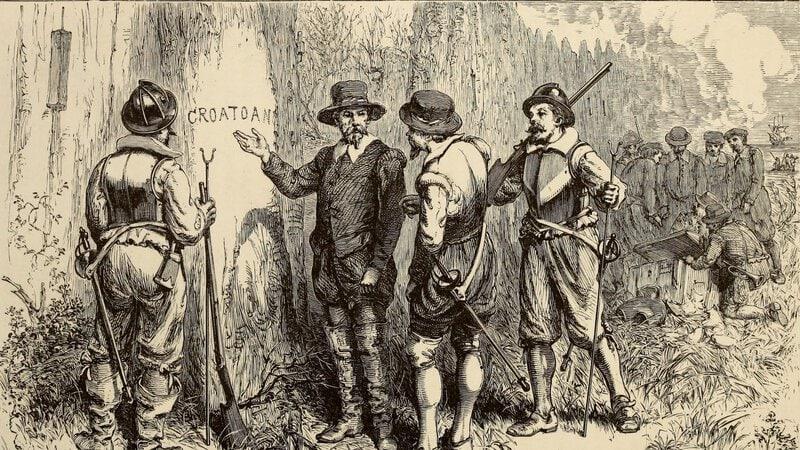

On a warm August evening in 1590, Governor John White stepped onto the shore of Roanoke Island and called out into silence. The palisade fence still stood. The cabins still held their shape. But every one of the 117 men, women, and children he had left behind three years earlier was gone — and the only thing anyone had left him was a single word carved into a wooden post.
A Ghost Town on the Carolina Shore

There are disappearances, and then there is this. What White found that August was not the wreckage of a disaster. There were no bodies, no burned timbers, no weapons dropped in panic. The settlement looked less like a massacre and more like a house whose occupants had simply walked out the door and kept walking. Grass had grown thick over the pathways. Vines had begun reclaiming the cabins. But the order of the place — the standing palisade, the deliberate quiet — made the emptiness feel stranger, not less frightening, than any scene of violence might have.
Before White had sailed back to England in 1587, he had made an agreement with the colonists: if they moved from the island by necessity, they would carve their destination into a tree or post. If they left under duress or in danger, they would add a Maltese cross above the name. When White’s party reached the fort, they found the letters CROATOAN cut cleanly into a palisade post and CRO roughed into a nearby tree. No cross. No sign of violence. Just that word, and the wind off Pamlico Sound, and nothing else. The Roanoke Colony had officially entered the realm of mystery — and it has never, in more than four centuries, been officially solved.
Why England Gambled on Roanoke in the First Place

To understand what made the disappearance so consequential, it helps to understand how much England needed this to work. By the late 1580s, Spain had already planted deep roots in the Americas, and Queen Elizabeth’s court was watching with a mixture of envy and dread. Roanoke Island, tucked inside North Carolina’s Outer Banks, was chosen as England’s beachhead — a place to prove that the English could not only cross the Atlantic but stay there.
The effort had already failed once. A military colony established in 1585 under Ralph Lane had collapsed within a year, undermined by deteriorating relations with the local Roanoke people and acute supply shortages. The men came home with little to show for the crossing. The 1587 mission was bolder and more desperate in equal measure. Rather than sending soldiers, Sir Walter Raleigh backed an expedition of over 100 settlers — entire families, not just fighters — to demonstrate that England intended to build something permanent, not merely plant a flag and retreat.
When 117 men, women, and children waded ashore on Roanoke Island in July 1587, they established the first attempted civilian English settlement in the Americas. That founding fact is what made their subsequent disappearance so confounding to the England they left behind, and so enduring as a puzzle for everyone who has come after.
John White’s Impossible Departure

The colony’s troubles began almost immediately. Within weeks of landing, relations with neighboring tribes had deteriorated sharply, a colonist named George Howe had been killed, and supplies were running dangerously thin. The settlers reached a grim consensus: their governor, John White, needed to sail back to England personally and press for emergency reinforcements. No one else had his connections at court. No one else could make the case with the authority the moment required.
What made the decision almost unbearable was timing. White’s daughter Eleanor had just given birth to Virginia Dare on August 18, 1587 — the first English child born in the Americas. When White climbed into the ship’s boat and pulled away from Roanoke Island, he was leaving behind not just settlers but his own newborn granddaughter. He likely told himself it would be a matter of months.
It was three years. White reached England in late 1587 only to find the entire English fleet commandeered to face the Spanish Armada. Queen Elizabeth’s Privy Council placed an embargo on outbound shipping, and no private captain could justify a resupply run to a remote island while the country itself was under threat. By the time White secured passage on a return voyage in 1590, it was aboard a privateer expedition that treated the colony as a secondary concern, stopping to raid Spanish ships along the way. Every detour was a week the colonists waited — and then stopped waiting.
The Single Word That Changed Everything

White’s party reached the fort on August 18, 1590 — exactly three years after Virginia Dare’s birth, a coincidence that must have struck the governor with particular force. The settlement was stripped but not ransacked. Possessions were gone, suggesting deliberate packing rather than panicked flight. The carved word CROATOAN pointed toward a plausible destination: Croatoan was both the name of a barrier island roughly 50 miles to the south — in what is now Hatteras Island — and the name of a friendly Native people whose leader, Manteo, had twice traveled to England and served as a trusted intermediary between the colonists and the world around them.
White believed the word was good news. No Maltese cross meant no distress. The colonists, he reasoned, had done exactly what they agreed to do: they had packed what they could carry, carved their forwarding address, and moved south to shelter with people they trusted. The relief expedition needed only to sail 50 miles and the mystery would dissolve.
A storm prevented it. The captain, facing rough seas and dwindling provisions, turned the ship south toward the Caribbean and then east toward England. White never returned to the New World. The word CROATOAN was left hanging in the air, pointing toward an island no one in authority would visit in time to learn anything definitive. It remains, to this day, one of the most enduring mysteries in American history.
Four Centuries of Theories — and Why None Fully Sticks

The leading hypothesis, and the one that has gained the most traction with modern researchers, is assimilation. Archaeological work at Hatteras Island has recovered European-style artifacts in clearly Native contexts — items that suggest sustained contact or integration rather than a brief visit or a simple trading exchange. Genealogical research has identified colonist surnames in later Lumbee and Hatteras tribal records, and ongoing DNA studies have found genetic markers tentatively linking some tribal members to English colonial ancestry. The picture this evidence builds is of colonists who were not killed or lost but absorbed — who joined Indigenous communities, raised children, and slowly became someone else’s ancestors.
A second theory points toward violence, though not necessarily at Roanoke Island itself. Spanish records confirm that Madrid was aware of the English colony and regarded it as a provocation. Some historians argue that an attack by the Powhatan Confederacy may account for deaths among colonists who had moved northward. The paramount chief Wahunsenacah reportedly told early Jamestown settlers that he had destroyed a settlement to the south — a claim that has fueled speculation for generations, though its exact meaning and geographic reference remain contested among scholars.
Environmental pressure offers a third angle. Dendrochronological data — tree-ring analysis used to reconstruct historical growing conditions — reveals that the years 1587 through 1589 brought one of the most severe droughts the region had experienced in eight centuries. Starvation and thirst may have fractured the colony into smaller groups, each moving toward different sources of food and water, each integrating with different communities, and none leaving a unified record that history could later find. Some researchers now argue that the very idea of a single dramatic disappearance is itself a misconception — that the colony’s end was slower, more incremental, and more human than legend allows.
None of these theories, taken alone, explains everything. The clean, unforced appearance of the site resists the violence narrative. The assimilation theory, compelling as it is, remains genetically and archaeologically suggestive rather than conclusive. The drought hypothesis explains why people might have dispersed but not precisely where they went or what ultimately became of them. The lost colony mystery endures precisely because the evidence, taken together, does not yet add up to a verdict.
What Modern Science Has — and Hasn’t — Settled

In recent years, researchers have brought serious technology to bear on the question. Ground-penetrating radar and LiDAR surveys have focused attention on a site researchers call “Site X” on the Albemarle Sound, where a patch on one of John White’s own 1587 maps appears to conceal a symbol suggesting a planned secondary settlement. Artifacts recovered there include English pottery consistent with the late sixteenth century — tantalizing, though not yet definitive proof of a Roanoke connection.
Collaborative DNA and genealogical projects with the Lumbee Tribe have continued to find suggestive connections between modern tribal members and English colonial surnames and genetic markers. The methodological debates around this research are real and ongoing, but the cumulative direction of the evidence keeps pointing toward integration rather than annihilation.
What has been effectively ruled out is a mass killing at Roanoke Island itself. No mass grave has been found. No burned structures consistent with an organized assault have been identified. The hypothesis that 117 people were slaughtered on the spot and left without a trace has been abandoned by serious researchers. The colonists left. The question is only where they went — and whether the world they walked into was welcoming enough to let some of them survive.
Despite every excavation, every DNA swab, and every archival search conducted over four centuries, no document, grave marker, or artifact has surfaced that unambiguously identifies itself as belonging to the Roanoke colonists. The disappearance remains, technically and genuinely, unsolved.
Why the Carved Word Still Matters
It is worth sitting with what CROATOAN actually represents, beyond its role as a clue. The colonists who carved it were not passive — they were people making a decision under pressure, communicating that decision as clearly as they could, and moving deliberately toward what they hoped would be safety. The word is an act of agency. It reframes the entire story from a tale of helpless victims swallowed by the wilderness into something more complicated and, in a way, more hopeful: a group of people who faced an impossible situation and chose, together, to adapt.
The colony’s fate also shaped what came next in concrete ways. Jamestown, founded in 1607, was planned with explicit attention to the lessons of Roanoke — firmer naval resupply commitments, clearer military provisions, and harder thinking about relations with Indigenous peoples. The lost colonists, in their disappearance, contributed to the survival of the English project that would eventually become the United States. They were written out of the founding story, but they helped write it.
Behind every theory, behind every fragment of evidence, are specific people. Eleanor White Dare, a young woman who had just become a mother in a strange land while her own father sailed away. Virginia Dare, an infant for whom Roanoke Island was the only world she had ever known. Manteo, a Native man who had traveled to England and back, who stood between two civilizations and tried to hold the space between them open. CROATOAN is the last thing any of them chose to say to history — a single word carved into wood, meant to be read by one man, read instead by everyone, and still not fully understood.
The Outer Banks wind still moves through Hatteras Island exactly as it did in 1590. The answer to what happened to the Roanoke colonists may be literally underfoot — waiting in the soil for a trowel, a radar pulse, or a strand of DNA to finally, after more than four hundred years, speak plainly.

 English
 Arabic
 French
 Spanish
 Portuguese
 Deutsch
 Turkish
 Dutch
Dutch
 Italiano
 Russian
 Romaian
 Greek
Greek