


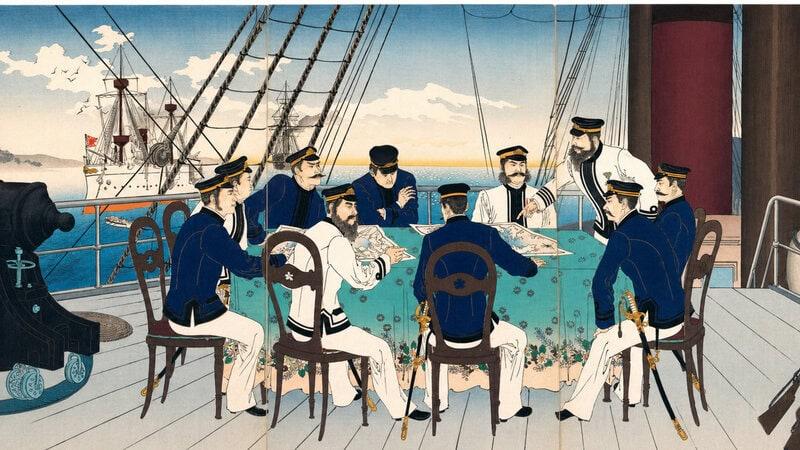

On the morning of January 3, 1868, a teenage boy sat in an imperial hall in Kyoto while samurai lords read aloud a proclamation that would shake the foundations of the modern world. The Tokugawa shogunate, which had ruled Japan with feudal authority for two and a half centuries, had just been abolished. The emperor was back. And Japan, whether it was ready or not, was about to be reborn.
The Boy Who Rewrote a Nation

His name was Mutsuhito, and he would come to be known to history as Emperor Meiji — the reign name meaning “enlightened rule,” chosen as though the oligarchs around him already understood what was coming. He had grown up in the cloistered ceremonial world of the Kyoto imperial court, a world of poetry, ritual, and political powerlessness, where emperors had reigned for centuries without governing. Yet the moment the restoration declaration was read aloud, he was nominally the most powerful man in Japan — and the architects of a revolution were using his name to legitimise the most ambitious national reinvention in modern history.
The central tension of the Meiji era becomes staggering when you hold it in a single image: in 1868, Japan was a country of rice paddies, wooden castle towns, and sword-carrying lords who had barely glimpsed the industrial world. By 1905, its navy had sailed into the Strait of Tsushima and annihilated the Russian Imperial Fleet — a European great power humiliated by a nation the West had barely noticed three decades earlier. One human generation. That is all it took. To understand how, you have to start with what Japan was running from.
The World Japan Was Escaping: Feudal Isolation and the Tokugawa Freeze

For more than two centuries before 1868, Japan had been locked inside itself. The Tokugawa shogunate — a military government based in the city of Edo, present-day Tokyo — had imposed sakoku, a closed-country policy that reduced Japan’s contact with the outside world to a thread: a small Dutch trading outpost on the artificial island of Dejima in Nagasaki harbour. Foreign books were filtered. Foreign ships were turned away. The world churned through an Industrial Revolution, fought Napoleonic wars, and carved up continents, while Japan watched almost none of it.
Inside the freeze, society was rigid by design. The Tokugawa system organised people into status groups, with samurai occupying a privileged position at the top of the social hierarchy, followed broadly by farmers, artisans, and merchants — though the reality was considerably more complex, with significant variation in wealth and influence within and across these categories. The shogun in Edo held real political and military power while the emperor in Kyoto existed in ceremonial silence, a sacred figurehead with no army, no treasury, and no meaningful governing authority. It was a system built for stability, and for two and a half centuries it delivered exactly that — at the cost of stagnation.
The shock that cracked the freeze arrived in July 1853, trailing black smoke. Commodore Matthew Perry of the United States Navy sailed four steam-powered warships — black-hulled and heavily armed — into Edo Bay and demanded that Japan open its ports to American trade. The Japanese had no equivalent vessels, no answer to steam power, no diplomatic framework for this kind of confrontation. The shogunate, under enormous pressure, eventually signed treaties it did not want. And in the domains of Choshu and Satsuma, younger samurai watched their rulers capitulate and felt something new: fury, and then ambition.
These men rallied initially around the slogan sonnō jōi — “revere the emperor, expel the barbarians.” It was a conservative battle cry. But exposure to Western firepower had a clarifying effect. You cannot expel foreign powers with swords when they arrive in steam-powered warships. The slogan quietly shifted in meaning. If Japan could not beat the West by exclusion, Japan would have to engage with Western knowledge and technology — selectively, strategically, on its own terms. First, though, the shogun had to go.
The Coup That Changed Everything: January 3, 1868

The declaration read in Kyoto that January morning was, in its narrowest sense, an elite reshuffling — a transfer of power within the ruling class, not a mass uprising of peasants or merchants. As Britannica’s account of the Meiji Restoration notes, it was a political and social revolution running from roughly 1866 to 1869 that ended the power of the Tokugawa shogun and returned authority to the imperial institution. There was relatively little violence on that specific day. The wider conflict came afterward.
Pro-shogunate forces did not simply accept the new order. The Boshin War of 1868 to 1869 was a civil conflict fought across the archipelago, from the streets of Edo to the snowy northern island of Hokkaido, where the last loyalists made their final stand. The new imperial forces, better armed and organised, won decisively. By 1869, the Meiji government’s authority was cemented from one end of Japan to the other.
The men who actually ran that government were not the teenage emperor. They were a cohort of young, ferociously capable samurai — Ito Hirobumi from Choshu, Okubo Toshimichi from Satsuma, Yamagata Aritomo, and others — who had concluded that sentiment was a luxury they could not afford. They had studied the fate of China, whose Qing dynasty was being carved apart by Western powers. They had watched how India had disappeared into the British Empire. They understood, with cold clarity, that the only way to preserve Japanese sovereignty was to industrialise, militarise, and modernise — faster than anyone thought possible.
The Transformation Engine: What the Meiji Government Actually Did
The scale and speed of what followed is difficult to fully absorb even now. The reforms were not gradual experiments; they were deliberate and successive overhauls, each one reshaping the social landscape before the effects of the last had settled.
In 1871, the government abolished the old feudal domain system. Roughly 270 semi-independent fiefdoms — each with its own lord, military forces, and tax arrangements — were dissolved and replaced by prefectures under direct central government control. Japan became, in administrative terms, a unified nation-state largely by decree.
That same year, the government dispatched the Iwakura Mission: a delegation of nearly fifty senior officials and students who spent almost two full years travelling through the United States and Europe. They took meticulous notes on everything — American railways, German military organisation, British factories, French legal codes, Scandinavian school systems. They were not tourists. They were architects of a nation, studying the best available models. Asia for Educators at Columbia University describes the mission as foundational to understanding how deliberately Japan constructed its modern institutional identity from carefully selected foreign models.
The reforms that followed came in rapid succession:
- Compulsory public education was introduced in 1872, establishing a national school system largely from scratch.
- A conscript national army replaced the old samurai military class in 1873 — every man, regardless of birth, could now be called to serve as a soldier.
- A central bank, a telegraph network, a railway system, and a Western-influenced civil legal code were all established within the first two decades of Meiji rule.
- The Meiji Constitution of 1889, modelled in significant part on the Prussian constitutional framework, created a bicameral parliament called the Diet — while carefully preserving ultimate sovereignty with the emperor.
The constitutional settlement was a masterwork of political engineering: modern enough to be taken seriously by Western powers, and traditional enough to preserve the imperial mythology that gave the new government its legitimacy. It was, in every sense, a calculated construction rather than an organic development.
Society Turned Upside Down: Samurai, Peasants, and the New Japan

Revolutions have human costs, and the Meiji transformation extracted them with particular severity from those who had the most to lose. The samurai class — the sword-carrying aristocracy that had defined Japanese culture, aesthetics, and social hierarchy for centuries — was legislated out of its old privileges. Hereditary stipends were phased out and eventually commuted into government bonds. In 1876, the Sword Abolition Edict stripped samurai of the one public marker that had always set them apart: the right to carry a blade in public. A class identity built over generations was dismantled in a few years of bureaucratic edicts.
Not everyone accepted this quietly. The Satsuma Rebellion of 1877, led by the celebrated commander Saigo Takamori, was the last serious armed resistance to the new order. Saigo had himself been one of the architects of the Meiji government before breaking with its leadership over the direction and pace of change. His army of disaffected samurai was crushed by the new conscript military — men from farming backgrounds armed with rifles, defeating trained sword-fighters in one of history’s more revealing ironies. Tradition fought modernity and lost, and it was the Meiji state’s own creation that delivered the decisive blow.
On the streets of Tokyo — Edo had been renamed in 1869 — the cultural change was rapid and visible. Men in Western-style clothing walked alongside women in kimono. Western music could be heard from new venues. Beef appeared on restaurant menus in a country where Buddhist dietary traditions had long suppressed its consumption. Foreign architects designed government buildings in neo-classical European styles within sight of ancient Shinto shrines.
Yet the government was deliberate about what it chose to preserve. The guiding philosophy was wakon yōsai — “Japanese spirit, Western technology.” Import the tools. Keep the cultural core. Japan Society’s overview of the Meiji era captures this tension clearly: modernisation was never intended to mean complete Westernisation. The emperor remained a sacred and unifying figure. Shinto was promoted as a pillar of national identity. Japanese cultural distinctiveness was not abandoned; it was reframed as the spiritual engine driving modern national power.
From Swords to Battleships: Japan on the World Stage

The proof of the transformation came in open conflict. In 1894, Japan went to war with Qing China over influence in Korea. The result startled Western observers who had assumed Asia was a museum of decaying empires: Japan’s modernised military dismantled Chinese forces with systematic efficiency. The First Sino-Japanese War ended in less than a year, and Japan emerged with Taiwan as its first colonial territory. The message to the world was unmistakable.
But it was 1905 that announced Japan’s arrival on the global stage with undeniable force. In the Russo-Japanese War, Japan and Russia clashed over competing interests in Manchuria and Korea. At the Battle of Tsushima in May 1905, Admiral Togo Heihachiro’s fleet — built in foreign shipyards and crewed by graduates of Meiji-era naval academies — met Russia’s Baltic Fleet, which had sailed halfway around the world to reach the theatre of war. The battle lasted roughly two days. The Russian fleet was effectively destroyed. It was, by any credible measure, the first time in the modern era that a non-Western nation had defeated a European great power in a major naval engagement. The world had not seen anything like it.
The strategic purpose of all that compressed reform was suddenly visible in its starkest form. Historians examining the Meiji period consistently observe that the reforms strengthened Japan sufficiently to remain a fully sovereign nation at a moment when China, India, Indochina, and most of Southeast Asia were being absorbed into European colonial empires. Sovereignty was always the point. Everything else — the railways, the schools, the constitution, the conscript army — was in service of that single, existential goal.
The Costs and the Shadow: What the Meiji Era Left Behind
The human and cultural costs of the transformation deserve more than a footnote. Millions of rural Japanese paid new land taxes that funded an industrialisation process they had no meaningful say in. The samurai class was stripped of its livelihood and identity through decisions made by bureaucrats rather than battles. Women’s lives were shaped by Meiji-era legal codes that defined their civil status in restrictive terms, encoding gender hierarchy into the structures of the modern state. The speed of change was not matched by any corresponding expansion of political participation for most of the population — the Diet created by the 1889 constitution was initially elected by only a small fraction of men meeting property qualifications.
By the time Emperor Meiji died in 1912, Japan held Taiwan and Korea as colonies, commanded genuine respect — and fear — among the great powers, and had completed in forty-four years a transformation that Europe had taken centuries to construct. It had done so at enormous cost to many of the people carried along by it.
The shadow cast by the Meiji era is long and morally complicated. The institutional machinery that modernised Japan — the centralised state, the emperor-as-sovereign framework, the disciplined military culture — was later accelerated into the imperial expansion and catastrophic violence of the 1930s and 1940s. You cannot understand the Pacific War without understanding the Meiji Restoration. The miracle and the catastrophe grew from the same foundations, shaped by the same logic of survival-through-power.
Why the Meiji Restoration Still Matters
The Meiji era poses questions that historians, political scientists, and economists continue to debate. When a nation remakes itself at that kind of speed — borrowing institutions, discarding traditions, reinventing its own identity under existential pressure — what does it genuinely preserve? What does it lose without fully recognising the loss? And who pays the price of a vision of the future that they never chose?
For anyone drawn to the history of modernisation, state-building, or the dynamics of power between nations, the Meiji Restoration remains one of the most compressed and consequential transformations in recorded history. Resources such as Binghamton University’s Meiji research guide and the Wikipedia overview of the Meiji Restoration offer useful starting points for readers who want to go deeper into the primary sources and historiography.
Consider two objects belonging to the same generation: a wooden practice sword hanging on the wall of a Kyoto dojo, and a photograph of an ironclad warship riding a grey sea. The distance between them — in technology, in culture, in what they required of the human beings who lived through the transition — is the precise measure of what the Meiji period accomplished and what it demanded. It remains the most compressed national reinvention in the history of the modern world, achieved by a boy emperor, a handful of determined oligarchs, and tens of millions of ordinary Japanese people who were carried along by forces largely beyond their control, and whose experience of the transformation has too often been left out of the story.

 English
 Arabic
 French
 Spanish
 Portuguese
 Deutsch
 Turkish
 Dutch
Dutch
 Italiano
 Russian
 Romaian
 Greek
Greek