


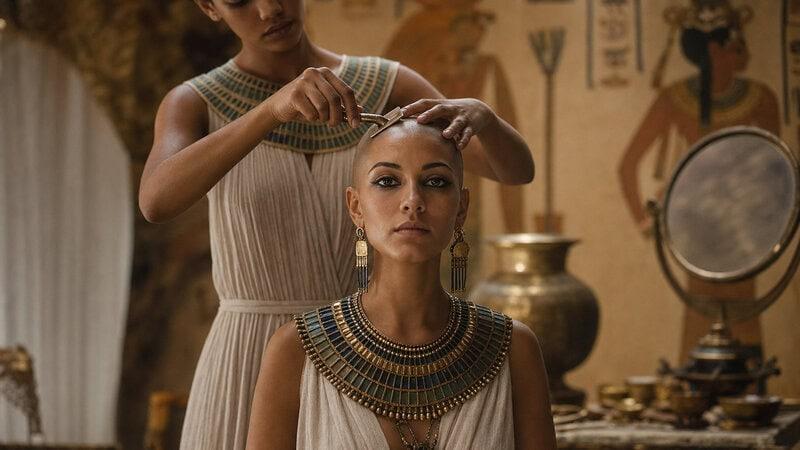

The smell reached her before the mirror did — kyphi, that thick Egyptian perfume of honey and myrrh, drifting through the room as a servant lifted a bronze razor and drew it, with practiced precision, across a noblewoman’s scalp. It is 1350 BCE, somewhere along the Nile, and the most fashionable woman in the room is completely, deliberately, impeccably bald.
The Morning Ritual That Defined a Civilization

Here is the paradox at the heart of ancient Egypt fashion: in a culture that produced some of the most elaborate and beautiful hairstyles the ancient world had ever seen — thick black cascades of braided hair, studded with gold and lotus blossoms — the people wearing those hairstyles had shaved every strand of their own hair away first. The wig came after the razor. The spectacle required the blank canvas.
Imagine the full sensory weight of that morning ritual. The cool touch of polished copper as the noblewoman studies her reflection. The smooth pull of oiled skin beneath the blade. Then, piece by piece, the transformation begins: linen draped in precise pleats against her body, a broad usekh collar — heavy, beaded, blazing with turquoise and carnelian — settled across her collarbone, and finally the wig, pinned and perfumed, descending in perfect symmetrical waves. What she has done is not merely get dressed. She has composed a statement.
That statement — and the question of what it meant that cleanliness, artifice, and social rank were so completely intertwined in the way ancient Egyptians dressed and adorned their bodies — is what makes this civilization’s approach to fashion so endlessly worth examining. The evidence to examine it properly exists: garments, wigs, cosmetic palettes, razors, and jewelry recovered from sealed tombs have allowed archaeologists and historians to reconstruct this visual world with genuine precision, moving well beyond guesswork into measurable, touchable specifics.
The Fabric of Every Egyptian Life: Linen From the Nile’s Banks

Whatever else divided ancient Egyptians — and a great deal divided them, from the pharaoh sealed inside his palace complex to the field worker bent over the flood plain — one material united them all. Everyone wore linen. Spun from the fibrous stems of flax plants cultivated along the Nile, linen was the great democratic thread of Egyptian civilization, the single fabric that dressed a society across more than three thousand years of continuous history. Garments recovered from tombs place the tradition firmly at or before 3000 BCE, and the practice continued unbroken into the Roman period.
The logic was partly climatic and thoroughly practical. In a desert environment where temperatures routinely climbed to extreme highs, linen’s lightness was close to a necessity. It breathed. It wicked moisture away from the skin. It could be bleached to a brilliant white that reflected the punishing sun rather than absorbing its heat. That whiteness also carried symbolic meaning — purity, cleanliness, divine favor — making it the natural choice for priestly vestments and burial garments alike. The two functions, practical and sacred, reinforced each other so completely that separating them is probably a modern error.
But linen’s democratic nature had its limits, and those limits were written into the weave itself. A laborer wore a rough, coarse kilt: undyed, unadorned, functional. A court official draped himself in linen so finely woven it approached transparency — pleated into architectural folds, softened with oil, almost luminous in torchlight. Same plant, same river, same basic garment. Worlds apart in every other respect. As World History Encyclopedia’s overview of fashion and dress in ancient Egypt makes clear, the quality of one’s linen was itself a form of social communication, readable at a glance by everyone who shared the room.
Wool and cotton were known in the ancient world, but wool was considered ritually impure by Egyptian religious standards and was largely excluded from temple contexts, while cotton did not become widely available in Egypt until considerably later in antiquity. Linen’s dominance was therefore not simply a matter of preference — it was structural, climatic, and religious all at once.
Simple Silhouettes, Complex Signals: What Ancient Egyptians Actually Wore

The core wardrobe of ancient Egyptian clothing was, structurally, quite spare. Men wore a white linen kilt wrapped around the hips and secured at the waist, sometimes worn alone and sometimes paired with a draped mantle or a bag-tunic for more formal occasions. Women wore a sheath dress — close-fitting, falling from the shoulder to the ankle, typically supported by one or two straps. These are the silhouettes that appear consistently across thousands of years of tomb paintings, temple reliefs, and surviving textiles.
Spare silhouette, however, did not mean plain garment. What ancient Egyptians wore when they wished to signal wealth and standing was those same simple forms transformed by vivid color, elaborate pleating, decorative fringe, and inlaid stones and beadwork. By the New Kingdom period — roughly 1550 to 1070 BCE — fashionable dress had grown considerably more complex, with both men and women wearing layered, heavily pleated garments of finer and finer linen, sometimes draped in multiple pieces simultaneously to create a deliberately intricate, tiered effect. The structure was always relatively simple; the surface treatment and layering were anything but.
The single most recognizable accessory in the entire visual vocabulary of ancient Egypt was the usekh collar — that wide, semicircular neckpiece built from rows of faience beads, gold, and semi-precious stones that fanned across the chest and shoulders. Men and women alike wore it. It appears in virtually every significant tomb painting across every dynasty. It functioned simultaneously as jewelry, as a visible marker of status, and as a religious object, with its colors and materials each carrying specific symbolic associations tied to particular deities and concepts of protection.
Even footwear told a precise story. Sandals were made from plaited papyrus reeds or leather and were worn by officials, priests, and royalty — with material and construction style forming a legible signal of rank. The poorest Egyptians went barefoot, including sometimes in proximity to those wearing gilded leather sandals. The distance between a bare foot and a carefully crafted leather sandal was, in ancient Egypt, approximately the same as the distance between subsistence and power. Wikipedia’s article on clothing in ancient Egypt surveys how footwear conventions, like linen quality, tracked closely with social position across different periods.
The Razor and the Ritual: Why Egyptians Removed Every Hair

The practice of full-body hair removal in ancient Egypt began, as so many things did, in the temples. Priests were required by religious custom to shave their entire bodies — head, face, and otherwise — at regular intervals as an act of ritual purification. Body hair was associated with contamination, with the animal world, with the kind of disorder that Egyptian religion was perpetually working to contain and transcend. Smooth skin was understood as sacred skin, properly prepared for proximity to the divine.
But the logic was not purely spiritual. In a hot, dusty climate where lice and parasites posed genuine everyday threats, smooth skin offered a practical defense that would have appealed to the pragmatic as much as to the devout. The two motivations — hygiene and holiness — reinforced each other so thoroughly that what began as priestly obligation gradually spread as the prevailing beauty and cleanliness standard across the upper classes, and the aspiration filtered downward from there.
The tools of this ritual are thoroughly real and thoroughly excavated. Bronze and copper razors have been recovered from multiple tomb contexts. Pumice stones were used to smooth skin after shaving. Ancient Egyptians also employed depilatory preparations made from animal fats and other organic compounds to remove hair from sensitive areas. The whole process was meticulous, time-consuming, and unmistakably deliberate. It was not self-erasure. It was self-preparation — the shaved body as the foundation on which the full spectacle of Egyptian personal adornment could be built to its full, intended effect.
Crowning Glory: The Wig as the Ultimate Status Symbol

A wig in ancient Egypt was not a disguise or a consolation. It was an engineered luxury object, and the moment you walked into a room wearing one, it announced your place in the social hierarchy with the same immediacy as a military rank or an official seal.
Elite wigs were constructed from human hair, woven onto a base of plant fiber or set with beeswax, then styled with resin that held intricate curls, braids, and plaits against the heat and movement of daily life. The finest examples incorporated gold tubes threaded onto individual braids, faience beads worked throughout the structure, and fresh lotus blossoms woven in for ceremonies and celebrations. The scent alone — resin, flowers, perfumed oils worked into the hair — would have identified the wearer as someone who could afford beauty at this level of craft and ongoing cost.
Egyptians of lesser means who wished to participate in the custom wore wigs made from plant fiber or wool. These were functional and not uncommon, but they were not convincing substitutes in a society whose elite understood precisely what human hair looked and felt like up close, and who read the distinction immediately. The gap between a wool wig and a human-hair wig was the gap between aspiration and arrival — visible, knowable, and socially significant.
The history of wigs in ancient Egypt stretches across virtually the entire documented span of the civilization — from the Old Kingdom period, roughly 2686 to 2181 BCE, through the Middle and New Kingdoms and into the Roman era. That is a duration of more than two thousand years for a single fashion practice. It speaks to how deeply the wig was embedded not merely in aesthetics but in Egyptian ideas about what it meant to be fully, properly, and respectably human — and how the practice was robust enough to survive radical political change, foreign conquest, and the eventual transformation of Egyptian culture under Greek and Roman influence.
Beauty Standards Written in Kohl and Gold: Cosmetics and Jewelry

Ancient Egyptian beauty culture operated on one consistent principle: the face was a surface to be intentionally transformed, not merely maintained. An unadorned face in elite or ceremonial company did not read as natural, refreshing, or admirably modest. It read as neglect, poverty, or social obliviousness — a failure to perform the expected language of appearance.
The defining cosmetic was kohl — a dark paste ground from galena (lead sulfide) or malachite and mixed with animal fat or another binding agent, applied in thick, emphatic lines that extended well beyond the outer corners of the eyes into long, horizontal sweeps. Men, women, and children all wore it, in everyday contexts as well as ceremonial ones. The practical benefits reinforced the aesthetic ones: the metallic compounds in kohl reduced sun glare in an intensely bright outdoor environment, and analysis of surviving kohl preparations has suggested antibacterial properties that would have helped protect eyes from the infections that were common in a dusty, insect-rich climate. Aesthetically, the extended eye line evoked the eye of Horus, one of ancient Egypt’s most potent protective symbols, connecting the wearer’s face to a concept of divine guardianship. Painting your eyes was, simultaneously, a beauty practice, a health measure, and a religious act.
Red ochre tinted lips and cheeks. Henna stained fingernails and palms in patterns that survive in visual records and in the physical evidence of mummified hands. Scented oils — made from plants including moringa, castor, and sesame — were worked into skin and hair to protect against the drying heat and to carry fragrance throughout the day. At formal banquets, guests are depicted in tomb paintings wearing perfumed cones of animal fat placed atop their wigs. As the evening progressed and the room warmed, those cones slowly melted — releasing fragrance and gleaming oil down over hair and skin in a deliberate, time-released luxury that was as much a social performance as a sensory pleasure.
Jewelry completed the composition. Layered over linen and combined with wigs and kohl, Egyptians of means wore broad usekh collars, armlets, anklets, finger rings, and earrings in gold and electrum set with carnelian, lapis lazuli, and turquoise. Each stone carried symbolic associations tied to specific deities and concepts; each metal carried hierarchical weight. Gold, which does not tarnish and was associated in Egyptian theology with the flesh of the gods themselves, was reserved for royalty and the highest priestly ranks. Further down the social hierarchy, faience and copper progressively replaced precious metal — still beautiful, still meaningful, but readable by anyone who knew the code as a different register of the same visual language. This overview of ancient Egyptian fashion and clothing draws together how cosmetics, jewelry, and garments functioned as an integrated system of social signaling rather than as separate concerns.
How Fashion Changed Across Egypt’s Dynasties
It would be a mistake to treat ancient Egypt fashion as static across three thousand years. The broad structures — linen garments, wigs, kohl, the usekh collar — persisted with remarkable consistency, but the details shifted with political change, foreign contact, and shifting aesthetics within Egyptian culture itself.
During the Old Kingdom, garments tended toward the simplest silhouettes: narrow sheaths for women, plain kilts for men, minimal layering, and relatively restrained ornamentation by later standards. By the Middle Kingdom, pleating had become more elaborate and jewelry more architecturally complex. The New Kingdom — the era of Ramesses II, of Tutankhamun, of Egypt’s greatest imperial reach into Nubia and the Levant — brought the most flamboyant fashions: multi-layered, heavily pleated linen robes, extravagant wigs with gold and faience decorations, and jewelry of exceptional technical sophistication. Foreign materials and influences entered Egyptian style through trade and conquest, with Nubian gold, Levantine lapis lazuli, and Aegean design motifs all leaving their mark on the objects recovered from New Kingdom tombs.
The Late Period and subsequent Ptolemaic era, when Egypt came under Greek influence following Alexander the Great’s conquest in 332 BCE, introduced Greek dress forms alongside traditional Egyptian ones, producing a blended visual culture in which Egyptian elites might wear Greek-style draped garments while still adorning themselves with traditional usekh collars and kohl-lined eyes. Fashion, in ancient Egypt as anywhere, was never entirely sealed from the world around it. Archaeological research into Egyptian clothing traditions continues to refine our understanding of how these shifts unfolded across different regions and social levels.
What Ancient Egypt Fashion Still Tells Us Today
What makes the fashion of ancient Egypt so striking to modern eyes is not its foreignness but its clarity. Every element of the Egyptian dressed body — the white linen base, the jeweled collar, the painted eyes, the human-hair wig pinned and perfumed into place — was a deliberate choice in a deliberate language. Fashion here was not frivolity. It was communication: of rank, of religious belonging, of social aspiration, of the particular kind of human being you had worked and paid and prepared yourself to be.
The impulse behind that language is not ancient at all. The desire to use dress and grooming to signal identity and position is unchanged across five thousand years of human life. Ancient Egypt simply pursued it with remarkable explicitness, maintained it with extraordinary consistency across millennia, and — crucially — buried enough of the physical evidence in sealed tombs that we can now reconstruct it with genuine historical precision rather than artistic imagination.
Which brings us back to that noblewoman, now fully composed. The razor put away. The linen pleated and settled. The usekh collar blazing against oiled skin. The wig perfumed and pinned precisely in place. She rises and walks toward the temple — not disguised, not concealed, but declared. Every inch of her a statement. Every choice a word in a language her whole civilization understood. After five thousand years, we are still learning to read it.

 English
 Arabic
 French
 Spanish
 Portuguese
 Deutsch
 Turkish
 Dutch
Dutch
 Italiano
 Russian
 Romaian
 Portuguese (Brazil)