


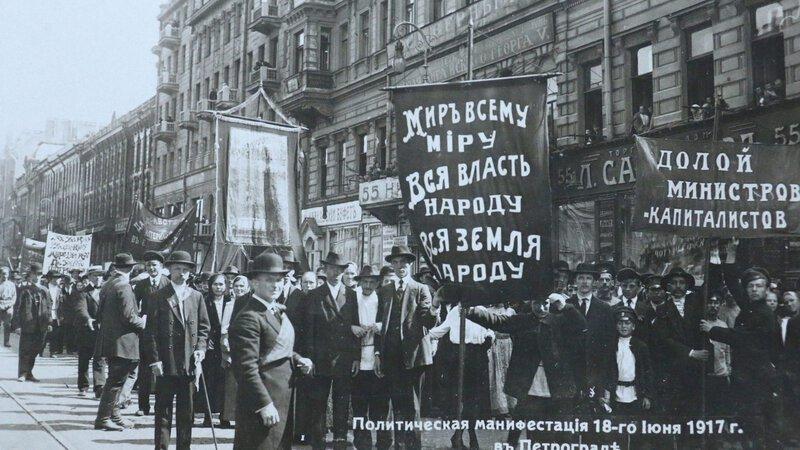

In the summer of 1917, a single decision — or rather, a single failure to decide — may have sealed the fate of the twentieth century. Alexander Kerensky had Lenin cornered, discredited, and on the run. He let him go.
The Man Who Could Have Changed Everything

Petrograd in July 1917 smelled of gunpowder and bread queues. The Romanov dynasty had collapsed just months before, and in the vast, exhausted empire it left behind, one man stood at the center of the storm: Alexander Fyodorovich Kerensky — lawyer, orator, moderate socialist, and head of the Russian Provisional Government. He was thirty-five years old and, for one extraordinary season, the most powerful man in Russia.
Then came the July Days: a chaotic, half-organized uprising in the capital that briefly turned the streets into a battlefield and ended with Lenin fleeing to Finland in disguise, hiding from an arrest warrant that Kerensky’s government had every legal and political justification to enforce. The evidence connecting Lenin to German funding was in hand. The press was howling. Even rivals on the socialist left urged action. And Kerensky hesitated.
That hesitation is one of history’s most consequential pauses. The man who would somehow survive everything — the revolution, the Civil War, Stalinism, the Second World War, the entire Soviet era — and die quietly in New York in 1970, chose procedural caution at the one moment history demanded decisiveness. He was a democratic idealist who played by the rules against a revolutionary predator who recognized no rules at all. The question that haunts the whole episode is as simple as it is devastating: what did he think was going to happen?
Who Was Kerensky? The Shooting Star of Russian Politics

To understand why Kerensky made the choices he did, you have to understand what he believed — and how intoxicating those beliefs felt in early 1917. He was not a Bolshevik firebrand, not a Tsarist loyalist, not a cynical operator. He occupied the most dangerous ground in any revolution: the moderate middle. A trained lawyer and member of the Socialist Revolutionary Party, Kerensky genuinely believed that Russia could avoid the worst of the bloodshed and arrive at Western-style constitutional democracy. He thought civilization was possible without a massacre to get there.
And for a few months, the crowds agreed with him. He could fill enormous halls with his speeches and leave audiences shaken with conviction. Soldiers at the front pressed forward to touch his coat. Newspapers called him the first love of the Revolution. There was a quality to his early celebrity that makes everything that followed feel less like a political defeat and more like a tragedy — the specific tragedy of a decent man in an indecent moment.
His ideology was also his vulnerability. As Britannica’s biography of Kerensky details, he was a moderate socialist whose entire project rested on building legitimate institutions: courts, elections, a Constituent Assembly that would let the Russian people determine their own future. Every instinct he had was oriented toward due process. That is an admirable thing to be. It was also, in 1917 Petrograd, close to fatal.
The Provisional Government’s Fatal Inheritance

The Russian Provisional Government that Kerensky eventually led did not choose its circumstances. It inherited a country already coming apart — three years of catastrophic war with Germany, a devastated army hemorrhaging men at a rate that defied comprehension, food shortages severe enough to drive city workers into the streets, and a population that had just toppled a three-hundred-year dynasty and expected something extraordinary in return.
Into this wreckage, Kerensky made his most consequential and most debated decision: he kept Russia in the war. The Allied powers pressed him hard, and his own convictions pressed harder. A democratic Russia, he argued, must honor the commitments its predecessor had made. To abandon the fight would be to destroy the new republic’s credibility before it had found its footing.
The front lines returned their verdict in brutal terms. Soldiers deserted by the hundreds of thousands. They had not overthrown the Tsar to die in the same Galician mud under different masters. And as they streamed away from the trenches, they were not turning toward Kerensky’s patient promises of a future Constituent Assembly. They were turning toward Lenin’s three words: Peace, Land, Bread.
This was the structural crack that ran through everything the Provisional Government tried to build. Kerensky governed by promise — pledging elections and assemblies that were repeatedly postponed because the situation was always too unstable, the timing never quite right. The Bolsheviks governed by demand, seizing the present and letting the future sort itself out. Against the urgency of hunger and exhaustion, patience is not a policy.
Lenin in His Hands: The July Days and the Moment That Slipped Away

The July Days of 1917 were chaotic — spontaneous street demonstrations by soldiers and workers that the Bolsheviks half-led and half-stumbled into, uncertain whether the decisive moment had arrived. The uprising failed. Kerensky’s government stabilized. And in the aftermath, documentary evidence emerged linking Lenin’s organization to German funding, suggesting that the Bolsheviks were, at least in part, instruments of Germany’s effort to knock Russia out of the war.
Lenin went underground, then slipped across the border into Finland. The arrest warrant existed. The press demanded its execution. Menshevik and other socialist critics of Lenin — people with no affection for Kerensky — nonetheless urged him to act. The political conditions had aligned in a way they would never align again.
Kerensky could not bring himself to do it. As History Today examines, his paralysis had a logic that deserves to be understood before it is condemned. He was terrified of becoming what he had fought against — a strongman who arrested opponents without due process, who bent the law to serve power rather than constrain it. If he hauled Lenin in on the basis of evidence that might not survive a proper trial, what was he but a new kind of autocrat? What separated him from the Tsar?
The answer, of course, was that a free Lenin in Finland was considerably more dangerous than a Lenin facing criminal charges in a Petrograd courtroom. Within four months of that failure to act, the positions would be entirely reversed: Lenin in the Winter Palace, Kerensky fleeing Russia in disguise, the democratic experiment finished before it had properly begun.
The Kornilov Affair: Kerensky Arms His Own Destroyers

If the July Days were the moment Kerensky failed to finish his most dangerous enemy, August 1917 was the moment he actively resurrected him. General Lavr Kornilov, commander of the Russian army, moved troops toward Petrograd in what Kerensky interpreted as an attempt at right-wing military dictatorship. In response, Kerensky made a decision that still defies easy summary: he released Bolshevik prisoners and distributed arms to Red Guards to help defend the capital.
The Kornilov advance collapsed largely on its own — the general’s forces melted away as soldiers refused to march against the revolution. But the damage was done in the most perverse possible direction. Kerensky had handed weapons and a hero’s legitimacy to the faction most determined to destroy him. The Bolsheviks, freshly armed and newly cast as defenders of the revolution against reaction, began recruiting at a pace that would have been impossible weeks earlier.
It is the Kornilov affair, more than any other single episode, that illuminates why Kerensky’s government ultimately collapsed. Not because he was stupid — he was not. Not because he was corrupt — he was not that either. But because his government had become so politically isolated, so trapped between a right-wing military threat and a left-wing revolutionary threat, that each response to one crisis worsened the next. By September he was governing from the Winter Palace, a man whose grip on events had long since loosened even as his grip on its symbolism tightened.
October: The Night the World Changed and Kerensky Fled

On the night of October 25th, 1917, by the old Russian calendar — November 7th by the Gregorian — Bolshevik forces moved on the Winter Palace in an operation that was less a dramatic assault than an almost embarrassingly quiet occupation. The ministers of the Provisional Government, waiting inside for reinforcements that never arrived, reportedly passed the hours playing cards. Kerensky himself was already gone, having left earlier to seek loyal troops at the front who might march back and restore order.
There were no loyal troops. Russia did not rise to defend its democratic government. The revolution that would reshape the entire twentieth century succeeded, in its decisive hours, in an atmosphere of exhausted anticlimax.
Kerensky understood then, if he had not before, that it was finished — not with a pitched battle, but with indifference. He fled Russia and made his way to Paris, beginning the long, strange afterlife that would consume the next five decades. He wrote memoirs, delivered lectures, and relitigated every decision in print and in conversation, constructing arguments for why things might have gone differently. Stanford Magazine’s account of his later years captures something of the poignancy of this — a man of acute intelligence condemned to spend most of his remaining life explaining a failure he could never fully accept.
He outlasted Stalin. He outlasted Khrushchev. He watched the Soviet state, born from his defeat, send men into space. He died in New York in 1970, aged eighty-eight, the last leader of democratic Russia before the Bolsheviks took power, and one of history’s most haunted survivors.
What Kerensky’s Failure Still Teaches Us
The historical verdict on Alexander Kerensky resists easy cruelty. He was not a villain. He was not, as Soviet propaganda insisted, a traitor or a fool. He was something more instructive and more troubling: a democratic constitutionalist dropped into a revolutionary moment that had no patience for constitutions, facing an opponent who understood that in a true crisis, the law is whatever the people with the guns say it is.
The lesson at the heart of the Kerensky story is one that democracies have had to relearn, painfully, in every generation since. Liberal proceduralism — due process, legitimate institutions, the rule of law — is among the finest achievements of political civilization. It is also a near-fatal vulnerability when facing actors who treat law purely as a tool: useful when it protects them, irrelevant when it does not. Kerensky refused to become the thing he hated. Lenin felt no such constraint.
The consequences were not abstract. The Soviet state that Kerensky failed to prevent killed tens of millions of its own citizens, consumed the lives of neighboring peoples through war and occupation, and reshaped the global order for seventy years. A series of hesitations across one Petrograd summer became among the most consequential acts of restraint in modern history — restraint that cost almost nothing in the moment and everything in the end.
Whatever Kerensky thought in his final years in New York, watching the century grind forward without him, he had lived long enough to outlast almost every actor in the catastrophe he had failed to prevent — and not long enough to see it truly end. He died in 1970, still convinced by most accounts that he had been right: that the rules had mattered, that democracy had been worth attempting. History, characteristically, declined to agree.

 English
 Arabic
 French
 Spanish
 Portuguese
 Deutsch
 Dutch
Dutch
 Italiano
 Russian
 Romaian
 Portuguese (Brazil)
 Greek
Greek