


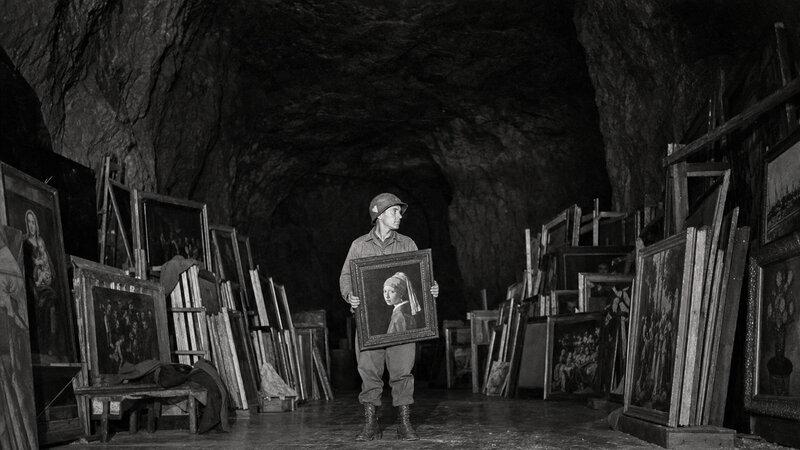

In May 1945, American soldiers crawled through the narrow entrance of a salt mine tunneled deep into the Austrian Alps near the village of Altaussee and emerged, blinking, into a cathedral of stolen beauty — Vermeer, Michelangelo, van Eyck, stacked in the cool dark by the thousands, earmarked by Adolf Hitler for a museum that would never be built. What they found that day was only a fraction of an estimated five million cultural objects the Nazi regime had systematically plundered from across occupied Europe — one of the greatest acts of cultural theft in recorded history, and one of the least-taught chapters of World War II.
Hitler’s Obsession: Why the Nazis Looted Art on an Industrial Scale
To understand the looting, you have to understand the dream. Hitler had conceived of a vast cultural complex to be built in Linz, Austria — his hometown — called the Führermuseum. It was to be the crown jewel of the Third Reich, a monument to German cultural supremacy intended to dwarf the Louvre, the Uffizi, and the British Museum combined. To fill it, he needed a collection on a scale the world had never seen. So he built a machine to take one.
That machine had two main gears. The first was the Einsatzstab Reichsleiter Rosenberg — known by its initials as the ERR — a special task force established in 1940 to systematically strip Jewish-owned collections across occupied territories. In France alone, the ERR catalogued and confiscated more than 21,000 objects, crating Rembrandts and Rubens with the methodical efficiency of a warehouse inventory. The second gear was Hermann Göring, whose appetite for art was personal as well as ideological. While overseeing the broader apparatus of wartime looting, he was quietly diverting masterworks from the official pipeline to fill his private estate at Carinhall.
But this was never purely about greed or aesthetics. The looting was cultural erasure. By seizing the collections of Jewish families — collections built over generations, representing not just wealth but identity, memory, and belonging — the regime was attempting to sever an entire people from their place in European civilization and rewrite that heritage as purely German patrimony. The scale of what would need to be recovered, and by whom, was something no Allied planner had yet seriously considered.
The MFAA: Curators Given Rifles and a Near-Impossible Mission

The Allied response was, initially, almost nothing. Then, in 1943, the Monuments, Fine Arts and Archives section — the MFAA — was formally established within the Allied military command structure. What it lacked in resources, it nearly made up for in expertise. Drawn from museums, universities, architecture firms, and conservation studios across thirteen nations, the MFAA eventually comprised roughly 345 men and women. They were, in the most literal sense, soldiers who happened to know how to handle a Flemish panel painting.
Their position was both heroic and faintly absurd. Operating in active war zones, most MFAA officers had a single jeep, a list of cultural sites, and the thankless job of persuading generals under fire to route their artillery around medieval cathedrals and not billet their troops in frescoed Renaissance palaces. They had no real authority. They had only the force of argument — and occasionally, the backing of Eisenhower himself, who issued formal orders protecting cultural property after being persuaded of the moral stakes involved.
Several figures stand out from the larger story. George Stout, a conservator from Harvard’s Fogg Museum, was the operational genius of the group — the man who improvised conservation techniques in the field, stabilizing war-damaged panels with whatever the military supply chain could spare. James Rorimer, a young curator who would later become director of the Metropolitan Museum of Art, worked the Paris angle and cultivated one of the operation’s most valuable intelligence sources. And then there was Rose Valland — a quiet, seemingly unremarkable French curator who had stayed at her post at the Jeu de Paume museum in Paris throughout the occupation, secretly documenting every artwork the Nazis crated and shipped eastward, at enormous personal risk. Her records would eventually function as a treasure map.
The MFAA operation was not, despite what cinema naturally implies, a small platoon on a single dramatic mission. It was a years-long, multinational effort stretched across hundreds of individuals and dozens of countries, grinding forward through bureaucratic indifference, inadequate resources, and the chaos of a continent at war.
The Race Against Two Clocks

By late 1944, the men and women of the MFAA were running against two simultaneous countdowns. Allied bombing campaigns were devastating historic city centers — sometimes unavoidably, sometimes through sheer lack of information about what lay in the crosshairs. And in the minds of the Nazi leadership, what would become the Nero Decree of March 1945 was taking shape: Hitler’s order that anything of value be destroyed rather than allowed to fall into Allied hands.
The MFAA fought on both fronts. Stout and his colleagues compiled safeguarding lists — detailed maps and descriptions of monuments to be avoided wherever tactically possible. Eisenhower’s formal protection orders changed the calculus of the campaign, even if compliance was uneven. The human weight of this work became concrete in individual objects: Michelangelo’s Bruges Madonna and the Ghent Altarpiece by Jan van Eyck were not abstractions. They were irreplaceable, singular, and fragile. Losing either to Nazi demolition would have been a wound to world heritage that no photograph and no reproduction could ever heal.
By spring 1945, with Valland’s secret records in hand, MFAA officers were racing ahead of retreating German columns, following the paper trail of the greatest art heist in history toward its hidden endpoints.
Into the Mines: What They Found

Altaussee was the jackpot. The salt mine held an estimated 6,500 artworks, including the Ghent Altarpiece, the Bruges Madonna, and Vermeer’s The Art of Painting — all packed in crates, some in chambers where explosives had already been placed. Local Austrian miners, in an act of quiet courage that deserves more recognition than it typically receives, had removed the detonators before the Monuments Men arrived. The art survived by days, possibly hours.
Altaussee was not the only revelation. In April 1945, at the Merkers salt mine in Germany, Monuments Men accompanied by Eisenhower, Patton, and Bradley descended into a cavern holding the entire gold reserve of the German Reichsbank alongside crated paintings from Berlin’s state museums. The generals, accustomed to the scale of war, were reportedly struck silent. Significant caches turned up in Bavarian castles, Italian monasteries, and Austrian manor houses — each site its own detective story, each recovery dependent on local knowledge, precise timing, and the particular tenacity of whoever was chasing that thread.
George Stout moved through these sites with improvised precision, stabilizing damaged works on the spot and making conservation decisions that no training manual had ever anticipated, because no situation like this had ever existed before.
After the Guns: The Long, Unfinished Work of Restitution

When the fighting stopped, the MFAA’s work did not. Central Collecting Points were established in Munich, Wiesbaden, and Marburg, where millions of objects were processed, catalogued, and prepared for return to their countries of origin. It was painstaking, underfunded, and morally complicated work — because “countries of origin” was an imperfect frame. Much of the looted art had belonged not to nations but to Jewish families, the vast majority of whom had been murdered. Postwar restitution too often meant returning works to governments rather than rightful heirs, a compromise that left generations of survivors and their descendants without recourse.
The reckoning came slowly. The 1998 Washington Principles on Nazi-Confiscated Art created an international framework acknowledging that governments and museums had an obligation to identify Nazi-looted works in their collections and pursue fair solutions with heirs. Eighty years after the war, that work continues. Museums from New York to Amsterdam are still identifying and returning works. Court cases are still being filed. Of the estimated five million objects looted by the Nazi regime, hundreds of thousands remain unlocated or in active dispute.
The Monuments Men’s mission, in a very real legal and moral sense, is not finished.
From History to Hollywood: What the 2014 Film Gets Right — and Where It Falls Short

George Clooney’s 2014 film The Monuments Men, written and produced by Clooney and Grant Heslov and drawn from Robert Edsel’s 2007 book of the same name, brought this largely forgotten chapter of World War II to a mass audience that had never heard of the MFAA. For that alone, it deserves genuine credit. Most people who walked out of theaters in February 2014 knew something they hadn’t known when they walked in.
The film’s dramatic compromises are worth naming honestly. The ensemble cast’s tight platoon structure and Hollywood pacing compress a vast, years-long, multinational operation into something more linear and intimate than the actual effort ever was. The tone — at times lightly comedic — sits uneasily against the gravity of what the historical figures faced, and some of the film’s most affecting dramatic moments are composites or inventions. These are fair criticisms from historians, and viewers deserve to know them.
But the film captures something true at its core: the bureaucratic indifference of military command toward cultural preservation, the genuine moral argument that civilization’s artifacts are worth a human life to protect, and the real emotional weight of standing inside a salt mine and holding a van Eyck in the dark. Those things happened. The men and women of the MFAA argued for them, fought for them, and in at least two cases died for them.
If you haven’t seen it, watching The Monuments Men on Prime Video is a worthwhile starting point. And if the film sends you looking for more — for the full story of Rose Valland’s secret notebooks, for George Stout’s improvised work in the caves, for the restitution cases still winding through courts today — then it will have done something more valuable than entertain you. It will have pointed you toward a piece of history that is stranger, more desperate, and more consequential than any two-hour film has room to hold.
The art that was recovered is hanging on museum walls right now. The art that was never found is still out there. And the question of who it truly belongs to is, in hundreds of cases, still being answered.

 English
 Arabic
 French
 Spanish
 Portuguese
 Deutsch
 Turkish
 Dutch
Dutch
 Italiano
 Russian
 Romaian
 Greek
Greek