


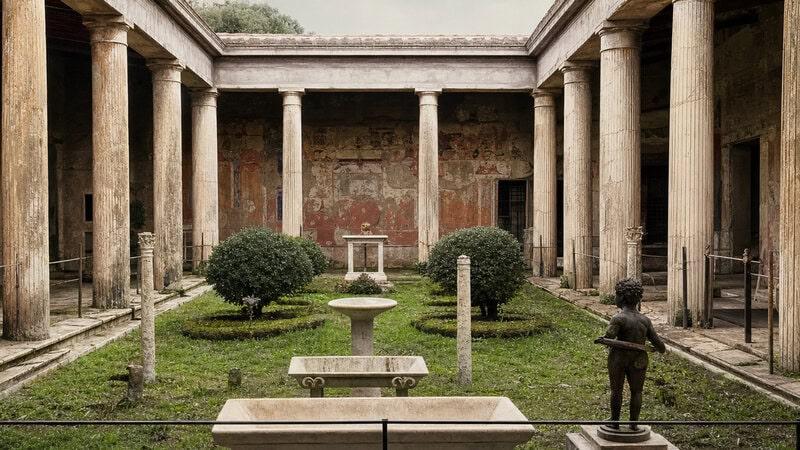

Somewhere beneath a grassy, cordoned field at the edge of Pompeii’s modern excavation boundary, a Roman street lies exactly as it was on the morning of August 24, AD 79 — bread carbonised in the oven, graffiti scratched into plaster, a dog’s skeleton still chained to its post, waiting in the dark for a morning that never came.
The Street That No Living Eye Has Seen

Despite hundreds of years of continuous digging, roughly one-third of Pompeii has never been touched by a modern trowel. The city covered approximately 66 hectares in total — a dense, vivid urban world of bakeries and brothels, temples and garden courtyards, election slogans and love poetry scratched into walls. The unexcavated portion represents an area larger than many contemporary city blocks, a frozen neighbourhood sealed under metres of volcanic debris, its contents intact and unbreathed-upon since the first century AD.
This is the story of what we know lies down there, why it hasn’t been dug up, and why that restraint may turn out to be the most consequential archaeological decision of our era.
A City Caught Mid-Breath: The Eruption and the Burial

Vesuvius didn’t simply explode. It performed, catastrophically and at length. On the morning of August 24, AD 79, the volcano drove a column of superheated ash and pumice approximately 30 kilometres into the atmosphere, raining debris down on Pompeii for around 18 hours. People sheltered indoors, waited, and misjudged the danger. Then, in the early hours of August 25, pyroclastic surges — fast-moving avalanches of superheated gas and volcanic material — swept down the mountain’s flanks and entombed the city in moments. What had been a place of noise, argument, and cooking smells became, almost instantaneously, a tomb.
The preservation mechanism was accidental but extraordinary. The thick blanket of pumice and ash excluded air and moisture with remarkable efficiency, locking organic materials in place for nearly two millennia. Wood didn’t rot. Food didn’t fully decompose. Fabric left impressions in the hardened matrix. Human bodies, encased in ash that solidified around them, left perfect voids — voids that, from the 1860s onward, archaeologists would fill with plaster to produce the haunting casts that have come to define the site’s emotional power.
Crucially, the sections of Pompeii that remain unexcavated have benefited from this unbroken seal the longest. In a bitter archaeological irony, the areas dug up first — in the 18th and early 19th centuries — were exposed before anyone fully understood how to protect what they were uncovering. The buried third, by contrast, has never been opened. Its painted walls have never met rain or sunlight. Its wooden beams have never been touched by the air that causes them to crumble. What lies in Pompeii’s buried sections is not just stone and pottery but potentially entire rooms of painted decoration, written documents, and biological material — seeds, bones, even traces of ancient DNA — that could deepen our understanding of Roman daily life in ways no other site can match. National Geographic’s account of ancient Roman life preserved at Pompeii offers a vivid sense of just how complete that preservation can be when conditions are right.
Hundreds of Years of Digging — and Still Not Done

Formal excavation at Pompeii began in 1748, under the patronage of the Bourbon King Charles III of Naples. Those early campaigns were less archaeology than treasure hunting — frescoes were stripped from walls to decorate royal palaces, statues were carted off for private collections, and the three-dimensional context that gives objects their meaning was almost entirely ignored. A painted panel was a prize; the room it once decorated was rubble to be cleared.
The discipline began to mature in the second half of the 19th century. Giuseppe Fiorelli, who took charge of excavations in 1860, introduced a systematic grid approach to the site, dividing it into numbered regions and insulae — the Latin term for the residential and commercial blocks that made up the city’s fabric. Fiorelli also developed the plaster-cast technique: recognising that the hollow spaces left by decomposed bodies in the hardened ash were perfect moulds, he injected liquid plaster to produce three-dimensional records of the dead in their final postures. It was an act of both scientific ingenuity and profound humanity.
The 20th century brought stratigraphic methods, soil sampling, and an increasingly forensic approach to the evidence. But it also brought a reckoning. Every section of Pompeii opened to the air immediately begins to deteriorate. Moisture penetrates painted plaster. Biological growth — moss, bacteria, plant roots — attacks ancient mortar. Tourists, whose feet and breath and sheer numbers exert continuous pressure on fragile surfaces, accelerate the decay. The site was generating a conservation backlog faster than it could be managed, and the governing logic shifted. Today, the official position of the Pompeii Archaeological Park is that the unexcavated portions should, for now, remain exactly where they are — a living archive, deliberately preserved for future generations equipped with better tools.
What the Scans Are Revealing Without a Single Shovel

The pause in large-scale excavation does not mean a pause in discovery. A revolution in non-invasive archaeology has allowed researchers to map Pompeii’s buried sections in extraordinary resolution without disturbing a single grain of ash. Ground-penetrating radar sends pulses of electromagnetic energy into the earth and reads what bounces back; magnetometry detects subtle variations in the magnetic properties of buried materials; LiDAR maps surface topography with millimetre precision; and muon tomography — a technique borrowed from particle physics — can image dense structures through metres of overburden.
Survey work using these methods has already identified underground anomalies consistent with unexcavated buildings, probable garden layouts, street grids, and large structures of unknown function, all mapped through the volcanic debris that covers them. Researchers are confident that among what is still buried at Pompeii are entire insula blocks, commercial districts, and possibly public buildings whose existence would significantly alter our understanding of the city’s organisation and scale.
The broader institutional framework for this work is the Grande Progetto Pompei — the Great Pompeii Project — launched in 2012 as a €105-million Italian government initiative. Initially focused on emergency conservation of the excavated areas, the project has evolved to encompass systematic scientific survey of buried zones, encoding in practice a new archaeological philosophy: study first, excavate second, and only when you are confident you can do so without destroying more than you learn.
The Regio V Breakthrough: A Taste of What Remains

If the case for the buried third ever needed a proof of concept, the ongoing excavations in Regio V — a partially explored neighbourhood in the north of the city, opened to serious investigation from 2018 onward — have provided it in spectacular fashion.
From Regio V came a ceremonial chariot of extraordinary preservation: its wooden frame partially intact, its bronze and tin decorations still in place, found in the stable yard of a suburban villa as though parked there for a journey that was never taken. From Regio V came a thermopolium — a Roman street-food counter — frozen mid-service, its large ceramic vessels still sunken into the masonry counter that kept them warm, containing traceable residues of duck, pig, fish, and snail. The painted panels above the counter advertised the menu in vivid colour. The serving surface was worn smooth by thousands of Roman elbows. Standing before it, archaeologists reported the uncanny sensation of a business interrupted rather than destroyed.
Political graffiti emerged from Regio V walls, endorsing candidates for municipal office in an election that never took place. Skeletal remains and plaster casts of individuals — some showing signs of trauma, some curled in postures of sleep — were recovered, and each is now a subject for isotope analysis and ancient DNA extraction: techniques that can reveal diet, geographic origin, disease history, and family relationships at a level of detail that would have seemed fantastical to earlier excavators.
The implication is stark. If a single partially excavated neighbourhood yielded a ceremonial chariot, a working snack bar, and a gallery of individual lives readable at the molecular level, the calculus for the larger, comparably intact areas that remain unexcavated is staggering. The continuing story of preserving Pompeii’s buried third reflects just how much professional attention this question is now receiving.
The Ethics of the Untouched: Why Leaving It Buried May Be the Bravest Choice

There is a philosophical dimension to Pompeii’s unexcavated sections that goes beyond logistics or funding. Every excavation is a one-way door. You cannot re-bury a site in its original state; the act of opening is irreversible. The analytical tools available in 2025 are, in all probability, limited compared to what 2075 or 2125 will offer. Ancient DNA sequencing was effectively impossible a generation ago; nano-scale materials analysis barely existed a decade ago. The case for waiting is, at its core, a case for epistemic humility — an acknowledgment that we do not yet know everything we will want to ask, and that the questions of future generations deserve answers too.
The conservation crisis at already-excavated Pompeii strengthens this argument considerably. The site receives millions of visitors annually, and the atmospheric and physical effects of that footfall are measurable and ongoing. Climate change is intensifying the rainfall and temperature swings that crack ancient plaster and promote biological growth. Structural decay in buildings opened in the 18th and 19th centuries is a persistent emergency. Against this backdrop, protective burial is not inaction — it is active stewardship.
The counterargument deserves honest acknowledgment. Some researchers note that seismic activity in the Campanian region, the slow subsidence and encroachment of the modern town of Pompeii above ground, and the long-term effects of climate change on buried organic materials represent real threats to the unexcavated sections. On this reading, waiting indefinitely is itself a gamble, and targeted excavation — conducted to the highest modern standards — might save material that would otherwise be lost to geological or environmental degradation before better technology arrives. It is a genuine tension, and professional archaeology has not fully resolved it.
The Buried Third as a Gift to the Future
Return, for a moment, to that unexcavated street. Somewhere beneath the grass and the ash and the pumice, a bakery counter still holds the carbonised shapes of loaves pulled from the oven as normal on an August morning nearly two thousand years ago. A painted lararium — a household shrine — still holds its colours in the dark. An election notice, the ink of its letters barely dry when the mountain spoke, still makes its case on a wall that no eye has read since the first century AD.
These things are not lost. They are banked, accruing interest in the form of advancing science. The people of Pompeii were erased in a single morning — their plans, their arguments, their ordinary routines cancelled without appeal. But the city they built, the meals they cooked, and the words they scratched into plaster may yet be returned to history in fuller and more intimate detail than almost any other ancient civilisation has managed to preserve.
The next generation of excavators will bring tools and methods not yet invented to these sealed layers. They will read ancient DNA from soil samples. They will image pigments without touching them. They will reconstruct wooden furniture from the ghost impressions it left in hardened ash. They will ask questions we haven’t thought to ask, and the buried third will have answers ready.
The unexcavated portions of Pompeii are not a gap in our knowledge. They are a promise, kept in volcanic ash, waiting for the moment we are finally ready to receive it.

 English
 Arabic
 French
 Spanish
 Deutsch
 Turkish
 Dutch
Dutch
 Italiano
 Russian
 Romaian
 Portuguese (Brazil)
 Greek
Greek