


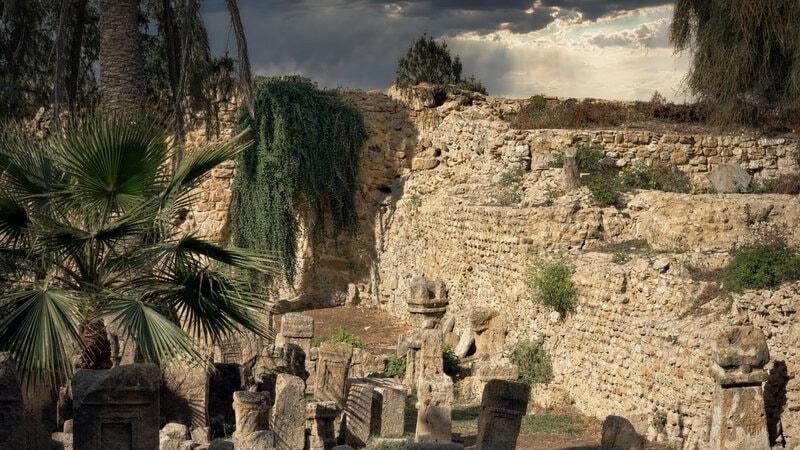

The fire burned for seventeen days. Roman soldiers moved through Carthage block by block, street by street, torching a city of hundreds of thousands until the smoke rose so thick it could be seen by sailors far out at sea — a civilization reduced to a column of black against the African sky, and the ancient world’s greatest commercial power turned to ash and memory.
The City That Refused to Die Quietly

It is 146 BCE, and what Rome is doing to Carthage is not merely victory. It is erasure. Three years of brutal urban combat have already hollowed the city. Now the fires do the rest. The Roman general Scipio Aemilianus, watching the destruction, is said to have wept — and quoted Homer’s lines about the fall of Troy, as if he understood, even then, that something irreversible was happening. A civilization was not being defeated. It was being unmade.
Then comes the legend that has haunted the story ever since: that Rome salted the earth of Carthage, pouring salt into the soil to curse it forever, to ensure nothing would ever grow there again. It is one of history’s most dramatic images — and almost certainly not true. No ancient source records the ceremony. The story appears to be a nineteenth and twentieth century scholarly embellishment, a myth that grafted itself onto real events because the real events were already extraordinary enough to feel like myth. What Rome actually did — legally cursed the site through a ritual called a devotio, sold the survivors into slavery, and demolished every structure to rubble — was arguably more thorough than salt.
That question — did Rome salt Carthage? — unlocks the whole story, because it reveals how completely Carthage has been filtered through the imagination of those who destroyed it. Ancient Carthage was not a footnote to Rome’s rise. It was Rome’s greatest rival — a seafaring superpower that dominated the western half of the Mediterranean for centuries, built one of antiquity’s most sophisticated republics, and produced a general who came within a knife’s edge of ending Roman civilization entirely. This is that story.
Origins: A Phoenician Seed in African Soil

Tradition places Carthage’s founding around 814 BCE, when Phoenician settlers from the Levantine city of Tyre established a trading post on a triangular peninsula jutting into the sea in what is now Tunisia. The location was strategic genius: a natural harbor on one side for commerce, open sea on the other, the whole site defensible from the landward approach. Legend credited the founding to Queen Dido, who reportedly struck a deal with the local Berber king — she could have as much land as an oxhide could cover. Then she cut the oxhide into the thinnest possible strips, laid them end to end, and enclosed a hilltop. The city that grew from that clever bargain would eventually house hundreds of thousands of people and command the western Mediterranean for centuries.
The Phoenician connection shaped Carthage’s early character — it inherited the Phoenician alphabet, religious traditions, and a merchant culture that valued trade over conquest. But here the story takes a genuinely surprising turn. A large-scale genetic study published in the journal Nature found that very few Carthaginians had any genetic link to Levantine Phoenicians. The ancient people of Carthage appear not to have shared ancestry primarily with the Levantine Phoenicians who established their culture — suggesting the city rapidly absorbed the indigenous North African and wider Mediterranean population and became something entirely its own.
This is not a minor genealogical footnote. It reframes everything. Carthage was not a colonial outpost of the Levant, forever looking eastward to its mother city for identity. It was a new civilization, rooted in African soil, shaped by the people already living there, borrowing Phoenician cultural tools and building something distinctly different with them. That independence of identity would define its ambition for the next five centuries.
The Empire of the Sea

At its peak, Carthage was a city of extraordinary scale and sophistication. Its population swelled to perhaps several hundred thousand people. Its harbor was an engineering marvel — a double port with a circular military inner harbor, the cothon, capable of sheltering hundreds of warships, and a rectangular commercial outer harbor where merchant vessels from across the known world unloaded cargo. Triple walls protected the landward approach. The merchant fleet reached as far as Britain for tin and the West African coast for gold, threading a commercial empire that controlled the western Mediterranean’s chokepoints: Sicily, Sardinia, Spain, and the Strait of Gibraltar.
The political structure was remarkable enough that Aristotle praised it in his Politics — one of antiquity’s few non-Greek republics to earn his sustained respect. Carthage was governed by two elected magistrates called suffetes, a powerful senate dominated by merchant oligarchs, and popular assemblies — a system of checks that Aristotle considered genuinely stable and well-designed. This was not a despotism or a monarchy. It was a republic built by traders, and it ran with the efficiency of a business empire.
Carthaginian religion centered on the gods Baal Hammon and Tanit. The city’s sacred precincts — called tophets — have generated centuries of controversy, with ancient Greek and Roman sources claiming they were sites of child sacrifice and modern archaeologists continuing to debate the physical evidence intensely. Some researchers argue the skeletal remains found there reflect a burial ground for children who died of natural causes; others maintain the ancient accounts carry weight. Whatever the truth, the sacrifice narrative became one of the primary ways Rome and Greece framed Carthage as barbaric — useful propaganda for those who would later need to justify destroying it. The civilization was complex enough, artistically rich enough, and politically sophisticated enough to deserve its own chapter in ancient history rather than a villain’s role in someone else’s story.
Hannibal: The General Who Almost Broke Rome

In the winter of 218 BCE, a Carthaginian general named Hannibal Barca led an army across the Alps. In winter. The passes were choked with snow and ice. Men and animals died on the slopes. Local tribes attacked the column from above. And yet Hannibal brought his forces through — emerging into the Po Valley of northern Italy and beginning one of the most audacious military campaigns in recorded history.
The context was the Second Punic War, the middle of three conflicts between Rome and Carthage now known as the Punic Wars, fought between 264 and 146 BCE. The first war had been fought primarily over Sicily and ended badly for Carthage. Now Hannibal was bringing the war directly to Rome’s doorstep, bypassing Roman naval power entirely by marching overland through Spain, across southern Gaul, and over the mountains.
What followed were years of Roman military catastrophe. The worst came at Cannae in 216 BCE, where Hannibal encircled and annihilated a Roman army in a single afternoon. Ancient sources put Roman dead at between 50,000 and 70,000 — figures modern historians treat with caution but regard as indicative of a genuinely catastrophic scale of loss. The double envelopment Hannibal executed that day — feigning weakness at the center while swinging his flanks around to close a trap — is still studied at military academies as one of the most tactically sophisticated battles ever fought.
And yet Rome refused to negotiate. It raised new legions, retreated to a strategy of attrition devised by the general Quintus Fabius Maximus, and held its Italian alliance network together through a combination of loyalty, coercion, and institutional resilience. Hannibal could win battles but could not win the war: meaningful reinforcements never arrived from Carthage, whose senate was divided and cautious, and no Italian city capable of shifting the strategic balance defected permanently to his side. He was eventually recalled to Africa and defeated at the Battle of Zama in 202 BCE by the Roman general Scipio Africanus. Carthaginian military power was finished. But Hannibal’s ideas — the double envelopment, the exploitation of terrain, the use of multi-ethnic coalition armies — echoed through military history from Julius Caesar’s campaigns to Napoleonic strategy and beyond. A Carthaginian’s genius outlasted Carthage itself.
The Deliberate Erasure

By the time the Third Punic War began in 149 BCE, Carthage posed no serious military threat to Rome. It had recovered economically, but it had surrendered its war fleet and its Spanish territories decades earlier under the peace terms of 201 BCE. The war happened anyway, driven in significant part by the obsession of the Roman senator Cato the Elder, who reportedly ended every speech he gave — regardless of subject — with the same declaration: Carthago delenda est. Carthage must be destroyed. That Rome’s anxiety about a weakened rival had curdled into something closer to compulsion tells you everything about what Carthage had represented at its height.
The siege lasted three years. When the walls finally fell, the fighting moved indoors — house to house, room to room, rooftop to rooftop. Then the fires. Seventeen days of burning. Scipio Aemilianus, watching from the edge of the inferno, reportedly recognized what destruction of this scale actually meant. He was not watching an enemy fall. He was watching the end of a world.
What followed was systematic. The site was ritually cursed. Survivors were sold into slavery. Every standing structure was demolished. The Roman province of Africa was established on Carthaginian land. A Roman city of Carthage would eventually rise on the same peninsula and become one of the empire’s great urban centers — but the Carthaginian civilization itself, its language, its archives, its own account of itself, was gone.
Why We Know So Little — And Why That Matters

Almost everything we know about Carthage comes from Greek and Roman sources — Polybius, Livy, Diodorus Siculus — men writing about an enemy, sometimes a defeated one, always from the outside. The Carthaginians produced their own extensive literature, including the agricultural writer Mago’s celebrated 28-volume work, which Rome considered important enough to have translated into Latin after the city’s fall. But almost nothing else from Carthaginian hands survives. A superpower’s self-told story is permanently silent. We hear Carthage only in the voices of those who destroyed it — a filter that shapes every judgment we make about who they were.
The genetic findings published in Nature sharpen this problem considerably. If the Carthaginians were not primarily descended from Levantine Phoenicians — if they were their own people, deeply rooted in North Africa and the broader Mediterranean — then the standard framing of them as a Phoenician colonial outpost has always been incomplete, and we have been misunderstanding the civilization’s identity from the start. Every fragment of archaeology recovered from the excavations at Carthage, a UNESCO World Heritage Site, feels in this light less like conventional history and more like forensics: assembling a portrait of people who were never permitted to speak for themselves.
Legacy: The Mediterranean’s Forgotten Superpower
There is a compelling argument that Carthage created the Rome we know. Without the existential pressure of the Punic Wars, Rome might never have built a serious navy, might never have mastered the large-scale logistics of sustained multi-front warfare, might never have developed the military discipline and institutional resilience that eventually forged an empire spanning three continents. The rival forged the conqueror. Carthage made Rome by forcing it to become greater than it was.
In modern Tunisia, Carthaginian identity has become a genuine source of national pride — a reminder that one of the ancient world’s great civilizations rose on African soil and engaged the entire Mediterranean world before Rome decided it had to go. Archaeologists continue to work the site, recovering artifacts, inscriptions, and biological material that slowly fill the silence Rome imposed. Each find pushes back a little against five centuries of enforced forgetting.
Rome burned the city. Legend says they salted the earth. But the trade routes Carthage established, the tactical innovations Hannibal devised, and the memory of a people who built something extraordinary on a North African peninsula have proved harder to erase than stone. Carthage endures — fragmented, half-heard, filtered almost entirely through the accounts of its enemies — as history’s most consequential example of what we lose when the winners alone decide what gets remembered. The smoke has long since cleared. The ghost remains.

 English
 Arabic
 French
 Portuguese
 Deutsch
 Turkish
 Dutch
Dutch
 Italiano
 Russian
 Romaian
 Portuguese (Brazil)
 Greek
Greek