


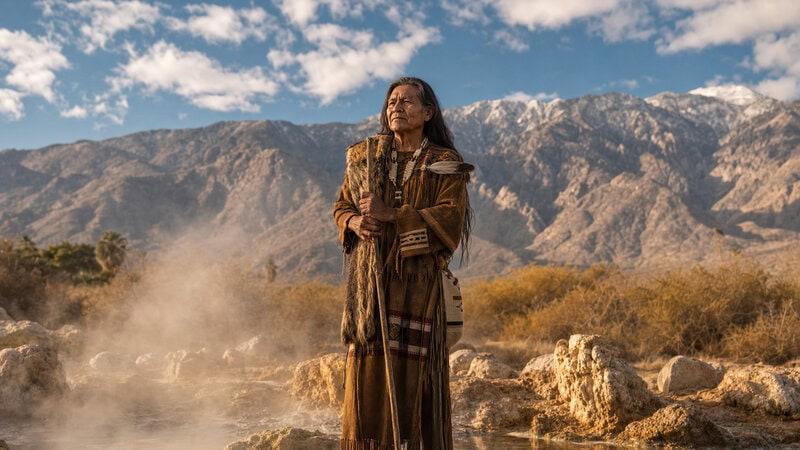

In the winter of 1850, imagine stumbling out of the Sonoran Desert into a valley where steam rises from the earth itself — where water, against all geological logic, boils up through cracked stone in the shadow of mountains that touch ten thousand feet. A traveler arriving at those springs might have felt he had found something. He had not. He had simply arrived somewhere people already were.
The Springs Nobody Could Own — Except the People Who Already Did

The Agua Caliente Band of Cahuilla Indians had been living in and around the Coachella Valley for at least a thousand years before a single Hollywood celebrity ever checked into a Palm Springs hotel. The springs that Spanish explorers would eventually label Agua Caliente — hot water — already had a name. The Cahuilla called them Se-Khi: boiling water. They were not a recreational curiosity. They were sacred ground, woven into the cosmology, ceremony, and daily life of a people who had built one of the most sophisticated desert civilizations in North America.
This is the history of Palm Springs that tends to get compressed into a polite paragraph before the story pivots to Frank Sinatra. That compression is costly. It flattens a layered, complicated, and still-unfolding story into backdrop, when in fact it is the whole point. To understand how this desert outpost became a glamour capital — and what that transformation required — you have to begin not with the stars but with the people who named the springs.
Before the Stars: The Cahuilla World That Shaped the Valley

The Cahuilla people have inhabited the San Jacinto Mountains, the Santa Rosa Mountains, and the Coachella Valley floor for somewhere between two thousand and three thousand years. The persistent outsider assumption that desert landscapes are inherently empty and therefore unclaimed is not an honest reading of the land. It is a colonial convenience. The Cahuilla built a civilization that worked with the desert rather than against it.
They cultivated mesquite, harvested agave with precise seasonal timing, managed irrigation along arroyos, and organized their society into clans with carefully mapped territorial stewardship. Each clan held responsibility for a specific portion of the landscape — its plants, its water sources, its hunting grounds — in a system of ecological accountability that preceded any Western notion of land management by centuries. The fan palms that line the canyons around modern Palm Springs are not accidental. They are, in large part, the result of generations of Cahuilla tending. Every Instagram-worthy grove of native palms is a living artifact of indigenous horticulture.
The sacred geography of the Cahuilla world was no less detailed than its practical one. Tahquitz Canyon — still bearing its Cahuilla name on every modern map and street sign — was home to the powerful spirit Tahquitz in Cahuilla cosmology. This was not myth kept politely separate from the landscape; it was embedded in it, inseparable from the canyon walls, the water, the specific play of light through the palms. The land was not property. It was identity.
Contact, Colonization, and the Long Shadow of the Mission Era

Spanish missionaries reached the edges of Cahuilla territory in the late eighteenth century. The remoteness of the desert offered partial insulation from the worst violence of the mission system, but only partial. European diseases — smallpox, measles, influenza — do not respect geography. Epidemics moved through Cahuilla villages with devastating force, collapsing populations that had no inherited immunity to illnesses the Spanish carried as casually as their theology.
The Mexican rancho period, following Mexican independence in 1821, introduced new pressures. Cahuilla leaders like the war captain Juan Antonio navigated a volatile political landscape with considerable skill, alternately allying and resisting as circumstances demanded, working to preserve what remained of their land base against a succession of colonial powers that viewed indigenous territory as real estate awaiting redistribution.
American annexation after the Mexican-American War and the Treaty of Guadalupe Hidalgo in 1848 — followed almost immediately by California statehood in 1850 — accelerated the pressure dramatically. Where Spanish and Mexican administrators had been, at least in theory, obligated to acknowledge some degree of indigenous land rights, American settlers arrived with a simpler philosophy: the land was available, and the people on it were an obstacle rather than a civilization.
Then came the wound that would define Palm Springs history for the next century and a half. In 1876, the federal government granted a railroad right-of-way through the valley to the Southern Pacific Railroad, dividing the land into alternating checkerboard sections. The Agua Caliente Band was assigned the odd-numbered sections; the railroad and, eventually, private developers held the even-numbered ones. The result was a legal and logistical tangle of almost comic complexity — a resort town that would develop with tribal land and non-tribal land interwoven like a patchwork quilt across the valley floor.
The Reservation Era: Protection That Was Also Reduction
The formal establishment of the Agua Caliente Indian Reservation in 1876, expanded in 1896, was framed in the language of federal protection. In practice, it represented a dramatic compression of the band’s original territory into a fraction of the land they had stewarded for millennia. The allotment philosophy that followed — rooted in the Dawes Act of 1887 — assigned individual parcels within the reservation to individual tribal members, parcels held in trust by the federal government and subject to Bureau of Indian Affairs approval for any lease or development.
What this meant, concretely, was that as Palm Springs grew into a fashionable resort destination through the early and middle twentieth century, the boom was happening on land the federal government was simultaneously holding on behalf of Cahuilla allottees who could not freely control it. Hotels were built on leased tribal land. Streets were laid over Cahuilla gathering grounds. The tribe was both landlord and dispossessed — owning the ground beneath a glamour economy from which they were substantially excluded.
The surreal inequality of mid-century Palm Springs deserves to be held clearly in mind: celebrity-filled restaurants and poolside bars operated on land leased from Cahuilla allottees, while tribal members were often barred from those same establishments by the segregation norms of the era. The ground was theirs. The door was not.
The legal battles that followed through the 1950s and 1960s were fought by Agua Caliente leaders — including tribal chairman Vyola Olinger, who pressed Congress relentlessly — to gain meaningful control over their own allotments. The campaign eventually produced landmark legislation enabling 99-year leases and, over time, movement toward fee-simple ownership rights. It was a genuine victory, but it arrived after decades of legally sanctioned exclusion from the prosperity generated on Cahuilla land.
Hollywood Arrives — On Cahuilla Ground

By the 1930s and 1940s, the desert air that had originally drawn tuberculosis patients to Palm Springs had been rebranded into something far more glamorous: escape. The dry heat, the mountain backdrop, the three-hour drive from Los Angeles, and the informal understanding that studio publicity departments did not follow celebrities into the desert made the Coachella Valley irresistible to Frank Sinatra, Bob Hope, Marilyn Monroe, Liberace, and the wider constellation of mid-century American celebrity culture.
Spanish Colonial Revival architecture, and later the clean geometric lines of Mid-Century Modern design, gave Palm Springs its signature visual identity. But as these styles were celebrated, photographed, and eventually listed on the National Register of Historic Places, Cahuilla place names, story sites, and ceremonial gathering grounds were being simultaneously paved over or rebranded as scenic amenities. Tahquitz Canyon became a hiking destination. The sacred became a backdrop for leisure photography.
The layered irony embedded in Palm Springs history is this: the resort town’s glamour and the tribe’s dispossession were not parallel stories running alongside each other. They were the same story, told from opposite ends of the transaction. The celebrities were guests. The Cahuilla were, in a precise legal sense, the landlords — just landlords whose federal trustees had spent decades limiting what they could do with their own property.
Today, visitors arriving at the Renaissance Palm Springs Hotel at 888 Tahquitz Canyon Way are standing on one of the most historically layered addresses in the American West. The street name itself — Tahquitz Canyon Way — is a surviving whisper of Cahuilla cosmology embedded in the civic infrastructure of a city that built itself on Cahuilla land. The Renaissance Palm Springs Hotel, one of the city’s premier in-town conference and lodging properties, adjoins the Palm Springs Convention Center in a district where the relationship between tribal land and resort development has always been more intimate than the polished architecture suggests.
Reclamation: How the Agua Caliente Band Rewrote the Ending

The legal and political victories the Agua Caliente Band pursued from the 1960s onward did not simply restore what was lost — nothing could do that — but they created the conditions for something rarer in American indigenous history: negotiating from a position of genuine leverage. Because the tribe held land within the city rather than at its margins, they had a seat at the table that many other tribes had been geographically denied.
The tribe developed tribal-owned commercial real estate, casino enterprises, and cultural institutions that fund sovereignty on their own terms. The Agua Caliente Cultural Museum — currently undergoing significant expansion — and the tribe’s management of Tahquitz Canyon and the Indian Canyons as tribal enterprises represent something meaningful: the reframing of tourism around Cahuilla history rather than despite it. Visitors who take guided canyon tours led by tribal members receive interpretation from the community whose ancestors shaped every rock formation and water source in view.
The Agua Caliente Band today is one of the most economically powerful tribes in California, with significant land holdings throughout Palm Springs — including parcels beneath or adjacent to major hotels, shops, and the convention district along Tahquitz Canyon Way. The checkerboard arrangement designed as a tool of dispossession became, over generations of legal struggle, an unexpected instrument of endurance.
But endurance is not the same as resolution. Repatriation of cultural objects continues. Water rights in the Coachella Valley aquifer remain the subject of active negotiation — and in a desert, water rights are not an abstract legal matter; they are existential. The quieter work of keeping the Cahuilla language alive, of passing ceremony from one generation to the next in a city that still sometimes markets itself as if history began with a celebrity poolside photograph, continues without fanfare and without guarantee.
What This History Means When You Visit Palm Springs Today
Understanding the history of Palm Springs means recognizing that the hot springs, the canyon trails, the native palm groves, and the name carved into every street sign along Tahquitz Canyon Way are not decorative details. They are the residue of a pre-colonial world that was never fully extinguished — only managed, leased, fought over, partially erased, and partially reclaimed.
Whether you are attending a conference at the Renaissance Palm Springs, hiking the Indian Canyons, or watching the Palm Springs Aerial Tramway rise toward the San Jacinto ridgeline, the experience is richer and more honest when you carry the Cahuilla story as context rather than footnote. The landscape you are moving through was interpreted, named, and tended by people who are still here, still naming it.
Three ways to engage with that history directly
- Visit the Agua Caliente Cultural Museum. It is the most direct way to engage with Cahuilla history and the tribe’s ongoing stewardship of their cultural heritage, and its current expansion will significantly deepen what the museum can offer visitors.
- Book guided tours of Tahquitz Canyon and the Indian Canyons through tribal enterprises. Interpretation delivered by members of the community whose ancestors shaped the landscape is categorically different from a trailhead placard.
- Support tribal-owned businesses deliberately. The reclamation story is not only a legal and political one. Every dollar that flows through tribal enterprises is part of how a nation sustains itself on its own terms.
Those steaming springs — Se-Khi, boiling water — are still there beneath the city. Still warming the ground. Still named in the Cahuilla language by the people who never entirely left. Palm Springs is not just a place to escape to. It is a place with a story deep enough to stay with you long after the desert heat fades and you have gone back to wherever you came from.

 Arabic
 French
 Spanish
 Portuguese
 Deutsch
 Turkish
 Dutch
Dutch
 Italiano
 Russian
 Romaian
 Portuguese (Brazil)
 Greek
Greek