


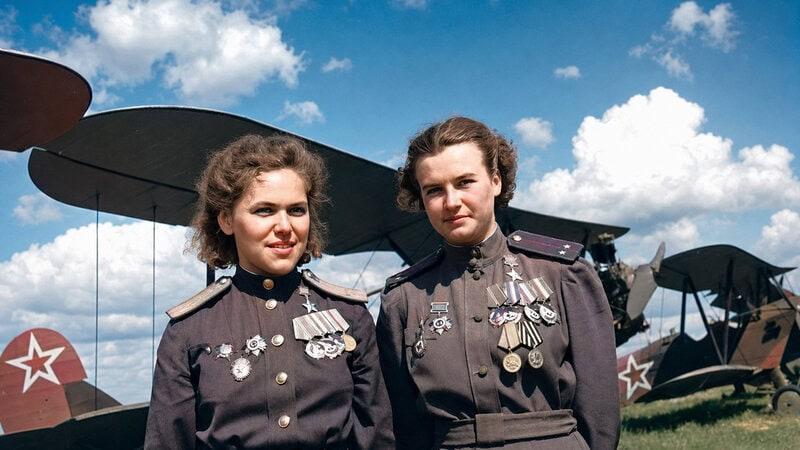

A German soldier on the Eastern Front in 1942 might spend the whole night straining his ears for the drone of engines — the reliable, terrifying warning that Soviet aircraft were overhead. He would hear nothing. Then, out of the black, a sound like a broomstick cutting the air, a soft rushing whisper through wire and canvas. Then the world came apart around him.
The Sound Before the Bombs Fell

By the time that soldier understood what he had heard, the plane was already gone — gliding back into darkness without a single engine beat to betray it. The bombs had been released on the final approach with the throttle feathered and the propeller barely turning, the aircraft descending in near-perfect silence. German troops who survived these raids began talking about the sound: not roaring engines, not the mechanical clatter of a modern warplane, but a low, eerie whoosh, like something supernatural moving through the night. They called it the sound of a witch’s broomstick. And so they named these pilots Nachthexen — Night Witches.
The name was meant to explain the inexplicable, and in giving it, German soldiers made an unwitting admission. These were young Soviet women flying open-cockpit biplanes from the 1920s against the most technologically advanced air force on earth — and they were succeeding. German command took them seriously enough that any Luftwaffe pilot who shot one down was reportedly awarded the Iron Cross. The women flying those canvas-and-wood trainers had become, by any measure that mattered, a genuine threat.
Who Were They? Building a Regiment from Nothing

The unit at the center of this story is the 588th Night Bomber Regiment, later redesignated the 46th “Taman” Guards Regiment — one of the Soviet military’s highest unit distinctions. What made this regiment unlike any other in the history of aerial warfare was absolute in its scope: every pilot, every navigator, every mechanic, every ground crew member was a woman. From the moment a plane left the runway to the moment it returned and was refueled and rearmed, no male hands were involved.
The women who filled those roles came from across Soviet society. University students who had been studying literature or engineering the previous spring. Sports aviators who had spent their weekends at flying clubs during the 1930s, when the Soviet state had actively encouraged young citizens — women included — to take to the air. Factory workers. Schoolteachers. Many had learned to fly through the government’s network of aero clubs and had developed real skill long before the war began.
When Germany launched Operation Barbarossa in June 1941, tearing through the Soviet western frontier in the largest land invasion in history, thousands of women volunteered within days. They did not want support roles. They wanted to fight. The regiment they eventually formed became, as the National WWII Museum documents, one of the most decorated Soviet air units of the entire war — a distinction earned in the face of institutional skepticism that bordered on contempt. Male commanders questioned whether women could endure the physical and psychological demands of combat flying. The regiment answered that question mission by mission, across four years and more than 24,000 sorties, until no one with access to the operational record could ask it seriously.
The organizing force behind the regiment was Marina Raskova, already a celebrated aviator and the Soviet Union’s most famous female pilot before the war. She petitioned Josef Stalin directly for permission to form all-female combat aviation units and received it in October 1941. Three regiments were ultimately created; the 588th was the one that would fly through the entire war and earn the Guards designation on the far side of it.
The Planes: Flying Antiques Into a Modern War

The aircraft the Night Witches were given did nothing to signal official confidence. The Polikarpov Po-2 was a two-seat biplane, fabric stretched over a wooden frame, designed in the late 1920s as a crop duster and basic trainer. It flew at speeds that modern WWII fighter aircraft could barely sustain without stalling. It had no radar, no radio navigation, and no heating system in the open cockpit. In the early period of operations, the aircraft carried no parachutes — the design had nowhere to stow them, and they were not prioritized for a regiment the high command barely believed in. The pilots navigated by starlight and landscape features, holding hand-drawn maps against their knees in the dark and matching the shadows below against what they remembered from pre-mission briefings.
At thirty below zero over the Russian steppe, the cold in an open cockpit was not discomfort — it was a physiological assault. Frostbite was routine. The bomb load was small by the standards of the war, carried in racks under the lower wings. Everything about the Po-2 announced that it was the aircraft no one wanted, issued to a regiment that male commanders did not expect to accomplish much.
What those commanders failed to see — and what the Night Witches understood with growing clarity — was that the Po-2’s apparent weaknesses were a tactical gift. German radar systems and anti-aircraft gun-sight mechanisms were calibrated for targets moving at speed. The Po-2 flew so slowly and so low that these systems consistently overshot it. The plane was too slow to be tracked effectively by the technology designed to kill it. The women had been handed an antique and discovered it was, under specific night-combat conditions, extraordinarily difficult to intercept. Institutional dismissal had inadvertently produced a tactical edge.
The Tactic: Silence as a Weapon

The bombing method the regiment developed was elegant in its simplicity and nearly suicidal in its demands on nerve. Planes flew toward a target in small groups, typically three aircraft. The first two approached with engines running, drawing searchlights and anti-aircraft fire, pulling as much defensive attention as possible. In that window of chaos, the third pilot feathered the throttle. The engine quieted. The propeller slowed. The plane became a glider, descending without sound toward the now-illuminated target while the guns tracked the other two.
In those final seconds of the approach — no engine, no altitude margin, no ability to abort — the only sound was the wind moving through the biplane’s bracing wires. Witnesses described it again and again: a low, rushing whisper. German soldiers lying in trenches, ears trained for the mechanical roar of engines, heard instead something that bypassed rational processing and reached older instincts. The bombs were already falling before searchlights could swing to find the third plane, and by the time they did, the pilot had restarted the engine and was climbing back into darkness.
Flying a gliding approach in total darkness demands an exact feel for altitude that instruments alone cannot supply. The pilots who made this choice — voluntarily, night after night, for four years — were exercising a quality for which “bravery” feels insufficient. It was closer to a sustained, disciplined refusal to imagine the alternative.
The operational record that method produced is formidable. Over the course of the war, the regiment flew more than 24,000 missions, striking Nazi supply depots, fuel stores, river crossings, troop concentrations, and munitions caches across the full length of the Eastern Front, from the Caucasus to the Baltic.
The Human Cost: Nights Without Sleep and the Friends They Lost

The tempo at which the regiment operated was relentless in a way that statistics struggle to convey. On peak operational nights, individual pilots flew eight, ten, sometimes as many as eighteen sorties before dawn. Between missions, they caught minutes of rest on the ground while their aircraft were rearmed and refueled — then climbed back in and went again. The cumulative exhaustion over months and years of this schedule was a form of slow erosion, each night taking something that did not fully return by the following evening.
Pilots died. Dozens of women were killed over the course of the war. Because parachutes were frequently unavailable in the early period — not prioritized for a regiment the high command viewed skeptically — a plane on fire often meant no way out. The regiment developed its own rituals for loss. One reported tradition held that when a pilot or navigator was killed, her bunk was left untouched for one night before being folded away: a few hours of acknowledgment before operational necessity required moving forward.
What held the regiment together through that attrition was partly ideology and national identity in a war that genuinely threatened the Soviet Union’s survival. But it was also something more immediate: the bond between a pilot and her navigator, sharing a two-seat cockpit in total darkness, dependent on each other with a completeness that most human relationships never approach. Trust, in that context, was not a sentiment. It was the difference between coming home and not.
Recognition: What the Record Actually Shows

By the end of the war, the 588th had earned the Guards designation and been renamed the 46th “Taman” Guards Night Bomber Aviation Regiment. Twenty-three members of the regiment received the title Hero of the Soviet Union, the highest honor the state could bestow. They had proven themselves in the hardest available metric: sustained combat effectiveness over four years against a sophisticated enemy that feared them enough to make shooting them down an occasion for decoration.
The regiment’s achievement sits in an important context within Soviet aviation more broadly. The Soviet Union mobilized women in combat roles at a scale no other nation matched during the Second World War, driven partly by ideological commitments to gender equality and partly by the staggering losses the Red Army suffered in the war’s early years. The Night Witches were the most operationally significant product of that mobilization — but they existed within a wider, and still underexplored, tradition of Soviet women in uniform.
Why the Story Disappeared — and Why It Came Back
In the West, the history largely vanished after 1945. Cold War politics created a systematic tendency to ignore or minimize Soviet military achievements, and the contributions of women in wartime were already undervalued across all national histories. For decades, the story of the Night Witches existed primarily in Russian-language sources. English-speaking readers encountered fragments at best.
The revival of serious English-language attention to Soviet female pilots in World War II began in earnest in the 1980s and accelerated as Cold War frameworks lost their grip on Western historical writing. What researchers found when they reached the primary sources — Soviet operational records, memoirs, and interviews with surviving veterans — confirmed and in some respects exceeded what the fragmentary Western accounts had suggested. The 24,000-sortie figure. The bomb tonnages. The Iron Cross policy. The individual combat records of pilots like Nadezhda Popova, who flew more than 850 missions, and Mariya Smirnova, who flew more than 900.
The scholarship has continued to grow. For readers who want to engage seriously with the historical evidence and its complexities, the sourced academic discussion around Soviet female pilots now extends well beyond the most famous unit, examining the organizational decisions behind all-female regiments, the experiences of women who served in mixed units, and the postwar treatment of female veterans in Soviet society — a history that is, in places, considerably darker than the wartime record.
Why It Still Matters: History Written in Darkness
Return, for a moment, to that German soldier on the Eastern Front. He heard a broomstick through the dark. He heard, though he could not have known it, a pilot making a choice — throttle feathered, engine silent, altitude bleeding away, target below — that she had made the night before and would make again the night after, while her navigator read the ground by starlight and the feel of the air. That choice, multiplied across four years and tens of thousands of missions, produced a military record that any historian of aerial warfare must account for.
The Night Witches matter not only as an inspiring story, though they are that. They matter as a concrete historical fact: every institutional argument that women could not perform effectively in direct combat roles was being actively and quantifiably disproved, night by night, over the Eastern Front, from 1942 onward. The barriers were not about capability. The record makes that plain. The proof was written in mission counts and bomb tonnage and the decorations awarded to the pilots who finally brought some of those slow, silent biplanes down.
What survived every attempt to minimize or forget the story was the name itself. Nachthexen — coined by men who heard broomsticks in the dark and reached for the supernatural because the real explanation was too unsettling. A slur that became, in the hands of everyone who learned what it actually meant, something close to the opposite. The Night Witches took the name their enemies gave them and made it mean courage, ingenuity, and what happens when you give underestimated people obsolete tools and impossible odds and discover, after four years and more than 24,000 missions, that you have made a catastrophic error of judgment.
That soldier never knew what he was hearing. He was listening to history being made in the dark, one silent approach at a time, by women who had decided that impossibility was not, in the end, a reason to stay on the ground.

 English
 Arabic
 French
 Spanish
 Portuguese
 Deutsch
 Turkish
 Dutch
Dutch
 Italiano
 Romaian
 Portuguese (Brazil)
 Greek
Greek