


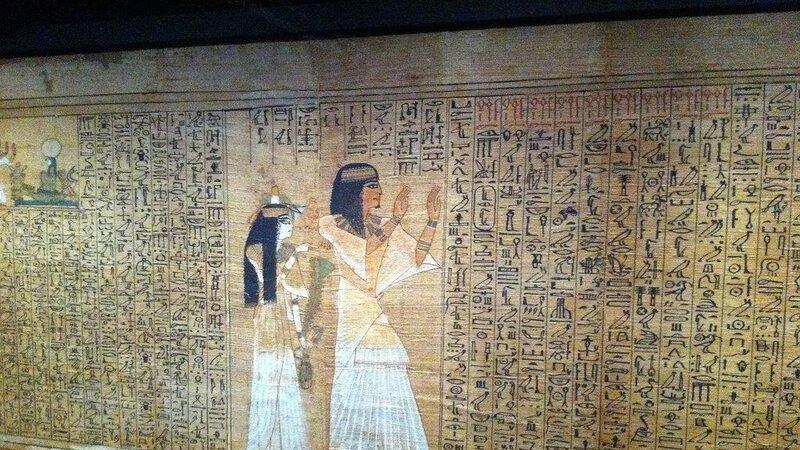

The brush moved slowly, the way it always does when something irreplaceable is at stake. Dust gave way to papyrus — ancient, amber-colored, improbably intact — and then to ink, still dark after roughly 3,500 years in the Egyptian earth, carrying spells for a journey no living person has ever completed.
A Scroll That Shouldn’t Exist

The excavation site at Tuna el-Gebel, in central Egypt, had already delivered the unexpected: a burial complex that no surviving historical record had marked, sealed away in darkness and dry desert air. Mummies lay in painted sarcophagi. Stone statues crowded the chambers. Burial goods of varying richness suggested an entire community of the dead, arranged by rank and ritual, waiting in a tomb complex the modern world had simply forgotten existed. And then, nested among it all, the scroll.
Archaeologists confirmed the papyrus as a Book of the Dead — one of ancient Egypt’s most storied ritual objects, a text whose very name conjures mystery and museum glass. Which raises an obvious question: if the Book of the Dead is already famous, already translated, already filling gallery cases from Cairo to London, why does every newly discovered copy feel like a revelation?
The answer is both simple and strange. It was never one book at all. And the copies still being found — in desert tombs, in museum storerooms, in fragments that have sat unexamined for a century — keep rewriting what we thought we understood about how an entire civilization negotiated the idea of death.
What the Book of the Dead Actually Is (and Isn’t)

Start with the label itself, because it misleads almost immediately. “Book of the Dead” is a 19th-century European invention, coined by the German Egyptologist Karl Richard Lepsius in 1842 to describe a collection of texts he was cataloguing. The ancient Egyptians had their own name for it: Reu nu pert em hru, roughly translated as “The Book of Coming Forth by Day.” Not a book of the dead — a manual for the living dead. A guidebook. A survival kit for a journey through the underworld.
And crucially, it was never a fixed scripture. The collection contains around 200 individual spells, but no single papyrus ever carried all of them. Every copy was commissioned, tailored, personal. A wealthy official might order a hundred spells inscribed on fine papyrus, accompanied by lavish vignettes — illustrated scenes in vivid pigment showing the soul navigating the perils of the Duat, the Egyptian underworld. A middle-class artisan’s family might afford a shorter roll, selecting only the spells they considered most essential, the ones they believed would matter most when their loved one faced what came next.
What came next, according to the spells, was elaborate and terrifying. The deceased had to move through a landscape populated by serpents, gatekeepers, and divine tribunals — passing correctly through numbered gates, reciting the right words at the right moments, knowing the secret names that unlocked passage. The journey culminated in the Hall of Two Truths, where the heart of the dead was placed on a scale and weighed against the feather of Ma’at, the goddess of cosmic order and truth. A heart heavier than the feather — burdened by wrongdoing — would be devoured by Ammit, a chimeric beast with a crocodile’s head, a lion’s forequarters, and a hippopotamus’s hindquarters. To pass was to achieve eternal life. To fail was to cease entirely.
The Book of the Dead didn’t emerge fully formed. It evolved over more than a millennium from earlier funerary traditions — the Coffin Texts of the Middle Kingdom, painted inside wooden sarcophagi, themselves descended from the Pyramid Texts carved into the stone walls of Old Kingdom royal tombs, some dating back more than 4,000 years. The Tuna el-Gebel scroll is a living link in that chain: a moment in an evolving conversation between the living and the dead, frozen in papyrus and ink.
Inside the Lost Cemetery at Tuna el-Gebel

Tuna el-Gebel was not an entirely unknown place before this excavation. The region had long been recognized for its animal catacombs — vast underground galleries where ibises and baboons sacred to the god Thoth were mummified and interred by the millions — and for the elaborate tombs of wealthy officials from the later periods of Egyptian history. But this particular cemetery was different: hidden, its location lost, its existence unrecorded in any document that had survived to the modern era.
When archaeologists broke through into the complex, the variety of what they found was telling. Mummies in painted sarcophagi indicated people of some means. But other burials were simpler, suggesting this was not an exclusively elite necropolis. People of different social ranks had apparently been laid to rest here together — which makes the presence of the Book of the Dead scroll both expected and significant. Expected, because anyone buried with care in ancient Egypt might aspire to the ritual protection the text offered. Significant, because it raises immediate questions about who commissioned it, who could read it, and who believed strongly enough in its power to ensure it traveled into the tomb.
The scroll had not been stored carelessly or displayed as decoration. It was buried deliberately, placed with the dead to fulfill its exact ritual purpose. The spells were not meant for the living to read — they were meant to activate in the dark, to speak themselves in the silence of the tomb, guiding a soul through obstacles that scribes had been describing, refining, and arguing about for thousands of years.
What archaeologists mean when they call a find like this “lost” is precise and important. The texts of the Book of the Dead were not unknown. But this physical community — this specific gathering of mummies and sarcophagi and statues, this particular scroll among them — had existed entirely outside the historical record. No one knew it was there. Its discovery adds not just an artifact but a context: a place, a population, a set of relationships between the dead that no amount of museum study could have supplied.
Why Provenance Changes Everything

Not every copy of the Book of the Dead arrived in scholarly hands through careful excavation. The 19th and early 20th centuries were not careful times for Egyptian antiquities. Scrolls moved through antiquities dealers and informal networks before reaching European institutions, stripped of the tomb context, associated objects, and skeletal remains that give any funerary text its full meaning. A scroll obtained without provenance helped decode the spells for generations of scholars — but it arrived as an orphan, severed from the burial it was made to serve.
One notable example: a copy was discovered in Luxor in 1888 by Egyptians trading in illegal antiquities, and was subsequently acquired by E. A. Wallis Budge, as he described in his autobiography By Nile… — arriving in scholarly hands without the burial context that would have made it fully legible.
The Tuna el-Gebel scroll arrives with everything intact: its burial context, its associated artifacts, its physical community of the dead. The scientific value of a properly excavated copy is immeasurably greater than one that passed through unrecorded hands, precisely because archaeologists know where it was, what surrounded it, and who may have commissioned it. Every scroll that moved through an antiquities dealer before reaching a museum lost the context that makes it fully legible. Every properly excavated copy gives that context back.
This distinction matters more now than it once did. Modern excavation techniques — stratigraphic recording, environmental sampling, isotopic analysis of human remains — can extract from a tomb information that earlier generations of archaeologists never thought to collect. The scroll is only one data point in a much larger picture that the site at Tuna el-Gebel is still revealing.
Fragments Hiding in Plain Sight

Some of the most striking Book of the Dead discoveries have required no excavation at all — only patience, expertise, and a willingness to open boxes that haven’t been opened in decades. In museum storerooms across Europe and North America, fragments of ancient papyrus have been identified by visiting scholars who recognized, sometimes at a glance, that what had been labeled vaguely or filed without analysis was actually part of a Book of the Dead scroll.
This keeps happening because earlier excavations moved fast and institutions received enormous quantities of material. Fragments were boxed, tagged with approximate descriptions, and shelved — sometimes for generations. A piece of papyrus with a few lines of hieratic script might sit under fluorescent lights for fifty years before someone with the right expertise happened to look at it properly.
When a scholar does make an identification, the work that follows is painstaking. Matching handwriting styles, spell sequences, and even the physical texture of papyrus fibers can connect fragments to known manuscripts — sometimes reuniting pieces that were separated at excavation and have since traveled to institutions on different continents. It is a jigsaw puzzle measured in millennia, and every piece changes the picture.
Each new physical copy, whether from an active dig or a rediscovered museum shelf, adds data points to a text that existed in hundreds of versions. Scholars can begin to map which spells were most prized in which regions and periods, how scribal fashions shifted over centuries, and what the choices made in each copy reveal about the person — and the family, and the scribe — who produced it.
Why Each Copy Rewrites What We Know

Because no two copies of the Book of the Dead are identical, each new scroll carries the potential to shift understanding in concrete ways. Regional scribal traditions left fingerprints in word choices and spell sequences. The timeline of which spells rose or fell in popularity is still being mapped. Linguistic analysis of newly found copies sometimes reveals variant wordings that change the meaning of passages scholars believed they had long since settled.
The Tuna el-Gebel find sharpens a particular tension in the scholarly literature. The cemetery’s apparent mix of social classes raises questions about access that Egyptologists are still working through. Was a Book of the Dead scroll, by this period roughly 3,500 years ago, still a luxury item available only to the wealthy? Or had the tradition broadened, becoming something that middle-rank Egyptians could commission in shorter, more affordable versions? The scroll found here, examined alongside the burial goods surrounding it, may offer new evidence for that debate.
Egyptologists estimate that hundreds of copies of the Book of the Dead once existed across ancient Egypt. Only a fraction have survived. Every excavation — and every storeroom reckoning — potentially adds a page to a book that was always, in truth, a library: plural, evolving, personal, and stubbornly resistant to the idea that any single version could speak for all the dead.
What the Dead Are Still Telling Us
The excavation at Tuna el-Gebel is far from finished. Archaeologists have indicated that the site remains largely unexplored, and the presence of a Book of the Dead scroll — deliberately placed, ritually purposeful — suggests more may lie ahead: additional papyri, further ritual objects, perhaps more chambers in a cemetery that surprised everyone simply by existing. Each season of excavation carries the possibility of another find that reshapes the picture.
Beyond the desert, the pace of discovery is accelerating through technology. Multispectral imaging can reveal text invisible to the naked eye on damaged papyrus. AI-assisted fragment matching is beginning to connect pieces across museum databases that span continents. Lost copies are being found in drawers as much as in sand — the archive of the ancient Egyptian afterlife expanding not through new burials but through new attention paid to what was already, quietly, in our keeping.
Return, finally, to the scroll itself. Roughly 3,500 years ago, someone sat with a scribe — perhaps negotiating over which spells to include, perhaps trusting the scribe’s expertise entirely — and a papyrus was prepared, rolled, and placed in the dark beside someone they loved. The spells were not decoration. They were instructions. They were meant to speak.
Archaeologists just gave them a new audience. And the question that lingers, as more copies continue to surface from tombs and storage boxes and digital databases, is not simply what the Book of the Dead says — but what it means that the ancient Egyptians were still arguing over, still revising, still personalizing their vision of eternity right up until the last scroll was sealed in the last tomb. The answer is still being excavated. It may be in the next box opened in a museum storeroom. It may be in the next chamber the archaeologists at Tuna el-Gebel have not yet reached.

 English
 Arabic
 French
 Spanish
 Portuguese
 Deutsch
 Turkish
 Italiano
 Russian
 Romaian
 Portuguese (Brazil)
 Greek
Greek