


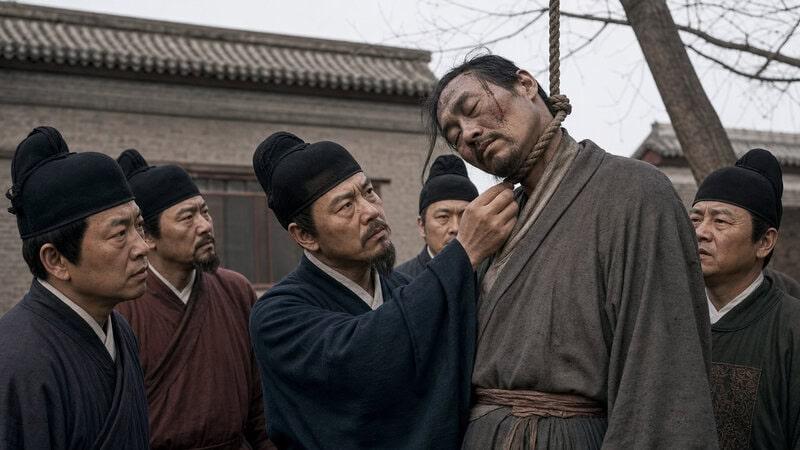

The landlord’s body hangs in a Beijing courtyard sometime in the fifteenth century, and every official on the scene is ready to write the word suicide and go home. Every official, that is, except one — a sharp-eyed government official who keeps staring at the bruising, the angle of the rope, the too-convenient silence of the neighbors, and refuses to stop asking questions until the geometry of the death starts telling a different story.
Meet Tang Fan: A Detective Who Orders Noodles First

That official is Tang Fan, and he is not what you expect from a detective. He holds no sword. He commands no soldiers. His most celebrated skill, as often as not, is identifying the best bowl of noodles in whatever neighborhood he happens to be investigating. But behind the food obsession and the unhurried manner is a mind that treats every unexplained death as a contract with the truth — one that cannot be closed until every physical detail has been accounted for, every witness’s silence explained, every convenient story tested against the evidence a body actually leaves behind.
Tang Fan is the hero of The Sleuth of the Ming Dynasty, a 2020 Chinese television series that became a quietly addictive phenomenon for viewers willing to meet it on its own terms. The show is doing something more than entertaining its audience with a charming investigator and his brooding partner. Threaded through every case is a historical argument the series never bothers to announce aloud: that China had systematic, codified, intellectually rigorous forensic criminal investigation centuries before Victorian England produced Sherlock Holmes and decided it had invented the detective.
Jackie Chan, a BL Novel, and the Fourteenth Year of Chenghua

The series was produced by Jackie Chan and is based on a novel by Meng Xishi. Its Chinese title — Chenghua Shisi Nian, meaning “The Fourteenth Year of Chenghua” — pins the story to an exact moment in imperial time: the reign of the Chenghua Emperor, who ruled the Ming Dynasty from 1464 to 1487. That precision is not mere decoration. It grounds the show in a specific political climate, a specific bureaucratic culture, and a specific flavor of court intrigue and street-level anxiety that shaped how crimes were committed, concealed, and occasionally solved.
Starring Darren Chen as Tang Fan and Fu Meng-po as the guardsman Sui Zhou, the series builds its drama around men who by all the logic of Ming social hierarchy should never occupy the same room. Tang Fan is senior, educated, and nominally above the dirty work of physical investigation. Sui Zhou is an officer of the Jinyiwei — the emperor’s feared imperial guard, an institution with the power to arrest and interrogate outside ordinary legal channels — which makes him simultaneously indispensable and dangerous to anyone who values due process. Their improvised partnership gives the show a lens that spans the full social architecture of a society whose rigid hierarchies shaped every aspect of justice, from who got investigated to whose death got recorded at all.
The source material began as a BL (boys’ love) novel, a detail that explains the charged, layered chemistry between its male leads and the devoted fandom that followed the adaptation with obsessive attention. The television version navigates that subtext carefully, but the emotional weight between Tang Fan and Sui Zhou — the tenderness beneath the professional partnership, the way each protects the other from dangers the other cannot name — gives the show a depth of feeling unusual in the action-investigation genre. For those new to the series, this primer offers a useful orientation to its world and appeal.
Who Really Policed the Ming Dynasty?

The Ming Dynasty lasted from 1368 to 1644, spanning nearly three centuries and producing a system of governance that was, by the standards of any era, extraordinarily elaborate. What it did not have was anything resembling a modern police force. Crime investigation fell instead to a patchwork of institutions: local magistrates who doubled as judges, senior civil officials who were legally expected to adjudicate disputes and examine evidence as a routine part of their administrative duties, and — hovering over all of it — the Jinyiwei, the imperial guard whose investigative reach extended wherever the emperor’s interest did, which could mean anywhere.
The Jinyiwei’s power was genuinely extraordinary. They could detain suspects, conduct interrogations, and pursue investigations that bypassed the normal channels of Ming legal procedure entirely. This made them both the most effective investigative body in the empire and the most feared — an institution that could protect the law or override it depending entirely on who was giving the orders. Sui Zhou’s position inside that structure is what makes him so valuable to Tang Fan and so morally complicated as a character. He can open doors no civil official can touch. He can also walk through doors that should stay closed.
Tang Fan’s role, meanwhile, mirrors a real feature of Ming governance that modern audiences find surprising: senior administrative officials were not merely paper-pushers. They were expected to conduct or supervise formal examinations of disputed deaths, weigh physical evidence, and render legally binding verdicts. Ancient Chinese criminal investigation was deeply codified, governed by imperial legal codes with roots stretching back to the Tang Dynasty, and that codification meant detective work was not a freelance pursuit — it was a function of the state, embedded in the bureaucracy, carried out by officials who had studied law as part of their standard training.
The Real Science Behind the Stories: Song Ci and the Washing Away of Wrongs

If Tang Fan has an intellectual ancestor, it is Song Ci — a thirteenth-century official of the Southern Song Dynasty who in 1247 produced a text that changed the history of criminal investigation without the Western world noticing for several centuries. Its title, Xi Yuan Ji Lu, translates roughly as The Washing Away of Wrongs, and it is the earliest known systematic forensic science manual in human history.
Song Ci’s text was not philosophical speculation. It was a working government document — required reading for officials across China who were legally obligated to certify cause of death before any criminal case could proceed to prosecution. Its contents were precise, practical, and clinically unsentimental. Song Ci taught investigators how to distinguish drowning from strangulation by examining fluid in the lungs and ligature marks on the neck. He documented how to read decomposition patterns for signs of poisoning. He described how insect activity on a corpse could help establish an approximate time of death. He explained what broken bones look like when the break happened before death versus after. Methods that would not appear in European legal medicine for another three centuries were, in Song Ci’s manual, presented as standard administrative knowledge.
By the Ming period — the world Tang Fan inhabits — forensic examination of a disputed death was not a novelty or an innovation. It was a legal obligation. A body could not simply be ruled a suicide and filed away without a physical inspection conducted in daylight, witnessed by neighbors and local officials, with findings recorded in standardized written forms. The system was imperfect, sometimes corrupted, often put under pressure by powerful families who preferred convenient verdicts, but it existed and it was institutionalized. Ancient Chinese forensic science was not a clever trick performed by exceptional individuals — it was a bureaucratic expectation, and that is what makes Tang Fan feel less like a genius anomaly and more like a man doing his job with unusual commitment.
How Ming Detectives Actually Worked: A 15th-Century Case File

A typical Ming investigation into a suspicious death followed a choreography that would be recognizable to anyone trained in modern evidence-based thinking, even if the tools were different. The body inspection came first: outdoors, in natural light, before decomposition could obscure what violence or accident or disease had written on the flesh and bone. Local officials and neighbors had to be present as witnesses. Every finding was written down in forms whose structure had been standardized precisely to prevent investigators from overlooking or omitting inconvenient details.
Officials were trained — formally, through legal texts including Song Ci’s manual — to look for contradictions between what a scene appeared to show and what the physical evidence actually demonstrated. A rope around a neck that produced bruising inconsistent with the victim’s height relative to the anchor point. Wounds on the hands of someone supposedly killed in a fall. The absence of defensive injuries on someone who supposedly fought back. These are the kinds of details Tang Fan catalogues in the landlord case that opens the series, and they are not the inventions of a television writer looking for drama — they are the categories of observation that Ming forensic procedure was specifically designed to capture.
Ming law also required a confession before a conviction could be formalized, which created one of the system’s darkest pressure points: the temptation toward coercive interrogation when physical evidence alone was deemed insufficient. But forensic evidence could, in the hands of a skilled and determined official, override a false confession or undermine a narrative that had been beaten into a suspect. The tension between evidence and coercion — between the logic of the body and the politics of the verdict — runs through the show with a consistency that feels very deliberate.
Why the West Thinks It Invented the Detective

Edgar Allan Poe introduced C. Auguste Dupin in 1841. Arthur Conan Doyle sent Sherlock Holmes onto Baker Street in 1887. These two figures are routinely framed as the origin point of detective fiction and, by implication, of the deductive investigative method itself — a framing that requires ignoring several centuries of Chinese legal literature and court-case storytelling without appearing to notice the oversight.
Chinese gong’an fiction — stories structured around magistrates and officials solving crimes through evidence, observation, and reasoning — flourished from the Song Dynasty onward. Judge Bao, a historical Song Dynasty official celebrated in legend for his incorruptible intelligence and his ability to see through lies to physical truth, became one of the most enduring cultural archetypes in Chinese literature and drama, a figure so embedded in popular imagination that his stories were still being retold and adapted centuries after his death. He arrived at his conclusions as a cultural hero long before Dupin existed as a concept.
The gap between Chinese forensic and detective tradition and Western awareness of it is partly linguistic — The Washing Away of Wrongs was not translated into a European language until the nineteenth century — and partly the product of an intellectual habit that measured civilization against European norms and rendered non-European knowledge invisible until it could be validated by European discovery. Shows like The Sleuth of the Ming Dynasty are part of a broader wave of Chinese historical drama actively engaged in reclaiming and dramatizing this tradition for audiences inside China and, increasingly, around the world. You can read an early first-impression review of the series here, or find the series listed on MyDramaList and IMDb.
Why Tang Fan Feels So Modern — And Why That Matters
There is a reason Tang Fan has connected with viewers who came to the show with no particular interest in Ming dynasty detectives or ancient Chinese forensic science and left it wanting to read everything they could find on both subjects. It is not just the cases, though the cases are good. It is the character — specifically, the way his love of street food and domestic comfort coexists with his investigative obsession without either quality diminishing the other. He is not a tortured genius or an ascetic crusader. He is a man who takes genuine pleasure in the world and is also, quietly and implacably, unwilling to let a preventable injustice stand. That combination feels startlingly contemporary because it is, in fact, timelessly human.
The show’s care with Ming material culture — the layered bureaucratic hierarchy, the Jinyiwei’s distinctive visual authority, the texture of capital city street life, the way power moves through paperwork and silence and strategic friendship — gives it an authenticity that functions as cultural education delivered without condescension. The TV Tropes entry on the series captures something of how the show manages to be simultaneously a satisfying genre piece and something with more ambition underneath.
What The Sleuth of the Ming Dynasty ultimately smuggles into its drama — through Tang Fan’s refusal to accept the landlord’s death as suicide, through Sui Zhou’s complicated loyalty, through every body inspection and court hearing and bureaucratic confrontation — is a simple and consequential argument. The desire to find truth in the face of power, corruption, and convenient lies is not a modern invention, not an English invention, not a Western invention. It is very old, and it was being practiced with rigor and sophistication in the cities of Ming Dynasty China centuries before the figure of the fictional detective was codified in European literature. That realization, carried lightly inside the frame of a compelling historical drama, is worth more than any number of lectures could deliver.

 English
 French
 Spanish
 Portuguese
 Deutsch
 Turkish
 Dutch
Dutch
 Italiano
 Russian
 Romaian
 Portuguese (Brazil)
 Greek
Greek