


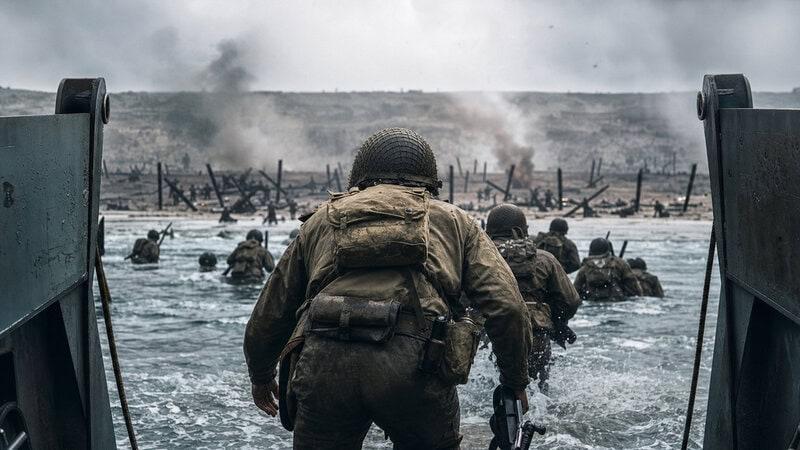

The ramp of a Higgins boat drops, and men are dead before their boots touch the water. In the opening minutes of Saving Private Ryan, Steven Spielberg does something Hollywood had never quite managed before: he makes you feel, in your chest and your stomach, that you are not watching a war — you are somehow inside one. That feeling is not an accident, and it is not entirely fiction.
The First 27 Minutes That Changed War Cinema Forever

On June 6, 1944, the beaches of Normandy swallowed men by the hundreds before any coherent battle had begun. Spielberg’s 1998 film opens with a recreation of that chaos so visceral that D-Day veterans reportedly left theaters shaking, and the U.S. Department of Veterans Affairs arranged counseling support near some screenings. Something in those opening minutes had reached across half a century and touched a nerve that polished, heroic war films never had.
The technique behind the sequence was as deliberate as the history it depicted. Cinematographer Janusz Kaminski altered the camera’s shutter angle and reduced color saturation, stripping away the dreamy motion blur that gives most cinema its comfortable distance from reality. The result carries the grain and jitter of newsreel footage — less like a Hollywood production and more like found footage from a catastrophe. Spielberg also withheld John Williams’s score entirely during the landing, letting the sound design carry the full weight of the sequence: the whip and snap of incoming rounds, the underwater muffle of a drowning soldier, the layered, industrial noise of men being killed at scale. Restraint, it turned out, was more terrifying than any orchestral swell.
The sequence took approximately three weeks to shoot on Curracloe Beach in County Wexford, Ireland, using roughly 1,500 extras, among them Irish Army reservists who formed the mass of bodies surging through the surf. Those 27 minutes have been praised by military historians, contested by armor and equipment specialists, and wept over by the men who were actually there. No stretch of Hollywood footage has been more forensically debated.
Was Saving Private Ryan Based on a True Story?

The question trails the film like a shadow, and the answer is layered. Screenwriter Robert Rodat drew inspiration partly from the Sullivan brothers — five Iowa siblings who all died when USS Juneau was sunk in November 1942 — and more directly from the Niland brothers, four of whom served in the Second World War. With two Niland brothers believed killed on D-Day and a third reported missing in the Pacific, the Army located the surviving brother, Fritz Niland, and removed him from the front lines under a genuine U.S. War Department policy designed to prevent the total loss of a family’s sons. That retrieval became the emotional and institutional seed of the film’s central premise.
The dramatic architecture built on that seed, however, is fictional. Captain John Miller, played by Tom Hanks, never existed. There was no sanctioned combat mission in which a squad of Rangers was sent to locate a single surviving brother behind enemy lines in occupied France. The policy was applied through administrative and military channels, not through a small-unit operation under fire. The film is therefore best understood as historically inspired rather than a literal true story: real policy, real carnage, real geography, with invented characters threading through all of it. The Wikipedia entry on Saving Private Ryan traces the Niland connection and the film’s production history in useful detail.
What the Film Gets Brutally Right About Omaha Beach

Where the film earns its reputation for historical fidelity is not in its plot but in its texture — the moment-to-moment, sensory truth of what Omaha Beach was like for the men who landed there.
Military historians and veterans consistently praised the film’s portrayal of disorganization. Units landed in the wrong sectors. Officers died in the first seconds. Men improvised survival rather than executing any coherent plan. The film’s Dog Green sector — where Miller’s fictional unit comes ashore — mirrors the catastrophic losses suffered by actual elements of the 1st Infantry Division and the 2nd and 5th Ranger Battalions, who faced withering enfilading fire from German MG-42 machine guns positioned in the bluffs above. Those guns were real. That geometry of slaughter was documented in survivor accounts and after-action reports.
The details accumulate with uncomfortable precision. Soldiers drowning under the weight of waterlogged equipment. Medics overwhelmed before they could begin to treat the wounded. Men wandering the surf line in the dissociated state the military then called combat exhaustion — what we would now recognize as acute stress responses. All of this is corroborated in testimony collected from survivors of June 6, 1944. Spielberg and his production team had clearly immersed themselves in that record, and the result functions in places as a forensic reconstruction of the psychological, not merely the tactical, reality of that morning.
Where Spielberg Took Creative License

Creative license is not the same as inaccuracy, but it is worth naming precisely where the film departs from the historical record.
The beach sequence compresses what was actually a fragmented, hours-long series of uncoordinated breakthroughs into a more legible narrative arc. The Bangalore torpedo breach and the flanking movement up the bluff’s draw dramatize processes that unfolded chaotically across a much longer timeframe, driven by scattered, independent actions from many different units and individuals — not by a single squad’s coherent effort. That compression is a storytelling necessity, but it does impose order on a reality that was far messier and more diffuse.
More morally complex is a brief scene in which German soldiers are shot after appearing to surrender. Such killings did occur on D-Day and are part of the documented historical record. The film handles the moment with some ambiguity and visible conflict among the American soldiers. Historical evidence suggests incidents of this kind were more widespread and, in many cases, less emotionally fraught than the film implies — though Spielberg deserves credit for including the moment at all when most war films of the era would have excised it.
The film’s fictional second half, centered on the defense of the town of Ramelle, invites additional scrutiny. Armor historians have contested specific details of the climactic tank battle, and the appearance of air support at a particular moment has been questioned on logistical grounds. These are the kinds of details that specialists notice and general audiences do not — but they are part of why the film occupies a specific, asterisked position among war films that claim historical fidelity.
The Real Omaha Beach: What the Numbers Actually Tell Us

Behind every cinematic choice is a reality that cinema can only approximate. Of the roughly 34,000 American troops who landed on Omaha Beach on June 6, 1944, casualty estimates range from approximately 2,000 to over 4,700 — a figure still debated by historians, partly because the chaos the film depicts made accurate record-keeping impossible in the moment. The number itself refuses to settle into clean fact, which is its own kind of testimony.
More striking still: the German defenders numbered only around 800 troops from the 352nd Infantry Division. A fraction of the attacking force nearly caused Allied commanders to consider abandoning Omaha as a viable landing zone. The actual breakthrough came not through any coordinated command decision but through the independent initiative of small, scattered groups of men who found paths up the draws in the late morning and afternoon — a reality that makes the true story arguably more extraordinary, and more democratically heroic, than any squad-level narrative can fully capture.
The beach today is preserved as part of the Normandy American Cemetery and Memorial, where 9,388 graves stand in rows above the water. No sequence of film — however powerful — can quite do what that number does when you let it land.
How the Film Reshaped Public Memory of the War

Saving Private Ryan was released in July 1998, the same year Tom Brokaw published The Greatest Generation, and the two arrived together into a cultural moment primed for commemoration of the Second World War. The film is widely credited with helping build Congressional momentum for the National World War II Memorial, which opened in Washington, D.C. in 2004. It won five Academy Awards, including Best Director for Spielberg, and permanently reset expectations for what combat cinema is supposed to look and feel like. Every serious war film made since has been measured, consciously or not, against those opening 27 minutes.
Perhaps the most historically significant response the film generated came from veterans themselves. Many men who had never discussed their service began talking after seeing it — describing the film not as entertainment but as the first thing they could point to and say, with something approximating relief, that is what it was like. That response is itself part of the cultural and historical record now, and it is not a small thing.
And yet the film’s emotional power carries its own complication. The moral clarity of Miller’s mission — the clean sacrifice, the legible meaning extracted from catastrophe — sits uneasily beside the messier, more morally complicated history that scholarship continues to surface. The film deepened public feeling about the war even as it may have simplified public understanding of it. Both things are true simultaneously, and neither cancels the other out.
The Verdict: Profound, Partial, and Irreplaceable
For anyone asking whether Saving Private Ryan is historically accurate, the honest answer is: partially and profoundly. Its plot is invented. Its central characters are fictional constructs moving through real geography, real institutional policy, and real historical carnage. But its sensory truth — the texture of what soldiers experienced on that beach on that morning — remains unmatched in Hollywood cinema. Film Forum’s programming notes on the film situate it thoughtfully within Spielberg’s broader body of work and its place in American cultural memory.
Spielberg and Rodat were transparent that they were making a meditation on sacrifice and memory, not a documentary. The fictional frame of Miller’s mission exists to give audiences a human journey through a real historical catastrophe — because catastrophe alone, without a face to follow, is too vast and too abstract to feel at human scale. Among films that attempt to portray the Second World War with both fidelity and feeling, Saving Private Ryan occupies a singular position: not a faithful recreation of specific events, but an emotionally and atmospherically honest portrait of what Normandy actually cost the men inside it.
Its most historically significant achievement may be the simplest one. It made June 6, 1944 impossible to view as a clean, triumphant abstraction. And in doing that — in making the horror real enough to open mouths that had been closed for fifty years — it honored the men of Omaha Beach more faithfully than strict factual accounting alone ever could.

 English
 Arabic
 French
 Spanish
 Portuguese
 Deutsch
 Dutch
Dutch
 Italiano
 Russian
 Romaian
 Portuguese (Brazil)
 Greek
Greek