


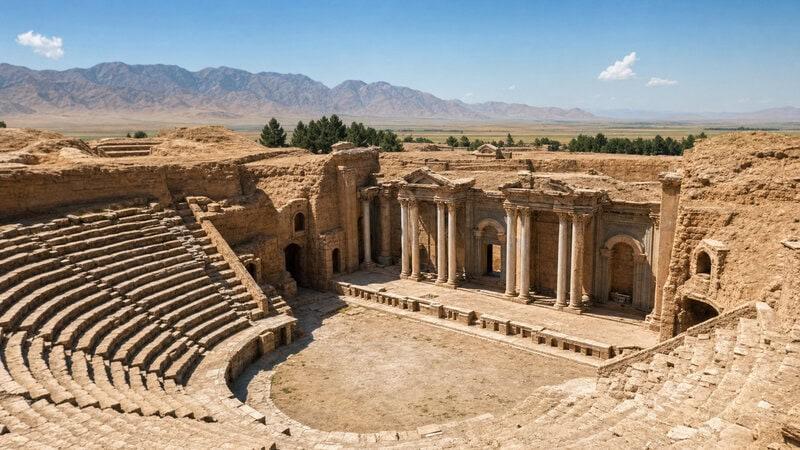

Imagine a Greek theater carved into the sun-baked earth of Central Asia, its stone seats filling with an audience who might have prayed at a Zoroastrian fire temple that very morning — while, on the stage below, actors performed a tragedy in a language most of the surrounding countryside had never spoken before Alexander the Great rode through. This was Bactria: a kingdom so improbable, so geographically remote, and so culturally combustible that it seems less like history than like something a novelist invented on a dare. Yet it was real, it lasted for centuries, and its consequences are still visible every time someone looks at an image of the Buddha.
The Land Where Empires Go to Be Tested

Bactria occupied a fertile basin pinched between two of the ancient world’s most dramatic geographic features: the snow-fanged Hindu Kush mountains to the south, their peaks rising past five thousand meters, and the broad, tawny Oxus River — the modern Amu Darya — rolling along the northern horizon. By Central Asian standards, the land in between was almost generous: well-watered valleys, productive soil, enough grass to feed cavalry horses and enough grain to sustain cities. By any other standard, it was profoundly isolated.
The territory corresponds roughly to northern Afghanistan, the southern fringes of modern Uzbekistan, and slivers of Tajikistan — the same relentlessly contested corridor that would later exhaust Mongol pacification campaigns, absorb British imperial ambitions in the nineteenth century, and eventually break the Soviet army in the 1980s. The terrain does not merely present difficulties; it seems to reject outside control as a matter of geological principle.
But Bactria was already ancient by the time anyone in Greece had heard of it. The region was home to the Bactria-Margiana Archaeological Complex, a Bronze Age urban culture that left behind planned cities and distinctive seals long before Greece had written anything down. Bactria also sat at the spiritual heart of the Iranian plateau’s eastern edge, associated by tradition with the prophet Zarathustra and the emergence of Zoroastrianism. Fire temples burned on the hills around Bactrian cities for centuries before a single Macedonian soldier set foot in the region. This was not a blank canvas waiting for Greek civilization to arrive and enlighten it. It was a fully inhabited, deeply layered world.
Geographically, Bactria functioned as a pivot point of the ancient world. To its west lay the Persian heartland. To its north, across the Oxus, stretched the steppe — the great nomadic highway connecting China to Eastern Europe. To its southeast, beyond the Hindu Kush passes, lay the Indian subcontinent. Whoever controlled Bactria sat at the junction of more civilizations than they could probably count. That position was simultaneously the kingdom’s greatest asset and the source of every pressure that would eventually destroy it.
Alexander Arrives — and Changes Everything

When Alexander the Great swept into Bactria during his Central Asian campaign between 329 and 327 BCE, he encountered something his conquest machine had not often faced: a population that refused to collapse on schedule. Bactrian warriors had long been celebrated in antiquity as formidable fighters — skilled cavalry, dangerous in the kind of broken mountainous terrain where Macedonian phalanx tactics lost much of their bite. The campaign became a grinding affair of river crossings, guerrilla ambushes, and fortress sieges rather than the clean, decisive pitched battles that had undone Persia.
What Alexander could not win cleanly by force, he attempted to absorb by strategy. His marriage to Roxana, a Bactrian noblewoman, was more than a romantic gesture — though ancient sources suggest genuine feeling was involved. It was a declaration that the new empire would not stand on Macedonian feet alone. It would incorporate Bactrian nobility, Bactrian custom, and Bactrian identity into its structure. His Macedonian officers were reportedly horrified. Alexander, characteristically, did not much care.
He seeded the region with garrison cities — among them Alexandria Oxiana — planting Greek veterans, merchants, artisans, and their families into a landscape that had never heard Homer recited or watched a youth exercise in a gymnasium. These were not merely military outposts but colonial transplants: entire communities expected to maintain Greek cultural life while surrounded by Iranian, Bactrian, and steppe cultures on every side. When Alexander died in 323 BCE and his empire immediately began fracturing among his generals, these communities found themselves stranded at the far eastern edge of the Hellenistic world, governed eventually by the Seleucid dynasty but never entirely comfortable with that arrangement. They were waiting, though they may not have known it yet, for someone bold enough to cut the cord.
Birth of the Greco-Bactrian Kingdom

Around 250 BCE, the Seleucid governor of Bactria, Diodotus I, made that cut. He declared independence and began minting his own coinage — in the ancient world, a statement of sovereignty as clear as any proclamation. The Greco-Bactrian Kingdom was born, roughly four thousand miles from Athens, in a region most Greeks would have struggled to locate on a map.
The coins Diodotus and his successors produced are among the most extraordinary artifacts of the Hellenistic age. On one face, they bore royal portraits of startling realism — not the idealized, god-like faces of earlier Greek coinage, but individualized human likenesses: kings with strong noses and specific expressions, the kind of portraiture that feels almost like photography. On the reverse, Greek deities — Zeus hurling thunderbolts, Apollo with his lyre — but increasingly, as the kingdom evolved, local symbols and Indian influences appeared alongside them. Some coins carried inscriptions in Greek on one side and in Kharosthi, the script of the Indian northwest, on the other. They were miniature manifestos of a civilization that refused to be just one thing.
Isolation, paradoxically, drove sophistication. Cut off from Mediterranean supply chains and from the cultural renewal that came with regular contact with the Greek heartland, the Greco-Bactrian Kingdom had to generate its own momentum. It developed intensive agriculture in its fertile river valleys, established trading relationships along routes that would eventually become the Silk Road, and built a military capable of projecting power in multiple directions simultaneously. Under Demetrius I, around 200 to 180 BCE, that military crossed the Hindu Kush and seized significant portions of northwestern India, making the Greco-Bactrian state briefly one of the largest Hellenistic kingdoms by sheer territorial extent — larger, at its peak, than most of its western counterparts had ever been.
Life Inside the Kingdom: Greeks, Zoroastrians, and Everyone In Between

What did it actually feel like to live inside this experiment? The archaeological site of Ai-Khanoum, in what is now northeastern Afghanistan, provides the most vivid answer we have. Discovered by modern scholars only in 1961 — a reminder of how thoroughly this civilization was buried — the city revealed a Greek-style urban layout: a palace complex, a theater, a gymnasium, colonnaded streets, and inscriptions quoting Delphic maxims. This was not a rough frontier outpost but a genuine city that would not have looked entirely out of place in Macedonia or Syria.
Yet its treasury was decorated with distinctly Central Asian motifs, and the surrounding countryside retained its Zoroastrian fire temples and its Iranian clan structures. The kingdom’s governing philosophy, visible in both its architecture and its coinage, was not erasure but layering. Greek civic forms were placed over existing local structures rather than substituting for them. The agora and the fire altar coexisted. Apollo and Ahura Mazda shared, if not exactly a pantheon, at least a sky. This was pragmatic imperialism — the kind that survives because it gives people enough of what they already value to make the new arrangement tolerable, even interesting.
We know frustratingly little about the specifics of daily life, because the Greco-Bactrian Kingdom left behind no surviving literary tradition of its own. Ancient Greek and Roman sources mention it only glancingly, usually with something like astonishment — the geographer Strabo noted that the Bactrian Greeks had extended their empire further east than Alexander himself. Almost everything historians know about the kingdom’s internal life comes from coins, ruins, and inference. It is a civilization reconstructed from its edges rather than its center, which gives our picture of it a permanent quality of incompleteness. That incompleteness is itself historically significant: it reflects how thoroughly the subsequent centuries of conquest and neglect erased one of antiquity’s most original political experiments.
The Long Collapse

The same expansionist energy that drove the kingdom’s growth also splintered it. After Demetrius, succession disputes fractured the ruling class into competing factions. Numismatists — scholars who study coins — have identified at least two dozen different Greco-Bactrian kings from their coinage alone, many of whom appear to have ruled simultaneously over different portions of the realm. A kingdom that needed unified military command to survive on its exposed frontiers was instead bleeding strength through internal rivalry.
From the north, across the Oxus, came the pressure that would prove fatal. The Yuezhi, a nomadic confederation displaced from Central Asia’s steppe regions, began pushing southward through the mid-second century BCE with the force of a slow, unstoppable tide. The kingdom’s northern territories fell first, then more followed. The city of Ai-Khanoum was burned and abandoned around 145 BCE — its library looted, its statues smashed, its colonnaded streets left to the wind and the encroaching desert. A city that had staged Greek plays in the shadow of the Hindu Kush was extinguished so completely that nearly two thousand years would pass before anyone dug it up again.
The Greco-Bactrian Kingdom proper had effectively collapsed by around 130 to 120 BCE. But the story did not end cleanly. Successor states — the Indo-Greek kingdoms — clung on in parts of what is now Pakistan and northwestern India for another century or more, their kings still minting coins with Greek lettering and Greek divine imagery well into the first century BCE. The culture had retreated, contracted, and hybridized further, but it had not yet fully disappeared. Its most consequential contribution to world history was, in fact, still taking shape.
The Artistic Legacy: How Bactria Gave the Buddha a Face

Before the influence of these hybrid kingdoms reached the artists of the Gandhara region — spanning modern Pakistan and eastern Afghanistan — the Buddha was not depicted as a human figure in sculpture. He was represented by symbols: a footprint, an umbrella, an empty throne. It was the artistic vocabulary of the Hellenistic world, transmitted through centuries of Greco-Bactrian and Indo-Greek cultural blending, that gave Gandharan sculptors both the tools and the precedent to portray the Buddha as a man. The graceful robes, the contrapposto posture, the idealized human face — these derived from Greek sculptural tradition, carried eastward and transformed through generations of contact. Every image of the Buddha in every museum, temple, and meditation center in the world carries, somewhere in its artistic DNA, a trace of a forgotten Greek kingdom in Central Asia.
This is not a minor footnote. It is one of the most consequential acts of cultural transmission in art history, and it happened because Greek settlers stranded in Bactria spent two centuries learning to live alongside — and eventually merge with — the world around them.
Why Bactria Still Matters
There is a painful contemporary resonance to Bactria’s fate as well. The territory of ancient Bactria — northern Afghanistan and its surrounds — has seen deliberate, systematic cultural destruction in recent decades. The Taliban’s demolition of the Bamiyan Buddhas in 2001, those colossal figures carved from cliff faces in central Afghanistan, echoed with grim precision the destruction of Ai-Khanoum’s statues roughly two thousand years earlier. The erasure of Bactrian civilization in antiquity was not a singular event; it was the first in a long series of attempts to unmake what this particular piece of earth had made.
But the deeper lesson Bactria offers is one of possibility rather than tragedy. For roughly two centuries, a Greek-speaking kingdom of Zoroastrian heritage, Iranian administrative tradition, and Indian commercial ambition sat at the crossroads of every major civilization in the ancient world — and not only survived but flourished and innovated. It demolishes, definitively, the comfortable myth that East and West are hermetically sealed categories that have always faced each other across an unbridgeable divide. They met in Bactria. They traded, governed together, prayed to different gods under the same roof, and minted coins that told both stories at once.
Consider the image that closes this story: a Greco-Bactrian coin, barely the size of a thumbnail, pulled from Afghan soil by a farmer or an archaeologist. On one face, a king with a thoroughly Greek name — Eucratides, perhaps, or Menander — staring out with that uncanny Bactrian portrait realism. On the other face, an elephant, symbol of the Indian world that began just over the Hindu Kush passes to the south. The whole improbable, magnificent, half-forgotten story of the Bactrian kingdom, compressed into a single piece of silver that has outlasted the civilization that made it by more than two thousand years. The coin endures. So, if we choose to look carefully, does the lesson.

 English
 Arabic
 French
 Spanish
 Portuguese
 Deutsch
 Turkish
 Italiano
 Russian
 Romaian
 Portuguese (Brazil)
 Greek
Greek