


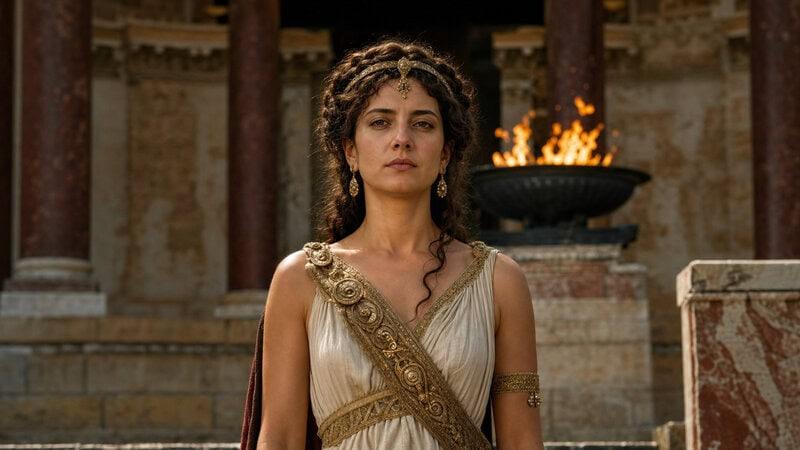

The wedding torches were still burning in Aegae when the screaming started. In the summer of 336 BCE, the Macedonian court had gathered for a spectacle of dynastic power — the marriage of a princess to a king — and then, between one breath and the next, Philip II of Macedon lay dying on the theater floor, and the world cracked open. Standing somewhere in that chaos was his daughter, Cleopatra, watching history detonate around her. She had just become both an orphan and the sister of the most powerful man alive. History, as it turned out, would remember only the second part.
A Name Swallowed by a Brother’s Legend
Cleopatra of Macedon (c. 356-308 BCE) was a princess, a queen regent, a widow, a survivor of the succession wars that shattered the ancient world, and a woman whom the most powerful men of her age competed to marry. She governed a kingdom while her brother conquered Persia. She maneuvered through fifteen years of the Diadochi’s murderous politics with a skill that left her enemies alternately courting and fearing her. And yet open almost any history of the period, and she appears — if she appears at all — as a footnote: Alexander’s sister. A supporting character in her own extraordinary life.
She also shared a name with Egypt’s most famous queen, a coincidence that compounds the confusion. Unlike the later Cleopatra VII who ruled Egypt, this Cleopatra never left the Greek world — she was Macedonian by birth, Epirote by marriage, and ultimately a prisoner in Asia Minor. The two women share little beyond a name and the experience of being reduced, by the men around them, to instruments of dynastic ambition.
Reconstructing Cleopatra of Macedon means reading against the grain of ancient historiography — picking her out from the margins of texts written by men who were interested in armies, not regencies; in generals, not the women who shaped or outlasted them. What emerges, even in fragments, is a principal actor in one of antiquity’s most consequential dramas, not merely the shadow her brother cast.
Born Into the Eye of the Storm

To understand Cleopatra, you have to understand Pella. The Macedonian royal court under Philip II was not a place of graceful ceremony and orderly succession — it was a militarized arena of polygamous alliance-making, where queens competed for influence, half-siblings were potential threats, and children were simultaneously beloved and political currency. Cleopatra entered this world around 356 BCE, almost certainly the same year as her brother Alexander, born of the same mother: Olympias of Epirus, Philip’s principal queen.
Olympias is one of ancient history’s most ferociously alive personalities, and she deserves to be understood as something more than simply Alexander the Great’s mother. An Epirote princess in her own right, she was fiercely intelligent, religiously intense — ancient sources linked her to the ecstatic Dionysiac mystery cults of her homeland — and utterly determined to secure her children’s futures in a court bristling with rival wives and their offspring. She treated every potential challenger to her children’s position as an existential threat, because in the zero-sum world of Macedonian succession, that is precisely what they were.
Being full siblings — sharing both Philip and Olympias — mattered enormously in this environment. It distinguished Cleopatra and Alexander from the half-siblings who surrounded them and gave Olympias two pieces to play on the same board. Alexander was the sword; Cleopatra was the alliance. From childhood, she was educated, watched, and positioned inside a court where her mother treated diplomacy as warfare conducted by other means. It was a crucible that produced two of antiquity’s most formidable personalities. We tend only to remember one of them.
The Strategic Marriage: Queen of Epirus

When Philip arranged Cleopatra’s marriage to Alexander of Molossis — King Alexander I of Epirus, and simultaneously her own maternal uncle — it was the kind of dynastic chess move that looks almost absurd to modern eyes and was entirely routine to ancient ones. For Philip, the match extended Macedonian influence westward into Epirus. For Olympias, it did something subtler and more important: it placed her bloodline on a second throne, creating a satellite power bound by blood to her son’s Macedonia.
The wedding took place at Aegae in 336 BCE, during the grand public spectacle Philip had staged to project Macedonian dominance across the Greek world. It was here, during the ceremonial procession into the theater, that Philip was stabbed by his bodyguard Pausanias. The ancient sources — Diodorus Siculus prominent among them — record the event but disagree on who, if anyone, conspired behind the assassin. Cleopatra witnessed the killing that ended her father’s reign and began her brother’s: a pivot point so sudden and violent that it reshaped the known world in an afternoon.
As Queen of Epirus, Cleopatra was no passive consort. Her husband Alexander I almost immediately began campaigning in southern Italy — an intervention invited by Greek colonies there — a venture from which he would not return, dying in battle near Pandosia around 331 BCE. That left Cleopatra, still in her mid-twenties, governing Epirus as regent for her young children. The particular cruelty of her situation was structural: she had been positioned as queen of a kingdom, only to be widowed and left alone to hold it together while her brother fought wars three thousand miles to the east and her mother continued her own combustible brand of court politics back in Macedon.
The Sibling Bond That History Underestimates

Ancient sources are fragmentary and often frustrating in what they choose not to record, but there are traces of genuine closeness between Cleopatra and Alexander — mutual loyalty, correspondence implied by later references, a relationship that seemed to stand apart from the murderous family politics consuming nearly everyone around them. This is, in itself, remarkable. The Macedonian royal family had a talent for fratricidal violence that made ordinary sibling rivalry look quaint.
The case for Cleopatra’s formative significance is not merely speculative. Raised by the same Olympias, shaped by the same court, exposed to the same cultural framework of royal entitlement, divine destiny, and absolute ambition, she and Alexander were products of an identical crucible. Olympias’s worldview — that her children were exceptional, that their claim was sacred, that enemies were to be destroyed rather than accommodated — left its marks on both of them. We credit that formation entirely to Alexander’s biography and largely forget that Cleopatra was forged by the same fires.
In the years after 323 BCE, that formation would become geopolitically significant in ways no one had anticipated.
After Alexander: The Most Sought-After Woman in the Greek World

Alexander died in Babylon in June 323 BCE, and within weeks the empire he had spent thirteen years building began to splinter. What his death also created — and this receives far less attention than it deserves — was a vacancy of legitimacy. The men who had served under him, the Diadochi or “Successors,” needed something to anchor their claims, and nothing on earth carried more Macedonian dynastic weight than the bloodline of Philip II.
Cleopatra, as Alexander’s only full sibling and a daughter of Philip II in her own right, suddenly became the most symbolically potent woman in the Greek world. The Successors recognized this with remarkable speed. Leonnatus sought her hand. Perdiccas, regent of the empire, reportedly pursued the match. Later, Ptolemy of Egypt — consolidating his own power in the richest province of the former empire — expressed serious interest. These were not romantic overtures; they were strategic calculations. Marrying Cleopatra of Macedonia meant acquiring a living claim to Macedonian legitimacy, and in the chaos following Alexander’s death, that was worth more than any single army.
What history habitually understates is that Cleopatra was not passive in this process. Ancient sources, including the historian Justin, suggest she was actively maneuvering and weighing her options. At one point she traveled toward Asia Minor with the apparent intention of joining Perdiccas before his assassination in 321 BCE — a bold, independent political act by a woman who understood her own dynastic value and intended to deploy it on her own terms, not to be allocated by men who happened to hold armies.
The response from those men was predictable. Antigonus — one of the most powerful of the Successors, controlling much of Asia Minor — placed her under effective house arrest in Sardis. He could not afford to let her marry any rival without tipping the balance of power catastrophically against himself, but he could not afford to marry her himself without provoking a coalition against him. She became a captive symbol: too valuable to release, too dangerous to use.
Murder in Sardis and the Silence That Followed

She spent years in that gilded captivity. Around 308 BCE, when Cleopatra apparently attempted to escape Sardis and make her way to Ptolemy in Egypt — one final bid for agency in a life that had been systematically constrained — Antigonus had her killed. Then, in a gesture whose cynicism is almost breathtaking, he executed the women he held responsible for carrying out the murder and gave Cleopatra a royal funeral.
Diodorus Siculus records this sequence with a deadpan precision that speaks volumes. Antigonus performed outrage at her death, honored her remains with ceremony befitting a queen, and thereby managed the optics of an assassination he had ordered. Even her corpse carried enough dynastic weight that it had to be carefully handled. She was buried with royal honors by the man who murdered her — a final, perfect encapsulation of how the ancient world related to women it found simultaneously indispensable and inconvenient.
Her fate mirrored her mother’s. Olympias, the fierce and complicated architect of so much of what Alexander became, had been executed by Cassander in 316 BCE — just a few years before Cleopatra’s own end. Both women, who had done perhaps more than anyone alive to shape Alexander the Great’s world, were eliminated by the same generation of men who built their power on Alexander’s legacy while systematically removing the women who had helped forge it.
The erasure then continued in the historical record. Ancient historiography was written overwhelmingly by men whose organizing framework was military campaigns, naval battles, and the decisions of commanders. It had no adequate vocabulary for the political lives of royal women — for regencies administered alone, dynastic marriages wielded as weapons, or the fifteen-year geopolitical career of a woman who never commanded a phalanx. Cleopatra’s story survived in fragments, in asides, in the margins of narratives about the men who wanted to marry or murder her.
Why She Matters: Recovering a Forgotten Actor in History
Cleopatra of Macedon was not incidental to Alexander’s world. She was shaped by the same extraordinary forces, wielded genuine sovereign power in Epirus during one of the most turbulent periods of ancient history, and remained a live geopolitical force for a decade and a half after her brother’s death. The Successors’ frantic competition to marry her is itself the clearest possible evidence of her political weight — men who commanded professional armies and governed entire provinces do not maneuver desperately over symbols without substance.
She belongs to a larger pattern of Macedonian royal women who governed, fought, and maneuvered at the highest levels of power and were then subordinated to male military narratives in the historical record: Olympias, who shaped the conqueror of Persia; Cynane, Philip’s daughter by an Illyrian princess, who led troops in the field; Eurydice II, who made her own bid for power in the succession wars before being captured and killed by Olympias in 317 BCE. Their stories were not lost by accident. They were lost because the frameworks used to record history — and to decide what counted as history — were not built to preserve them.
Recovering Cleopatra of Macedon is not simply an act of historical justice, though it is that. It is a reminder that the way history remembers — and forgets — is itself a choice with consequences. When we read Alexander the Great as a solitary genius who emerged fully formed from the hands of destiny, we are accepting a story that required the deletion of Olympias’s ferocious ambition, Cleopatra’s dynastic maneuvering, and the entire web of women who made the man possible and then outlasted him in a world his conquests had made ungovernable.
Somewhere in Sardis, in 308 BCE, a woman who had been a princess, a queen, a regent, and a kingmaker was buried with royal honors by the man who ordered her death. It is, in the end, a precise metaphor for how history has treated women it could not afford to remember: celebrated just enough to manage the optics, then folded back into the margins while the story of the men continued.

 Arabic
 French
 Spanish
 Portuguese
 Deutsch
 Turkish
 Dutch
Dutch
 Italiano
 Russian
 Romaian
 Portuguese (Brazil)
 Greek
Greek