


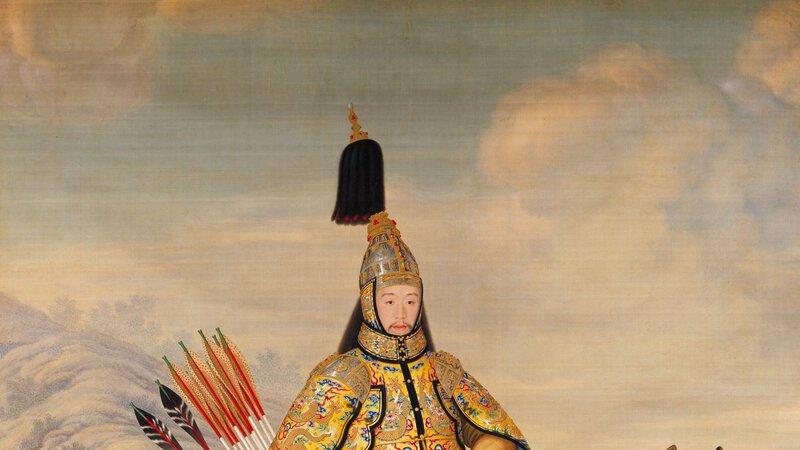

On New Year’s Day 1796, in the crystalline winter light of the Forbidden City, an 84-year-old man did something almost no emperor in Chinese history had ever chosen to do: he gave away the most powerful throne on earth — and he did it to keep a promise to his dead grandfather.
The Day the Most Powerful Man in the World Chose to Step Down

The ceremony was elaborate, as everything in the Qing court was elaborate, layered in silk and ritual and the weight of heaven’s mandate. The Qianlong Emperor — born Hongli, temple name Emperor Gaozong of Qing — stood before his court and formally installed his son on the dragon throne, becoming what Chinese tradition called a Retired Emperor. The officials who witnessed it would have understood the gesture immediately. What they may not have fully understood was how little had actually changed.
The reason Qianlong gave for his abdication was staggering in its filial logic. His grandfather, the Kangxi Emperor, had reigned for 61 years — a tenure so revered within the Qing dynasty that it functioned almost as sacred law. Qianlong had vowed publicly, before heaven itself, that he would never allow his own reign to exceed Kangxi’s in length. When 1796 arrived and the calendar ticked past that boundary, he kept his word. To have done otherwise, in the Confucian moral universe he inhabited, would have been a kind of spiritual crime against the ancestor who had made the dynasty possible.
And yet the central paradox of Qianlong’s life is written right there in that ceremony: a man of almost incomprehensible ambition, who had spent six decades expanding an empire, composing tens of thousands of poems, and accumulating artistic treasures beyond counting, chose to define himself through an act of self-restraint. It was, in its way, the most theatrical gesture of his reign — and he continued making every major decision from his retirement quarters until the day he died.
Born to a Dynasty, Groomed for Greatness

Hongli came into the world on 25 September 1711, the son of the Yongzheng Emperor, a ruler famous for iron discipline and administrative severity. From boyhood he was identified as exceptional. Court accounts — admittedly sources that had every reason to flatter — describe a first meeting with his grandfather Kangxi that left the old emperor visibly impressed, a story that may be embellished but speaks to how the family narrative was already being constructed around this particular child.
He grew up inside one of history’s most fascinating cultural double games. The Qing were Manchu conquerors who had seized China in 1644, ending the Ming dynasty and installing themselves as rulers of a civilization far older and, in many ways, more sophisticated than their own. Their response was not to suppress Han Chinese culture but to master it — to become, in the eyes of the governed, more Chinese than mere ethnicity required. Young Hongli absorbed this imperative voraciously. He studied calligraphy under serious masters. He learned to paint. He memorized classical poetry and Confucian philosophy. He trained in military strategy. By the time he ascended the throne in 1735, at age 24, he was not just a prince but a fully prepared emperor — one educated, in effect, for exactly this moment.
It is worth pausing on a small but telling historical wrinkle. Britannica describes him as the fourth emperor of the Qing dynasty, while other credible sources describe him as the fifth or sixth — a discrepancy that turns on whether shorter-reigning transitional rulers in the dynasty’s earliest years are counted in the sequence. Neither figure is wrong in its own framework; they are simply counting differently. The important point is that by any accounting, he arrived on the throne of an already-formidable empire and proceeded to transform it into something larger than it had ever been.
The Reign: Six Decades That Remade an Empire

From 1735 to 1796, the Qianlong Emperor presided over what historians consider the absolute apex of Qing power. The National Gallery of Victoria, reflecting broad scholarly consensus, frames his era as a golden age — a period during which China’s territory, treasury, and cultural confidence all reached their historical peaks simultaneously.
His military campaigns, known to posterity as the Ten Great Campaigns, pushed Chinese authority into Tibet, deep into Central Asia, and across frontiers that previous dynasties had never managed to hold. The empire Qianlong governed at its height was larger than any Chinese dynasty had governed before — a geographic footprint whose borders still echo, loudly and sometimes contentiously, in modern discussions of Tibet, Xinjiang, and Inner Asia. He was not simply administering an inheritance; he was actively building something new.
Domestically, the story was similarly expansive. The population roughly doubled during his reign. The treasury filled. The arts flourished under a ruler who did not merely patronize culture from a comfortable distance — he practiced it with genuine obsession. He is credited with composing an estimated 40,000 poems over his lifetime, a number so large it strains credulity until you remember that he lived for 87 years and seems to have reached for a brush the way other men reach for conversation. He amassed one of the greatest private collections of Chinese paintings, calligraphy scrolls, and jade objects ever assembled, acquiring with the systematic intensity of a man who understood that collecting ancient masterpieces was itself a form of political argument about legitimacy and continuity.
Yet the reign did not close without shadows. In his later decades, Qianlong extended catastrophic favor to a court official named Heshen, whose corruption became so notorious that it functioned almost as a symbol of imperial decline. And beneath the prosperity, structural vulnerabilities were accumulating — a deepening suspicion of Western trade, an administrative culture built on personal loyalty rather than institutional resilience — that would crack open devastatingly in the century after his death.
The Scholar-Warrior on the Dragon Throne

Contemporaries and historians alike have described Qianlong as simultaneously a politician, a militant commander, a Tibetan Buddhist priest-king, a scholar, and a working artist — not merely a collector but a calligrapher and painter who studied the great masters seriously and put brush to paper almost daily. He resists easy categorization, which is part of what makes him so compelling across the centuries.
His passion for calligraphy was never just a hobby. It was a political statement of the first order, aligning a Manchu ruler with the deepest roots of Han Chinese cultural identity. Every scroll he produced, every classical allusion he deployed in verse, said the same thing to his subjects: the Qing are not foreign occupiers. We are the inheritors of three thousand years of civilization. We have earned this throne not just by conquest but by understanding.
He famously inscribed his own poems and personal seals directly onto ancient masterpiece paintings in his collection — a habit that makes modern art historians and conservators wince, since some of the most priceless works of the Tang and Song periods now bear his mark across their surfaces. For Qianlong, the gesture was not vandalism. It was dialogue. He was entering into conversation with the artists of the past, placing himself in their lineage, insisting on his own belonging in that lineage. Whether you find it magnificent or maddening likely depends on whether you are an emperor or a museum curator.
This dual nature — conqueror and poet, general and aesthete, Manchu ruler steeped in Han culture — made him one of the most fully realized personalities ever to occupy the Chinese throne, and helps explain why his reign felt, to those who lived through it, like the literal center of the world.
The Grandfather Problem: A Filial Calculation That Defined a Legacy

The Kangxi Emperor reigned from 1661 to 1722 — 61 years — and was revered across the Qing court as the dynasty’s founding genius, the man who consolidated Manchu rule over China and made it, if not inevitable, then at least enduring. To the Qing imperial family, Kangxi was not just an ancestor. He was the standard against which all subsequent emperors were measured.
Qianlong had made his vow publicly, which meant he could not unmake it quietly. When 1796 arrived and his reign reached its 61st year, he did what almost no emperor in Chinese history had ever done voluntarily: he stepped aside. The abdication ceremony was genuine in its ritual form. His son, the Jiaqing Emperor, was installed on the throne. Court documents were rewritten to reflect the new reign period. And Qianlong withdrew to his retirement quarters.
What he did not withdraw from was power. For the remaining three years of his life, he continued to make virtually every decision of consequence. Jiaqing was emperor in name and in the records; Qianlong was emperor in the room where it mattered. It was one of history’s great political performances: an act of ostentatious humility that was simultaneously a demonstration of total, unchallengeable control. He surrendered the title while surrendering none of the substance.
The Final Years and the Measure of a Life

For those last three years, Qianlong occupied a strange constitutional space that Chinese political tradition had no precise language for. Nominally retired, actually dominant, he kept the court frozen around him — including around the corrupt Heshen, whom no one dared touch while the old emperor still breathed.
He died on 7 February 1799, aged 87. The span of his life is almost vertiginous to contemplate: he was born into the era of Peter the Great and died in the era of Napoleon, having outlived virtually everyone who had ever known him as a young man. Within weeks of his death, the Jiaqing Emperor moved swiftly to arrest Heshen and force his suicide — a speed that tells you everything about how completely Qianlong’s living presence had frozen the court, even in his eighties, even in nominal retirement.
As Berkshire Publishing records, Qianlong both lived and ruled longer than any other emperor in China’s written history — a distinction that makes the voluntary abdication all the more remarkable. He was not stepping back from weakness or illness or political pressure. He was stepping back from a position of complete, unchallengeable strength, because a promise to a dead grandfather weighed more to him than the title of emperor.
The Macartney Mission: When East Met West and Neither Blinked
No account of Qianlong’s reign is complete without the episode that, in retrospect, reads almost like a hinge of world history. In 1793, Britain sent a lavish diplomatic mission led by Lord George Macartney to the Qing court, bearing trade proposals, technological gifts, and a request to open formal commercial relations. Macartney arrived with clocks, scientific instruments, and an artillery demonstration — the material confidence of an industrializing empire presenting its credentials.
Qianlong received the mission with courteous magnificence and refused every substantive request. His reply to King George III, delivered in the measured language of a ruler who considered the matter already settled, remains one of the most famous diplomatic documents of the eighteenth century. China, he wrote, possessed all things in prolific abundance and had no need of the manufactures of outside barbarians. The letter was not bluster. It reflected a genuine, internally consistent worldview — one in which the Qing empire was the center of civilization and trade concessions were, at best, acts of imperial charity toward lesser powers.
The refusal was entirely in character for Qianlong, and it was not obviously wrong given the world as he had known it across 80 years of life. But the world was changing faster than the Forbidden City could perceive, and the closed posture he reinforced in 1793 would contribute directly to the catastrophes his successors faced in the following century. The Opium Wars, the unequal treaties, the humiliations of the nineteenth century — none of these were inevitable in 1793, but Qianlong’s response to Macartney narrowed the paths that might have avoided them.
Why Qianlong Still Matters
The empire Qianlong built — its territorial reach, its cultural confidence, its administrative machinery — set the physical and psychological boundaries of what China understood itself to be. Those boundaries echo loudly in contemporary geopolitics: every modern debate about Tibet, Xinjiang, and Inner Asia is conducted, whether participants acknowledge it or not, within a framework that Qianlong’s campaigns largely created.
His reign represents both the summit of the Qing and the beginning of its long, slow descent. The prosperity of the High Qing masked structural vulnerabilities — a closed posture toward Western trade, a court culture increasingly dependent on personal favor rather than institutional reform — that would crack open devastatingly across the nineteenth century. The cracks were not Qianlong’s alone to own, but they were deepened on his watch, and the man he left in charge of managing them was a son who had spent three years on the throne without having genuinely learned to rule.
As a cultural figure, Qianlong remains one of history’s great collector-patrons, the man whose taste and acquisitive energy shaped what survives of imperial Chinese art — even if his habit of stamping enormous personal seals across priceless Song and Tang masterpieces continues to provoke complicated feelings in conservation labs around the world. He could not resist leaving his mark. He never could.
And the abdication story endures as something genuinely rare in the annals of absolute power: a ruler who chose self-limitation not because circumstance forced him to, but because a promise made before heaven — to a grandfather he had barely known as a child, about a length of reign that almost no one else would have bothered to count — mattered more to him than the throne itself. It is a very human detail at the center of an almost incomprehensibly vast life, and it is the detail that keeps drawing people back to the Qianlong Emperor, centuries after the Forbidden City has stopped being anyone’s home.

 English
 Arabic
 Spanish
 Portuguese
 Deutsch
 Turkish
 Dutch
Dutch
 Italiano
 Russian
 Romaian
 Portuguese (Brazil)
 Greek
Greek