


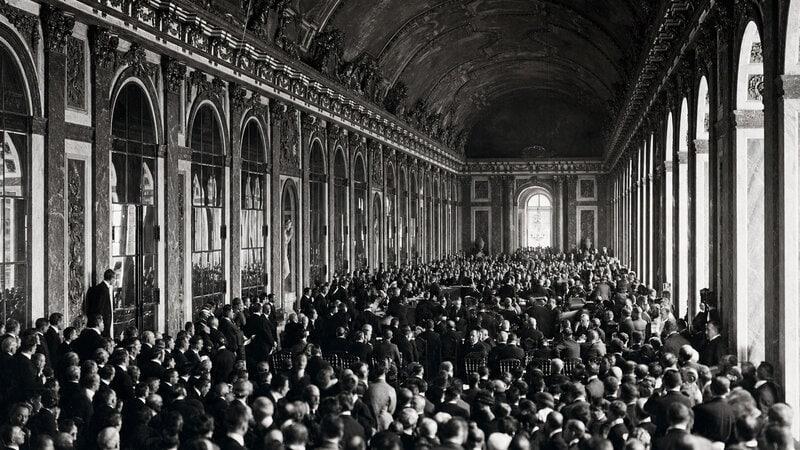

On June 28, 1919, the Hall of Mirrors at the Palace of Versailles blazed with chandeliers and self-congratulation. Diplomats in formal dress crowded the gilded room, photographers jostled for position, and the great powers of the world prepared to sign the document that would, they believed, end war forever. One man was not celebrating. John Maynard Keynes, the brilliant young British economist who had spent months watching the peace being written, was already gone — bags packed, post resigned, a cold fury driving him toward his desk and toward one of the most consequential books of the twentieth century.
The Man Who Walked Out of Versailles

Keynes had arrived at the Paris Peace Conference as a representative of the British Treasury, positioned at the intersection of high politics and hard numbers. He was thirty-five years old, already formidable in economic circles, and possessed of a mind sharp enough to see, with unusual clarity, what the politicians in those gilded rooms could not — or would not — see. The math of the peace being constructed was, in his judgment, catastrophically wrong. And the moral framework being draped over that math was making it worse.
He resigned his post before the ink was dry on the final treaty. Within six months, he had written and published The Economic Consequences of the Peace, a book that landed like a grenade in the victory celebrations of the Allied world. In it, Keynes argued, with meticulous economic reasoning and barely contained outrage, that the Treaty of Versailles had not ended the war — it had merely scheduled the next one. Everyone in that mirrored hall believed they were architects of a lasting peace. Keynes believed they were writing a funeral notice for European civilization and calling it a birth announcement.
What Was Actually Signed That Day

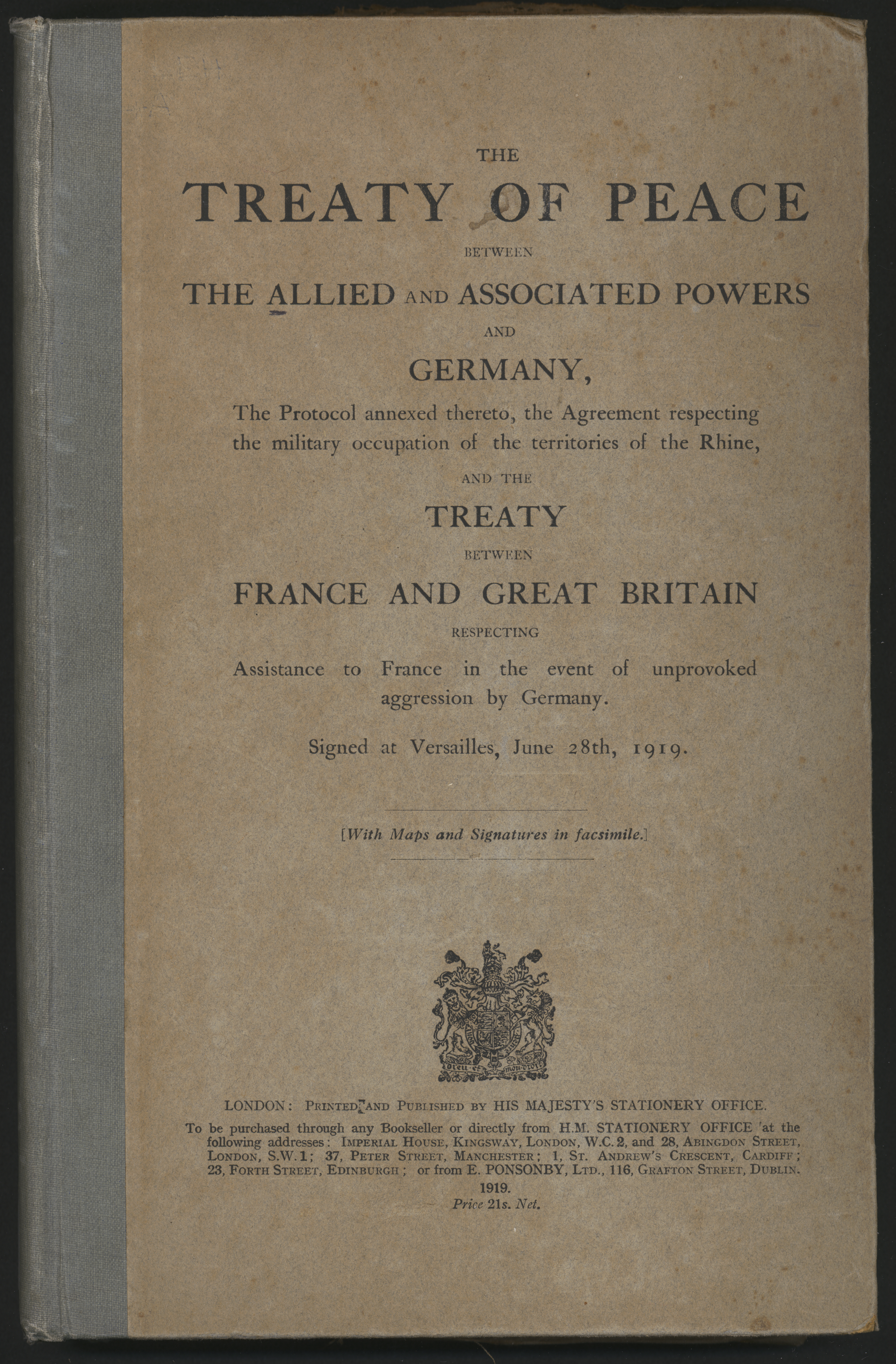
The Treaty of Versailles was the primary treaty produced by the Paris Peace Conference, and it formally ended World War One between Germany and the Allied Powers on June 28, 1919 — a date chosen with deliberate symbolism, being exactly five years after the assassination of Archduke Franz Ferdinand in Sarajevo, the spark that had ignited the whole catastrophe.
The treaty was shaped by three dominant personalities whose visions for the postwar world clashed almost irreconcilably. Woodrow Wilson, the American president, arrived in Paris carrying his Fourteen Points — an idealistic blueprint for a new international order built on national self-determination, open diplomacy, and a League of Nations that would resolve future disputes peacefully. Georges Clemenceau, the French premier, had watched his country bleed for four years on its own soil and wanted Germany weakened so thoroughly it could never threaten France again. David Lloyd George, the British prime minister, moved uneasily between them — aware that his domestic public demanded vengeance but that his strategic instincts warned against destroying Germany entirely.
The result was a compromise that fully satisfied none of them. Germany lost significant territory: Alsace-Lorraine returned to France, the Rhineland was demilitarized and placed under Allied occupation, and large portions of eastern Germany were ceded to the newly reconstituted Poland. Germany’s army was capped at 100,000 men, its navy was gutted, and it was forbidden an air force altogether. The planned League of Nations — Wilson’s great ambition — was written into the treaty’s opening pages as Part I. And then there was the clause that would become the treaty’s most toxic legacy.
The signing took place in the Hall of Mirrors — not by accident. It was the same room in which the German Empire had been proclaimed in January 1871, after Prussia’s crushing defeat of France in the Franco-Prussian War. Clemenceau had championed the location with the specific intention of inverting that humiliation. The French were signing a peace treaty in a room chosen to remind Germany of its own past triumphalism. That impulse — revenge dressed as justice — ran through the entire document.
Article 231: The Four Lines That Changed History

Article 231 of the Treaty of Versailles — the War Guilt Clause — forced Germany to accept responsibility for causing the war and all the loss and damage suffered by the Allied governments as a consequence of a war “imposed upon them by the aggression of Germany and her allies.” It was a short passage that rewrote history in the most consequential and contested way imaginable. Most historians now regard it as a severe oversimplification of a catastrophically complex chain of events involving the decisions, miscalculations, and imperial ambitions of multiple nations across multiple decades.
But Article 231 was not merely symbolic, and that is what made it so dangerous. It was the legal foundation upon which Germany was made liable for reparations covering Allied civilian losses and material damages. The Reparations Commission ultimately fixed the total in 1921 at 132 billion gold marks — a figure whose true economic weight historians continue to debate, but whose political weight was immediate and devastating. The clause fused a moral judgment with a financial sentence, and Keynes understood at once why that combination was uniquely explosive.
Ordinary Germans who had spent four years being told by their government they were fighting a defensive war — defending the Fatherland against encirclement by hostile powers — woke up to find their nation legally branded as the sole author of history’s worst catastrophe. The psychological wound this opened was real and deep, and it was not suffered only by nationalists and militarists. It was felt by workers, teachers, mothers, veterans. It was a humiliation distributed across an entire population, and humiliation, as history demonstrates with painful regularity, is a political resource waiting to be harvested.
Keynes’s argument was not sentimental. It was structural. You cannot, he insisted, impose a crushing moral condemnation and an economically ruinous financial penalty on a nation of tens of millions of people and expect stability to follow. You will get rage. You will get radicalization. You will get exactly the forces that rational, liberal, democratic Europe most feared — and you will have created the conditions for them yourself.
Keynes Reads the Numbers — and Sees a Ghost
What made Keynes’s critique so powerful, and so difficult to dismiss, was that it did not come from pacifism or sentimentality toward Germany. It came from arithmetic. He was an economist doing calculations, and the calculations were telling him that the reparations demand was larger than Germany could realistically meet without wrecking its own economy and, by inevitable chain reaction, the economies of the continent to which it was deeply connected.
In The Economic Consequences of the Peace, Keynes warned that reducing Germany to poverty would not produce a docile, chastened nation grateful for the chance to repay its debts in peace. It would produce a humiliated, radicalized nation whose population would be susceptible to any political movement promising to restore their dignity and reverse their misfortunes. He warned that economic desperation has political consequences, and those consequences are never mild.
He specifically described the possibility of a violent political convulsion inside a broken Germany — a reckoning between the forces of reaction and revolution. He wrote this in 1919. Nobody in that year had heard of Adolf Hitler. The National Socialist German Workers’ Party was not yet in existence; Hitler was still an obscure agitator in Munich. And yet the consequences Keynes mapped out — monetary chaos, mass resentment, democratic collapse, the rise of authoritarian nationalism — unfolded almost precisely as he had forecast, one grim domino at a time, across the following two decades. As the United States Holocaust Memorial Museum’s analysis of the treaty makes clear, the climate of grievance and instability the peace created was central to enabling the Nazi movement’s eventual rise.
The Critics Who Called Him Wrong — and What the Evidence Shows
Keynes was not celebrated for his prophecy. He was attacked. Allied publics who had buried a generation in the mud of Flanders were in no mood for economic lectures about German suffering. He was called naive, pro-German, unpatriotic. His book was resented in the very capitals whose governments he had served.
The counter-arguments were not entirely without substance. Some historians, most notably the economist Barry Eichengreen and, in a revisionist direction, Sally Marks, have argued that the reparations schedule as actually implemented — frequently revised downward, with payments repeatedly deferred — was not as economically impossible as Keynes claimed. Marks in particular argued that Germany’s economic dysfunction in the early 1920s reflected partly deliberate mismanagement by the German government, which at times had political incentives to demonstrate inability to pay. The debate over Germany’s genuine capacity to meet its obligations remains live among serious scholars.
What is harder to dispute is the political verdict of events. By 1923, Germany experienced catastrophic hyperinflation that annihilated the savings of its middle class — the social bedrock of any functioning democracy. By 1929, the Great Depression demolished the already fragile Weimar Republic’s political credibility. By 1933, Hitler was Chancellor of Germany, running explicitly on a platform of reversing the Versailles settlement. By 1939, a second European war in a generation had begun.
The question of whether Versailles caused the Second World War does not have a single, clean answer — history rarely provides those. But Keynes had identified the mechanism with devastating precision: not that the treaty made catastrophe inevitable in some iron-fated sense, but that it manufactured the conditions — economic ruin, wounded national pride, discredited moderate politics — that made the rise of fascism very difficult to prevent. The treaty did not write Hitler’s name. It wrote the vacancy he filled.
The League of Nations: The Safety Valve That Failed

There was one genuinely idealistic element built into the peace settlement — one mechanism designed to catch exactly the kind of catastrophe Keynes was predicting. The League of Nations, constituted as Part I of the treaty itself, was Wilson’s signature achievement: a standing international forum where nations could bring grievances, resolve disputes, and apply collective pressure against aggressors without resorting to war.
The tragic irony was immediate. The United States Senate refused to ratify the Treaty of Versailles, meaning the United States never joined the League of Nations — the institution an American president had designed and championed above everything else. The country that had tipped the military balance of the war walked away from the peace, gutting the League’s authority before it had conducted its first substantive session. The Senate voted twice, in November 1919 and March 1920, failing on both occasions to reach the two-thirds majority required for ratification.
The consequences were precisely what a clear-eyed observer might have foreseen. When Japan invaded Manchuria in 1931, the League condemned the action and did nothing effective. When Italy invaded Ethiopia in 1935, the League imposed limited sanctions and watched the conquest proceed. When Germany remilitarized the Rhineland in 1936 in direct violation of Versailles, the League was paralyzed. The one mechanism built into the peace to correct its own structural flaws — to manage the grievances Keynes had warned would become explosive — had no reliable enforcement power and no great power reliably willing to supply it.
The peace had been built on punishment, with a safety valve that did not work. The institution meant to reinforce the settlement turned out to be constructed of paper.
The Territorial Settlements and Their Long Shadows
The human geography reshaped by Versailles and the associated peace treaties extended far beyond Germany’s borders, and its consequences reach into conflicts still active today. The collapse of the Ottoman Empire produced settlements that drew the modern borders of the Middle East, often through peoples rather than around them, leaving minority populations stranded on the wrong side of new lines and planting ethnic and sectarian grievances that have never fully healed.
In Europe, the principle of national self-determination — Wilson’s great rhetorical gift to the conference — proved impossible to apply cleanly in a continent where nationalities had been intermixed for centuries. New states like Czechoslovakia and Yugoslavia were themselves multinational entities, internally fragile, whose internal tensions would resurface catastrophically within decades. Germans found themselves living as minorities in Poland and Czechoslovakia. The Sudetenland Germans of Czechoslovakia would become Hitler’s first successful pretext for territorial revision in 1938.
The Paris Peace Conference of 1919, as the United States State Department’s historical record of the period makes clear, attempted to resolve in a matter of months problems that had been accumulating across centuries. The ambition was extraordinary. The tools available — and the political will to use them wisely — were not equal to it.
What Versailles Teaches Us — A Century Later
The men who built the post-World War Two international order had read Keynes, and the contrast is instructive. The Marshall Plan — the American program that invested massively in rebuilding Western Europe, including West Germany, rather than extracting from it — was a direct philosophical rebuke to everything Versailles had represented. It worked. West Germany became a stable democracy and an economic anchor of the continent within a single generation, integrated into European institutions rather than chained outside them in resentment.
The lesson was not that defeated nations should face no consequences. It was that consequences must be calibrated to what a society can absorb without fracturing — and that the political stability of your former enemy is, ultimately, your own security interest. That insight, absorbed painfully from the wreckage of Versailles and its aftermath, shaped the most successful peace settlement in modern history.
The central lesson Keynes carried out of that gilded room in June 1919 remains essential: you cannot build a lasting peace on humiliation. You cannot impose collective punishment on entire populations and expect gratitude. You cannot chain a major nation in poverty and shame and be surprised when it breaks those chains violently. These are not soft, idealistic observations. They are the conclusions of careful analysis, confirmed by the most catastrophic two decades in modern European history.
The Hall of Mirrors on June 28, 1919: victors gathered in a room built entirely of reflections, surrounded by their own faces, seeing only their triumph. The flashbulbs popped. The champagne circulated. And through a side door, carrying a prophecy in his briefcase and a fury he would spend the next six months converting into prose, walked the one man in the building who fully understood what had just been signed — and what it would cost.

 English
 Arabic
 French
 Portuguese
 Deutsch
 Turkish
 Dutch
Dutch
 Italiano
 Russian
 Romaian
 Portuguese (Brazil)
 Greek
Greek