


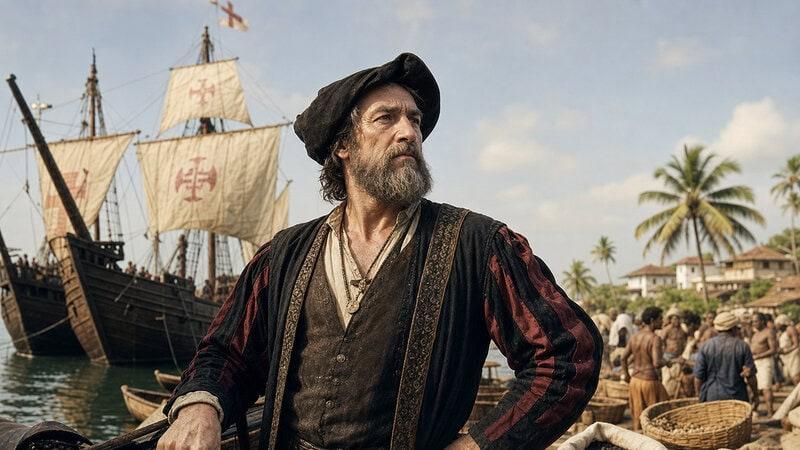

The smell hit them first. Before the anchors splashed into the harbor at Calicut in May 1498, the men aboard Vasco da Gama’s battered fleet caught the scent of pepper and cinnamon drifting across the water — the smell of everything Europe had been desperate for, suddenly within reach after ten months at sea and the longest deliberate ocean passage any European crew had ever attempted.
Columbus Gets the Monuments. Da Gama Changed the Economy.

Columbus has the holiday, the statues, the mythology baked into school curricula on three continents. He stands as the symbolic hinge of the Age of Exploration in the popular imagination — the man who sailed west and bumped into a world Europe didn’t know existed. But among historians who study the actual economic and geopolitical consequences of European exploration in the 1400s and 1500s, a quieter, more precise argument has been building for decades: the voyage that genuinely rewired the modern world left Lisbon in July 1497 and arrived in India the following spring.
Da Gama’s route to Calicut didn’t discover a new world. It did something arguably more consequential — it unlocked the wealthiest markets on Earth and handed Portugal the keys to global trade. This is not a case against Columbus. It is a case for reordering the story most of us were taught, and for asking a sharper question: which voyage produced the most durable, world-altering consequence? The answer matters not just to historians but to anyone who has ever picked up an age of exploration game, stared at a map, and wondered what it actually felt like to make these decisions with the fate of empires riding on the wind.
Europe in the 1400s Was Economically Panicked

To understand why Da Gama’s voyage mattered so profoundly, you have to feel the desperation that preceded it. When the Ottoman Empire seized Constantinople in 1453, the old overland Silk Road — the arterial route through which pepper, cinnamon, cloves, and nutmeg had flowed from Asia into European kitchens and pharmacies for centuries — was effectively strangled. Spices were not a luxury in medieval Europe; they were preservatives, medicines, and the closest thing the era had to a currency of taste. Suddenly, every gram passed through Ottoman hands and was taxed accordingly. European merchants and monarchs didn’t just feel inconvenienced. They felt trapped.
Portugal saw opportunity in that trap. Tiny, resource-thin, and facing the Atlantic rather than the Mediterranean, Portugal under Prince Henry the Navigator began treating ocean exploration as a national infrastructure project — not the romantic adventure of legend, but a methodical, decade-by-decade campaign to inch ships further down the African coast in search of a southern route to Asia. This is one of the essential age of exploration facts that textbooks sometimes flatten: Portugal’s expansion was bureaucratic, strategic, and sustained across generations of rulers. It was less like a heroic quest and more like a very long, very dangerous engineering program.
The proof-of-concept moment came in 1488, when Bartolomeu Dias rounded the Cape of Good Hope, proving that the Atlantic and Indian Oceans were connected by open water. The route existed. Someone just had to sail it all the way to India — and survive.
Meanwhile, Spain was betting on a different theory. A Genoese navigator named Christopher Columbus had convinced Queen Isabella and King Ferdinand that Asia lay a manageable distance to the west across the Atlantic. The two Iberian powers were now racing on parallel tracks, each convinced the other’s route would fail — a real-world competitive dynamic that modern age of exploration games and simulations have tried hard to recreate, and with good reason. The stakes were the entire future of global trade.
Columbus Gets His Due — And His Limits

Give Columbus this: his 1492 crossing was an act of audacious navigation, and the world it accidentally revealed would eventually transform everything. The Columbian Exchange — the transfer of crops, animals, diseases, and peoples between the Old and New Worlds — reshaped diets, demographics, and ecologies on a planetary scale. The silver extracted from the Americas eventually flooded European markets and financed empires. These are consequences so enormous that dismissing Columbus entirely would be historically illiterate.
But consequences and intentions are different things. Columbus died believing he had reached Asia. He never found the spice markets he had promised his Spanish backers. His four voyages produced no cargo of pepper or cinnamon and no direct trade relationship with the wealthy courts of the East. Spain’s return on its initial investment was slow, uncertain, and built on conquest and extraction rather than commerce. The Caribbean islands Columbus landed on were not Calicut. He was looking for the richest markets in the world and found something else entirely — something world-historical in its own right, but not what he went looking for.
The Vasco da Gama versus Columbus debate sharpens here. Da Gama knew exactly where he was going. Calicut was the world’s spice capital, the hub through which the entire Indian Ocean trade network moved. Arriving there with ships — even small, underpowered ships with unimpressive trade goods — meant Portugal could theoretically bypass every middleman between Asia and Lisbon: the Arab traders, the Egyptian brokers, the Ottoman tax collectors, the Venetian merchants who had grown fat on the markup. The first fleet back in Lisbon carried a cargo of spices reportedly worth sixty times the cost of the entire expedition. Columbus never produced a return remotely approaching that figure from any of his voyages.
The Voyage Itself: Ten Months, Three Oceans, One Hinge Point

Da Gama departed Lisbon in July 1497 with four ships and roughly 170 men. Almost immediately, he made a decision that announced the caliber of navigator he was: rather than hugging the African coast as Dias had done, he swung his fleet deep into the South Atlantic to catch favorable winds, sailing so far from land that his crew went approximately 93 days without sighting a coastline. No European fleet had ever made a deliberate open-ocean passage of that length. The men had no way of knowing whether they would find land again. The psychological weight of that silence — weeks of open water, no landmarks, no reassurance — is almost impossible to reconstruct from the comfort of reading history.
The Cape of Good Hope crossing in November 1497 was brutal. Storms hammered the fleet, the crew pushed toward mutiny, and the ships were battered badly enough that one would eventually be scuttled. Then Da Gama did something Columbus never managed: he found a skilled local navigator. Somewhere along the East African coast, a pilot with deep knowledge of the Indian Ocean’s seasonal winds joined the fleet and guided it across open water to India. Da Gama’s voyage was not a lone-wolf act of European genius. It was a collaboration built on local knowledge that Portugal had no other way of obtaining — which makes it, if anything, a more interesting story.
Calicut in May 1498 was simultaneously a triumph and a humiliation. The Zamorin, the city’s ruler, was unimpressed by Portugal’s trade goods — cheap cloth and trinkets that looked embarrassing next to the silks and gold that Arab merchants brought. Da Gama left without a trade treaty and with a fragile cargo. But the route was proved. Portugal’s next fleets would come better armed, better supplied, and carrying cannons instead of apologies.
The human cost was staggering. Scurvy, starvation, and storms killed roughly half the crew before the survivors reached Lisbon in 1499, and Da Gama lost one of his four ships entirely. Yet the route he had proved became the artery of the first truly global trade network — and that changes the entire arc of European exploration history in the 1400s and 1500s, permanently, from 1498 onward.
Why Historians Argue This Changes Everything

The Portuguese route to India didn’t just move spices. Within twenty years of Da Gama’s first landfall, Portugal had established trading posts from Mozambique to Malacca to Goa, controlling the Indian Ocean’s chokepoints with a combination of cannon fire and commercial cunning. Information traveled the route — astronomical knowledge, cartographic data, religious texts, disease. Capital moved at a speed that had never been possible when everything was filtered through overland intermediaries. Historians who study the period have argued that Da Gama’s voyage created the first genuinely connected world in an economic sense — not a discovered world, but a commercially linked one where prices in Lisbon began, slowly and imperfectly but really, to influence prices in Calicut.
The most important voyage debate ultimately turns on what you are measuring. If the metric is geographical drama, Columbus crossing an unknown ocean wins on spectacle. If the metric is cultural collision, the encounter between Europe and the Americas is unmatched in scale. But if the metric is durable economic consequence — the trade networks that persisted, the institutions that were built, the sequence of historical events that followed directly — then the India route wins. The Dutch East India Company, the British East India Company, the entire colonial architecture of South and Southeast Asia: these trace their institutional origins to Da Gama’s opening of the sea route, not to Columbus’s landfall in the Caribbean.
A counterfactual that sticks: without Da Gama’s route, the Ottoman stranglehold on eastern trade persists longer, Portugal never becomes a global empire, and the sequence of events that produced those massive trading companies — and their world-shaping, world-scarring consequences — is delayed or diverted entirely. Columbus reshaped the western hemisphere. Da Gama reshaped the world economy.
How Games and Simulations Are Keeping This History Alive
There is something about the Age of Exploration that resists passive consumption. The decisions were too consequential, the uncertainty too real, the logistics too staggeringly complex. How do you explain to a modern reader what it meant to provision four ships for a voyage whose length no one could accurately predict, into waters no European had charted? Games, it turns out, are one of the most honest ways to make those stakes legible — and the range of options available today, from classroom simulations to digital RPGs, reflects just how much the era rewards interactive engagement.
A discussion on r/gamingsuggestions about a serious Age of Exploration game concept captures exactly the bureaucratic drama that made Da Gama’s achievement so staggering. One user imagined a game in which players begin by appealing for funding, then build a fleet, hire crew, gather provisions, and finally set sail into genuine uncertainty. That sequence — the lobbying, the logistics, the slow accumulation of commitment before a single sail is raised — is precisely what dry textbook accounts flatten. Da Gama didn’t just sail. He spent years inside the machinery of the Portuguese state before the fleet ever left Lisbon, and a game that forces players to navigate that process would teach more about the era than most textbook chapters do.
The Mariners’ Museum Ages of Exploration resource approaches the same problem from an educational angle, turning explorer biographies into interactive challenges where each explorer tests users with three questions and awards experience points for correct answers. That structure makes the Vasco da Gama versus Columbus comparison feel like a living argument rather than a settled footnote — which is exactly what it should feel like, because historians are still having it.
Board game designers have found the era equally irresistible. The top Age of Exploration games on BoardGameGeek include titles that combine competition between rival nations and natives with the genuine uncertainty of discovery and the unpredictable effects of nature — mechanics that mirror the actual risk calculus Da Gama’s backers in Lisbon were running in 1497, when they were betting enormous sums of money and a large number of lives on a route that had never been completed.
Classroom simulations do similar work with younger students. One classroom age of exploration game tasks students with reaching the New World before a die is rolled 20 times — a simple mechanic that nonetheless forces players to feel the randomness and risk that real explorers navigated. Teachers Pay Teachers lists a wide range of similar role-play activities designed to place students inside the explorer’s perspective, turning historical decision-making into something personal rather than abstract. For students who want a more game-like revision experience, the Age of Exploration Walk the Plank game at School History turns historical knowledge into a competitive challenge aimed at ages eleven and up — a low-barrier entry point that keeps the core facts about routes, explorers, and dates in play without making revision feel like revision.
For players who want something more immersive, Age of Discovery on Steam is a top-down 2D RPG in which players travel through six continents, exploring cultures and gaining experience — a design that captures the personal-scale experience of moving through an unfamiliar world. It is as close as most of us will get to imagining what it felt like to step ashore in Calicut in 1498 and realize that the people you needed to trade with had no particular reason to want anything you had brought.
What the Games Get Right That Textbooks Miss
The best age of exploration games — whether digital, tabletop, or classroom simulations — share a structural insight that textbooks rarely manage: they make failure a real possibility. In a board game or a classroom role-play, your fleet can run out of supplies, your crew can mutiny, your royal sponsor can withdraw funding, and your rivals can reach the same port before you. That possibility of failure is not a dramatic flourish. It is historically accurate. Most of the voyages launched during the Age of Exploration did fail, or returned with far less than they set out to find. The ones that succeeded did so through combinations of skill, accumulated knowledge, local assistance, and the kind of luck that only becomes visible in retrospect.
Da Gama’s first voyage succeeded on all of those counts simultaneously — and still cost roughly half its crew their lives. A game that conveys the weight of that trade-off is doing something valuable: it is making the past feel contingent rather than inevitable, which is the first step toward understanding it honestly. When students or players are forced to decide how many provisions to load against how much trade cargo to carry, they are inhabiting the same calculations that occupied the Portuguese crown’s planners for decades before a single ship left the Tagus.
Reframe the Story You Were Taught
Columbus opened a door neither he nor his sponsors fully understood. Da Gama walked through a door Portugal had been building toward for sixty years, through the methodical work of a dozen navigators and the accumulated knowledge of African and Arab pilots, and came back with proof that the world’s wealthiest markets were now reachable by sea. That difference — between an accident of extraordinary consequence and a strategy of extraordinary execution — is exactly what age of exploration history tends to obscure when it leads with Columbus and treats Da Gama as a footnote.
The era between roughly 1415 and 1600 was not primarily a series of heroic individual discoveries. It was a relentless, state-funded, commercially motivated campaign to find cheaper routes to expensive goods — and Da Gama delivered the most valuable route of all. Every other consequence, from the spice trade’s collapse into European hands to the rise of the great trading companies to the colonial architecture of Asia, flowed downstream from that single delivery.
In Lisbon today, the Monument to the Discoveries shows Da Gama standing just behind Henry the Navigator at the prow of a stone ship — second in the lineup, never quite the headline act. It is exactly the historiographical position he has occupied for five centuries. Whether you encounter the story through a classroom simulation, a board game, an interactive museum resource, or simply by looking up what happened when Da Gama returned to Calicut on his second voyage in 1502 — carrying cannons and very different intentions — the Age of Exploration rewards anyone willing to move past the Columbus chapter and find out what came next.

 English
 Arabic
 French
 Spanish
 Deutsch
 Turkish
 Dutch
Dutch
 Italiano
 Russian
 Romaian
 Portuguese (Brazil)
 Greek
Greek