


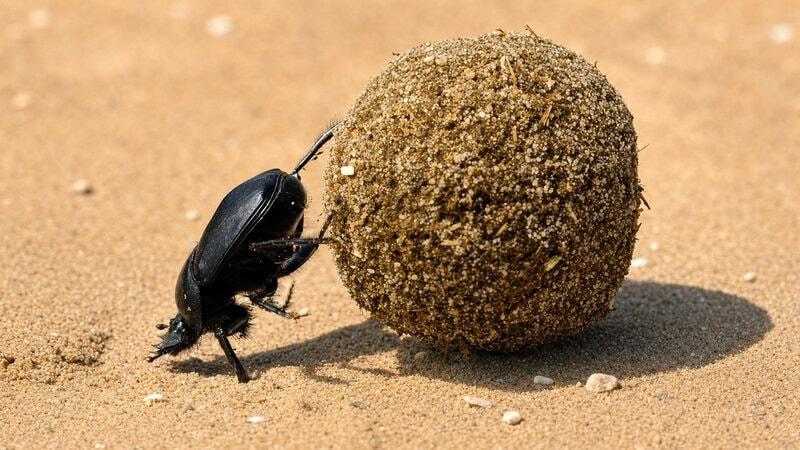

Just after dawn, on the edge of the Egyptian desert, a small black beetle shoulders its way out of the sand and begins to move. It finds a fresh pile of dung, works it methodically with its forelegs and mouthparts into a near-perfect sphere, and then rolls that sphere — with remarkable, unhesitating purpose — directly toward the rising sun. A priest watching from the riverbank does not see an insect performing a biological routine. He sees the universe explaining itself.
A Tiny Beetle That Moved a Civilization

The central paradox of Egyptian religious history is hiding in plain sight: one of the most potent sacred symbols ever devised by a human civilization was born from watching an insect push excrement across hot sand. The scarab beetle — rendered in gold, carved in lapis lazuli, pressed into the clay of royal decrees, and laid upon the chests of mummified pharaohs — began as a careful observation of animal behavior. And the civilization that made that observation built a theology of cosmic renewal around what it found.
The sheer scale of the beetle’s biological family makes the cultural narrowing all the more striking. The family Scarabaeidae contains more than 35,000 species of beetles worldwide, ranging across every continent except Antarctica. Yet out of that enormous diversity, a single species — Scarabaeus sacer, a stocky, blue-black creature roughly the size of a walnut — captured the entire Egyptian imagination and held it for three thousand years.
What the Beetle Is Actually Doing — And Why It Looks So Strange

To understand why the Egyptians responded the way they did, you have to stand in the heat and watch the beetle work. The process begins with detection: Scarabaeus sacer locates fresh animal dung by scent, sometimes traveling considerable distances to reach it. Once there, it moves quickly, sculpting the material with its serrated forelegs and broad, shovel-shaped head into a sphere. Then it orients itself and rolls.
The rolling is what stops observers. The beetle moves in a straight line, pushing its ball backward with its hind legs, body angled toward the ground, head down — an image of absolute, almost absurd commitment. Modern researchers have confirmed that Scarabaeus beetles navigate using the sun’s polarized light during the day. In a discovery that would have resonated with any Egyptian priest, some dung beetle species have also been found to orient using the Milky Way on clear nights, making them among the first insects confirmed to use the galaxy for navigation. The Egyptians who associated the scarab with cosmic order were observing something real.
The biological purpose of the dung ball is twofold. The adult beetle feeds on the nutrient-rich material during rolling and storage. The ball also serves as a brooding chamber: the female lays her eggs inside it, and the larvae develop entirely within the dung, sealed from the outside world, completing their full metamorphosis — egg to larva to pupa to adult — within that dark sphere of waste. When development is complete, a fully formed beetle pushes up through the earth and emerges into sunlight.
For ancient Egyptian observers, this moment of emergence was the detail that changed everything. Here was an animal appearing, seemingly from nothing, out of dead matter buried in the ground — life conjured from the earth, whole and complete. There was no visible parent, no visible egg. Just the ground, the dung ball, and then a living creature blinking in the morning light.
One further detail sealed the symbolism: during the day, the beetle rolls its ball broadly from east to west, tracing on the desert floor the same arc the sun makes across the Egyptian sky. The parallel lit a religious fuse that burned for millennia.
Khepri: The God Who Was Also an Insect

The Egyptians named the theological conclusion they drew from all of this: Khepri, deity of the rising sun and of morning creation. His name derives from the Egyptian verb kheper, meaning roughly “to come into being” or “to transform” — the same root that gives the scarab beetle its Egyptian name. Language and theology collapsed into each other here in a way that felt, to Egyptian thinkers, less like metaphor and more like revelation.
Khepri’s iconography is among the most visually arresting in the Egyptian pantheon. He appears as a man with a scarab beetle in place of his head, or sometimes simply as the beetle itself — one of the rare Egyptian gods whose entire divine identity could be compressed into a single animal form without remainder. The beetle was not merely a symbol of Khepri. For theological purposes, the beetle was Khepri, and Khepri was the beetle, and both were the sun at the moment it cleared the horizon.
The theological logic was elegant and self-reinforcing. Just as the beetle pushed its dung ball across the sand and new life emerged from inside, Khepri pushed the solar disk across the sky and new life — the day itself — emerged each dawn. Just as the beetle disappeared underground and returned transformed, the sun descended into the underworld each night and returned renewed each morning. The scarab’s life cycle was not merely analogous to solar mythology; it appeared to be the same event, happening simultaneously at two scales.
Khepri sat within a broader Egyptian solar framework: the morning sun as Khepri, the noon sun as Ra at the height of his power, and the evening sun as Atum, the aged creator preparing to descend. The scarab did not represent the sun in general but a very specific, charged moment — the instant of rebirth, the first light, the daily proof that destruction is not permanent. That precision gave the symbol its weight.
From Observation to Icon: How the Scarab Entered Egyptian Culture

Scarab amulets appear in the Egyptian archaeological record as early as the Old Kingdom period, roughly 2686 to 2181 BCE — meaning the symbolism was already ancient, already established, by the time the great pyramid builders were at work. What happened over the following centuries was not the birth of the scarab symbol but its explosion across every available medium and every layer of Egyptian society.
Scarab images were carved in stone, molded in faience — a glazed ceramic whose characteristic blue-green color evoked both water and new vegetation — pressed into gold, and painted onto tomb and temple walls. They appeared on jewelry worn by the living, on seals used in royal administration, on the coffins of the dead, and embedded in the linen wrappings of mummies. Across Egyptian history, scarab beetles were used as amulets symbolizing protection and good fortune — a meaning broad enough to apply equally to a nobleman’s signet ring and a peasant’s clay pendant.
The most consequential application was the heart scarab. Placed directly over the heart of the deceased during mummification, these objects were typically large — sometimes palm-sized — and carved from green or black stone. They were inscribed with spells drawn from what we now call the Book of the Dead, specifically the chapter intended to prevent the deceased’s own heart from speaking against them during divine judgment in the afterlife. The heart, in Egyptian belief, carried the full record of a person’s moral life. The scarab’s role was to hold it quiet at the crucial moment. A beetle associated with transformation and rebirth was placed at the most vulnerable hinge point between death and whatever came next.
The Scarab as Political Instrument

Power-conscious rulers recognized quickly that a symbol simultaneously associated with the sun, with transformation, and with divine protection was too useful to leave in the hands of priests and embalmers alone. Pharaohs absorbed the scarab into the machinery of statecraft.
Amenhotep III, who reigned approximately from 1388 to 1351 BCE, issued large commemorative scarabs inscribed with royal announcements — records of significant hunts, royal marriages, military achievements, and building projects. Distributed across Egypt and to foreign courts, these objects functioned as the official communiqués of the ancient world: durable, portable, and stamped with divine authority. The scarab’s shape was not decorative choice but argument. A message carried on a scarab was a message underwritten by the solar order itself.
At the administrative level, scarab-shaped seals were pressed into clay to authenticate documents, verify the contents of storage jars, and mark royal property. Every jar sealed with a scarab stamp was, in a quiet bureaucratic way, also sealed by the sun god’s authority. The symbol managed simultaneously to be a practical administrative tool and a theological statement — a compression of functions that suited a political system in which the pharaoh was understood to be a divine solar being, the human incarnation of the same creative force that rolled the sun across the sky each morning.
The scarab traveled far beyond Egyptian borders. Phoenician traders carried Egyptian-style scarab amulets across the Mediterranean, and archaeologists have recovered examples from sites ranging across the ancient Near East and into the western Mediterranean — one of antiquity’s most widely distributed religious objects, carried by commerce into cultures that had no direct connection to the Nile or to Khepri, but recognized the value of carrying transformation in your pocket.
What Modern Science Confirmed — And What It Adds to the Story

In 2013, researchers at Lund University published findings confirming that dung beetles use the Milky Way to navigate on clear nights — the first insects confirmed to orient by the galaxy. The beetles became disoriented when the night sky was obscured and rolled in measurably straighter lines when the galactic band was visible overhead. The finding drew wide attention partly for its elegance, and partly for what it implied about a civilization that had associated the scarab with celestial order more than three thousand years earlier.
The Egyptians had no framework for polarized light or galactic navigation. But they had watched — carefully, over generations — and their observations led them to an intuition that was not wrong: this beetle moves in alignment with the sky. The cosmos and the creature are in some relationship that matters. They built a theology on that intuition, and the theology, it turns out, was tracking something real.
The biomechanics of the roll are extraordinary on their own terms. Before setting off, the beetle climbs on top of its ball and performs what researchers describe as an orientation dance — rotating slowly, calibrating direction using available light cues, then descending and rolling. The image of a beetle standing atop a sphere of dung and turning in a slow circle to read the sky becomes stranger and more beautiful the longer you hold it in mind.
And the emergence from the dung ball — that moment which convinced Egyptian observers they were witnessing spontaneous generation — remains among the more dramatic examples of complete metamorphosis in the insect world. The entirety of a beetle’s transformation from egg to adult occurs sealed within a sphere of waste, underground, invisible. What surfaces appears to have no origin. That appearance of origin-less life was the observation at the center of everything.
Why the Scarab Still Matters
The civilization that created the scarab symbol collapsed. Its temples fell into sand and its writing became unreadable for more than a thousand years. The scarab survived all of it. Scarab imagery persists in contemporary jewelry, tattoo culture, architecture, and popular design — often stripped of context, rarely accompanied by any memory of Khepri or the heart scarab or the Book of the Dead, but still carrying some faint undertow of the original meaning: protection, transformation, the possibility that something whole and new might emerge from difficult or unpromising circumstances.
What the Egyptians were doing, at the deepest level, was not superstition. It was sustained, precise attention paid to the natural world over long periods of time. They watched the beetle with enough care to notice the east-to-west roll, the emergence from the earth, the apparent self-creation. They were wrong about the mechanism — there was no god pushing the sun, no spontaneous generation — but they were right about the structure: here is an animal whose life cycle enacts transformation, whose navigation is tied to the sky, whose emergence from darkness into light is real and repeatable and worth building a worldview around.
Every dawn, somewhere in the African desert, a scarab beetle is still rolling its ball toward the rising sun. It is navigating by polarized light, or perhaps by the Milky Way if it worked through the night, completely indifferent to the three thousand years of human meaning piled on its back. It has no idea it once moved a civilization. It is simply doing what it does — and it is still, if you watch it long enough, genuinely difficult not to see the sun.

 English
 Arabic
 French
 Spanish
 Portuguese
 Turkish
 Dutch
Dutch
 Italiano
 Russian
 Romaian
 Portuguese (Brazil)
 Greek
Greek