


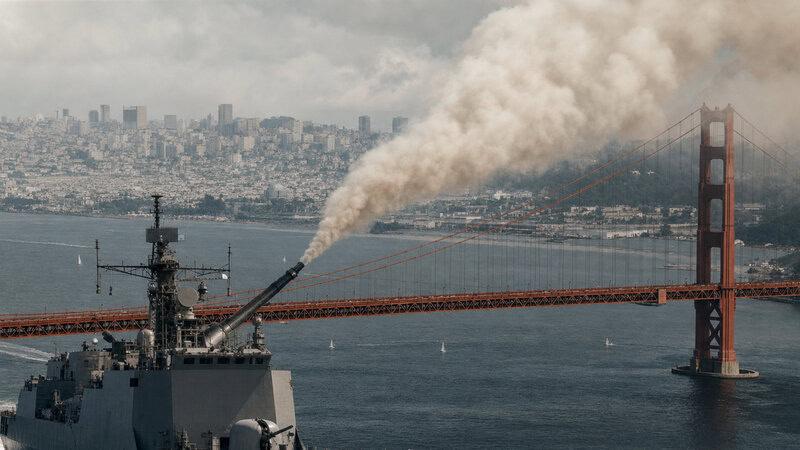

On a quiet September night in 1950, the famous fog rolled in off San Francisco Bay exactly as it always did — thick, cool, and unremarkable. What the city’s roughly 800,000 sleeping residents could not have known was that this particular fog carried something extra: a fine, invisible mist of bacteria, deliberately sprayed from U.S. Navy vessels cruising just offshore, drifting on the onshore wind through neighborhoods, over hospitals, and into the lungs of an entire American city.
A Fog That Wasn’t Fog

The ships moved quietly along the coastline, their crews operating aerosol-generating equipment with the calm efficiency of men executing a classified order. On shore, nobody stirred. No sirens, no warnings, no public health notices. The operation was invisible to the people it targeted, and it was designed to stay that way. Within weeks, something strange began happening at a city hospital: patients started arriving with a rare bacterial infection that most physicians had never encountered in clinical practice. Eleven people would contract serious illness. One of them would not survive.
That the U.S. government secretly used its own citizens as unwitting test subjects during peacetime — and then logged the results as a success — is not a conspiracy theory. It is a documented chapter of American Cold War history, one that took nearly three decades to surface and has never been fully reckoned with.
Cold War Paranoia and the Birth of Operation Sea-Spray

To understand how military planners arrived at the decision to spray a major American city with bacteria, it helps to remember what 1950 felt like. The Korean War had just begun. The Soviet Union had detonated its first atomic bomb the previous year, shattering the comfortable American assumption of nuclear monopoly. Inside the Pentagon and the intelligence community, a particular nightmare scenario was gaining traction: what if an enemy power released a biological agent over a densely populated coastal city — from a ship, a low-flying aircraft, even an ordinary freighter — and simply disappeared into the horizon before anyone realized what had happened?
The threat was not imaginary. Biological weapons are uniquely terrifying precisely because their delivery can be invisible, odorless, and silent, with symptoms appearing days later when any trail has gone cold. American military strategists desperately wanted to know how far a released biological cloud would actually travel through an urban environment, how concentrated it would remain, and how thoroughly it could blanket a population. The only way to get real-world data, they concluded, was to run a real-world test.
Operation Sea-Spray was their answer: a classified U.S. Navy program designed to simulate a covert biological attack on a major American port city and map, with scientific precision, how airborne bacteria moved through streets, buildings, and human respiratory systems. Before San Francisco, the program had run smaller trials, including an April 1950 release off Norfolk, Virginia. Those operations proved the delivery method worked. Planners were emboldened to scale up — dramatically.
Choosing the Bacteria — and Why Officials Called Them Safe

The two organisms selected for Operation Sea-Spray tell their own story about the gap between institutional confidence and actual scientific knowledge. The first was Serratia marcescens, a rod-shaped bacterium chosen partly for a useful laboratory quirk: it produces a vivid red pigment, making it easy to identify in air samples collected from testing sites across the city. The second was Bacillus globigii, a spore-forming organism considered a reliable stand-in for anthrax — capable of mimicking anthrax’s environmental behavior without, planners believed, its lethality.
Both organisms were classified at the time as non-pathogenic to healthy adults. Military planners genuinely believed — or persuaded themselves — that spraying these bacteria over a civilian population carried no meaningful health risk. The phrase “healthy adults” is doing considerable work in that sentence. It quietly sets aside the elderly, newborns, surgical patients, people receiving chemotherapy, and anyone with a compromised immune system — in other words, exactly the populations most likely to be present in a dense urban environment and most likely to be harmed.
As Smithsonian Magazine has reported, that oversight would prove fatally consequential within weeks of the San Francisco operation concluding.
The Operation Itself: Bay Winds, Aerosol Hoses, and 800,000 People
The mechanics of the operation were straightforward in their chilling efficiency. Navy vessels equipped with giant aerosol hoses moved along the San Francisco coastline, releasing a fine bacterial mist timed to coincide with the natural onshore winds that reliably push Bay fog deep into the city’s neighborhoods. The geography was nearly ideal for the military’s purposes: San Francisco’s dense population, its predictable fog patterns, and its position as a major port city made it an almost perfect simulation of the kind of target an adversary would choose.
Ground teams fanned out across the city, collecting air samples at dozens of locations, tracking the bacterial cloud as it traveled, measuring its concentration, and documenting how uniformly it spread. According to KQED’s investigation of the declassified records, the bacteria spread across virtually every corner of San Francisco, reaching far into residential neighborhoods and well beyond the waterfront.
The military logged this as a success. What it confirmed, in clinical military language, was that a biological attack launched from the water against a coastal American city would be devastatingly, almost perfectly effective. The report moved up the chain of command. The ships returned to port. San Francisco went on breathing.
The Hospital Ward Nobody Was Supposed to Know About

In the weeks following the spraying, physicians at a city hospital began noticing something deeply wrong. A cluster of patients had developed infections caused by Serratia marcescens — an organism so rarely seen in clinical medicine at the time that many doctors had never encountered a single case. Suddenly there were eleven patients infected, their conditions ranging from serious urinary tract infections to bloodstream infections that proved extremely difficult to treat.
The bacterium that military planners had classified as benign was behaving, inside vulnerable human bodies, as a genuine pathogen. The patients were not healthy adults meeting the military’s theoretical standard for safety. They were people already weakened by illness, by age, by the circumstances that bring anyone to a hospital ward.
One of those eleven patients died. His name was Edward Nevin, a retired public works employee who had been hospitalized recovering from a urinary tract procedure — exactly the kind of patient, with exactly the kind of vulnerability, that the military’s safety calculus had quietly excluded. His family would not learn of any possible connection between his death and the classified military operation for decades. At the time, without any knowledge that a secret experiment had blanketed their city in bacteria, his doctors had no framework to explain what had happened. And the military had no intention of providing one.
Secrecy, Lawsuits, and the Long Road to Disclosure

Operation Sea-Spray remained classified for nearly three decades. The curtain was pulled back not by a whistleblower or an investigative journalist but by a Senate subcommittee. In 1977, congressional investigators examining the scope of covert government programs revealed for the first time that the U.S. military had conducted open-air biological tests on American cities and citizens. As PBS American Experience has documented, Operation Sea-Spray was far from an isolated incident: the military had conducted more than 200 open-air biological and chemical tests on American soil between the 1940s and 1960s, many involving populated areas, none involving the knowledge or consent of those exposed.
When Edward Nevin’s grandson learned of the 1950 spraying and its possible connection to his grandfather’s death, he sued the federal government. The lawsuit made it through the courts and ultimately failed. A federal judge ruled the government could not be held liable under the Federal Tort Claims Act — a legal outcome that resolved nothing morally and satisfied no one emotionally.
The government’s official position, maintained through litigation and subsequent historical scrutiny, was consistent: the bacteria used were believed to be safe at the time, and the tests were a necessary component of Cold War defense preparedness. Scholars writing in peer-reviewed bioethics literature have noted that this justification, while not entirely without logic in its Cold War context, cannot account for the fundamental decision to conduct experiments on an uninformed civilian population — a decision that violated the most basic principles of informed consent that were already established in research ethics by 1950, in the wake of the Nuremberg Doctors’ Trial just three years earlier.
A Wider Pattern of Secret Testing
San Francisco was not a singular lapse. The 1977 Senate hearings revealed that the military’s open-air testing program was systematic and geographically broad. Bacterial and chemical simulants were released in cities, subway systems, and rural areas across the United States over roughly two decades. The people living and working in those locations were never informed, never asked, and never compensated when things went wrong. Operation Sea-Spray was simply the most dramatic documented example — a major American city, a documented death, and a paper trail comprehensive enough to survive declassification.
The scale of what the hearings uncovered shocked many Americans who had assumed the boundaries of government authority over citizens’ bodies were far narrower. It was not an assumption the evidence supported.
What Operation Sea-Spray Means Now
More than seventy years later, Operation Sea-Spray has not faded into pure historical curiosity. It sits at the intersection of questions that never go away: How far will governments go in the name of national security? Who bears the cost when that logic goes wrong? Can citizens trust institutions that operate in secrecy, ostensibly on their behalf?
The Cold War dilemma was real. The threat of biological warfare was not invented, the strategic questions were legitimate, and the United States was genuinely trying to understand a vulnerability that could have cost millions of lives in an actual attack. None of that changes what the decision actually was: to expose hundreds of thousands of people, without consent and without warning, to organisms the military had not adequately tested for safety across the full range of human vulnerability. It was a fundamental breach of the social contract between a government and the people it claims to protect.
The revelations that emerged from the 1977 Senate hearings did not merely embarrass the military. They helped drive substantive reforms in the bioethics landscape — strengthening federal oversight of human subjects research and the regulatory frameworks that govern what government researchers are permitted to do to people without their knowledge. The public skepticism toward government health assurances that has resurfaced repeatedly in the decades since has deep and documented roots in episodes exactly like this one.
At the center of every classified document, every air-sample collection plate, and every military success metric was a city full of people going about their ordinary lives — people who trusted the morning fog was just fog. And at the center of the hospital records that nobody connected to anything for twenty-seven years was a man named Edward Nevin, who checked into the hospital expecting to recover, and never came home.

 English
 Arabic
 French
 Spanish
 Portuguese
 Deutsch
 Turkish
 Dutch
Dutch
 Italiano
 Russian
 Portuguese (Brazil)
 Greek
Greek