


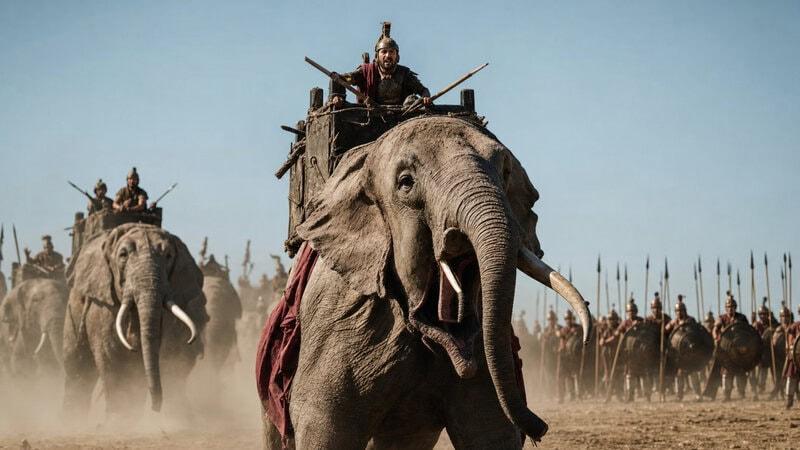

In the autumn of 202 BC, on a dusty plain near Zama in North Africa, something extraordinary happened before the killing truly began. Hannibal’s war elephants — the shock weapons that had terrorized Roman armies for nearly two decades — charged forward, heard the Roman trumpets answer them, panicked, and wheeled back into the Carthaginian lines. In that single, shattering moment of chaos and reversed momentum, the battle was already decided. Roman swords finished the work, but Roman psychology had already won it.
The Paradox at the Heart of Ancient Battle

There is a counterintuitive truth embedded in the history of ancient warfare that most modern readers never encounter: the side that collapses first frequently suffers fewer casualties in the actual exchange of weapons. Military thinkers who have catalogued the study of moral effect have long observed that the winner often loses more by fire than the loser — because an army that breaks and runs does so before the systematic, close-quarters killing truly begins. The pursuers do the real slaughter. The rout, not the clash, is where men die in numbers.
This means that everything leading up to the moment of psychological collapse — the reputation of the enemy general, the sound of ten thousand shields hammered in unison, the sight of a line that does not waver — is not theatrical. It is the actual mechanism of battle. Fear, engineered deliberately and delivered with precision, was among the most lethal weapons the ancient world possessed. And no civilization understood this more completely, or exploited it more systematically, than Rome.
What Moral Effect Actually Means — and Why It Isn’t Soft

Strip away the jargon and moral effect is a precise concept: the psychological impact of a military action on the enemy’s will to fight, entirely separate from its physical damage. A burning village that breaks a tribe’s nerve may achieve more than a skirmish that kills twenty men. A general who appears from an unexpected direction three days early can achieve more than one who arrives on schedule with superior numbers. The concept is not about cruelty for its own sake — it is about economy of force applied to the mind rather than the body.
The logic sharpens when you examine what happens at the moment of contact between two ancient armies. In battle, two moral actions, even more than two material actions, are opposed, and the strongest wins. Will, unlike the number of spears in a formation, can be actively engineered in advance.
An army standing still, even a frightened one, is dangerous. An army in flight is almost helpless — it cannot form, cannot turn, cannot protect its flanks or rear. The moment the psychological threshold breaks, physical destruction accelerates exponentially. Ancient generals who invested heavily in spectacle, noise, reputation, and terror were not indulging in theater. They were compressing the time between first contact and rout by attacking the enemy’s coherence before the first spear flew.
Before Rome: The Ancient World Already Knew This

The Assyrians of the 9th through 7th centuries BC grasped the principle with chilling clarity. Their royal annals — carved into palace walls and circulated to neighboring kingdoms — were as much psychological weapons as historical records. Graphic, detailed accounts of mass deportations and brutal punishments for resistance were not simply royal boasting. They were carefully distributed signals to every city-state within reach: submission is the rational choice. The annals functioned as a standing terror-broadcast, making resistance feel irrational before a single Assyrian soldier appeared on the horizon.
Alexander the Great demonstrated a more surgical version at Gaugamela in 331 BC. Facing a Persian force that substantially outnumbered his own, Alexander understood that Darius’s vast line would only hold together as long as Darius himself held nerve. His oblique cavalry charge was not aimed at the Persian line in any conventional sense — it was aimed at the Persian king’s confidence. When Darius fled, his army dissolved around him, not because it was physically destroyed but because its psychological center had been removed. The soldiers’ wills followed their king’s will into collapse.
Even the Greek hoplite phalanx, that densely packed wall of bronze and ash-wood spear, derived a significant portion of its battlefield power from the terrifying visual and sonic assault it delivered before contact — the synchronized stamping, the hedge of leveled spearpoints, the painted faces of the shields. Individual skill mattered, but the impression of overwhelming, inhuman regularity mattered more. And Hannibal at Cannae in 216 BC engineered perhaps the most psychologically sophisticated trap in ancient military history: he deliberately allowed his center to bow inward under Roman pressure, feeding the legionaries a sustained sensation of success — of winning, of driving the enemy back — right up to the moment the encirclement snapped shut and hope evaporated entirely. He weaponized false hope as a tactical instrument.
Rome’s System: Engineering Panic as Policy

What distinguished Rome from every predecessor was not the discovery of these principles but their institutionalization — the transformation of instinctive psychological warfare into codified, trainable, repeatable doctrine embedded in the structure of the legion itself.
Rome’s shift from the rigid Greek-style phalanx to the flexible manipular legion, developed during the 4th century BC and refined through the Punic Wars, was as much a psychological innovation as a tactical one. The manipular system allowed centurions to rotate fresh soldiers to the front line continuously. To the enemy, this presented a nightmarish illusion: Rome’s line never seemed to tire. Every time an opposing warrior found the nerve to face down the man before him, another man — fresh, screaming, driven — took that man’s place. The legion did not merely fight. It performed inexhaustibility.
The standard Roman assault sequence was a choreography of escalating terror. The barritus — a deep, rolling war cry that began low and built to a roar — struck the enemy’s nervous system before any weapon did. Then came the pilum volley: heavy javelins designed to punch through shields and bend on impact, making those shields unwieldy and forcing men to fight encumbered or abandon them entirely. Then the gladius at close quarters, a weapon Rome had optimized for the terrifying intimacy of pressing combat. Each stage of the sequence was calibrated to peak the enemy’s fear precisely at the moment of physical contact, when that fear was most likely to trigger collapse.
Rome also applied moral engineering internally, to its own soldiers. Decimation — the execution of one man in ten from a unit judged to have shown cowardice — was not primarily a punishment in the conventional sense. It was a recalibration of fear. If a soldier’s dread of Roman military discipline could be made to exceed his dread of the enemy in front of him, that dread became fuel for aggression rather than flight. Rome manufactured its soldiers’ courage by ensuring that the alternative was more frightening than the battle itself.
The triumphal procession — that grand theater of defeated kings and captured standards paraded through Roman streets — served a parallel function outward. It was a broadcast signal to every client kingdom, every wavering ally, every restless tribe on the frontier: this is what the end of resistance looks like, made flesh, walking in chains through the city’s heart.
Caesar: The Master Practitioner

Julius Caesar absorbed this entire inheritance and extended it further, understanding that different enemies required different psychological keys. The Gallic tribes he faced during the campaigns of the 50s BC were ferocious in assault but psychologically dependent on momentum and clan honor — a single shocking reversal could shatter their will where the same reversal would merely irritate a Roman legion trained to absorb setbacks and regroup.
At the siege of Alesia in 52 BC, Caesar constructed two simultaneous rings of fortification — one facing inward to contain the trapped army of Vercingetorix, one facing outward to confront the massive Gallic relief force assembling beyond. The sheer audacity of the engineering, building an eleven-mile outer circumvallation wall while effectively besieged from without, was itself a moral effect operation of the first order. It announced, in wood and earth and ditches, that Roman willpower was operating on a different plane of reality from anything the Gauls had previously encountered. The fortifications said, continuously and legibly, that Rome was not afraid. They said it for weeks, in a language that required no translation.
Caesar also weaponized velocity. His legions moved at speeds that consistently wrong-footed opponents, appearing before towns whose garrisons had expected days more to prepare their defenses. A garrison that has worked itself into a defensive fury over a period of days is a different proposition from one that wakes to find a Roman army already outside the walls with siege equipment being assembled. Caesar understood that the moral effect of unexpected speed could make a siege unnecessary before it began — that a garrison given no time to steel its collective nerve would frequently surrender on sight.
His written Commentarii — those vivid, coolly composed third-person accounts of his campaigns in Gaul and Britain — were partly propaganda distributed to Roman audiences, carefully constructed narratives of Roman invincibility that fed back into the reputation machine driving his enemies’ fear and his allies’ confidence. Caesar understood that a text was a weapon with a longer range than any catapult, and he used it accordingly.
The Internal Dimension: Maintaining Your Own Army’s Will

The logic of moral effect runs in both directions. Every technique a commander applies to break the enemy’s will has a mirror application in sustaining the will of his own men. Rome’s most striking institutional achievement was not its tactical flexibility, formidable as that was, but the psychological resilience it built into its legions as a structural feature rather than a lucky characteristic of particularly brave soldiers in a given generation.
The cult of the eagle standards, the elaborate system of unit decorations and commendations, the religious rituals embedded in military life, the training cycles that made Roman drill feel like a second nature — all of these were technologies of cohesion. They created in each soldier a sense of belonging to something that had never broken and never would, something larger and stranger and more durable than any individual man or any individual battle.
After the catastrophic defeats at the Trebia in 218 BC and at Lake Trasimene in 217 BC — two of the worst military disasters Rome had ever suffered, both delivered by Hannibal with devastating psychological as well as physical force — Rome did not dissolve. It did not sue for peace. It raised new legions, restructured its command, and continued. The moral infrastructure Rome had built over generations kept Roman institutional coherence functional even when the physical situation was dire. An army that can absorb a catastrophe without losing its fundamental will to continue possesses a compounding advantage over one that cannot, because it can outlast opponents who are objectively stronger at any given moment.
The Deeper Logic — and Why It Still Echoes
Return to the uncomfortable truth seeded at Zama: if the losing side often suffers fewer casualties in the actual weapons exchange than the winner, the entire calculus of battle tilts toward the psychological from the very beginning. This means ancient generals who burned crops, executed prisoners, or staged elaborate spectacles of terror were not always acting from sadism or cultural habit. Many were operating from a coldly rational reading of the moral effect equation: reduce the enemy’s will below its breaking point and the physical battle becomes largely secondary — a mopping-up exercise after the real decision has already been made in the mind.
Battles in the ancient world were often decided days, hours, or minutes before the first clash — by reputation, by the sight of a formation that moved with uncanny precision, by the sound of trumpets calibrated to make elephants wheel back into their own lines, by whether the enemy general’s face betrayed hesitation. The history of moral effect in warfare is ultimately a history of this understanding: that armies are not machines but collections of human nervous systems, and human nervous systems can be played with considerable precision by a commander who understands what he is actually doing.
The Roman system did not vanish when Rome fell. Byzantine military manuals inherited and codified its principles. Medieval siege doctrine borrowed from it, understanding that starvation and psychological pressure frequently accomplished what assault could not. Early modern European drill, with its emphasis on synchronized movement and the intimidating geometry of disciplined formation, carried the same message Rome had encoded into the manipular legion: we are not individual men; we are something larger and more frightening than that. The lineage runs in a traceable line from the Assyrian annals through the Roman triumph to the formal psychological operations doctrine of contemporary military establishments, which recognizes moral effect as a core component of military power alongside firepower and logistics.
Scipio Africanus won at Zama not simply because his tactics were superior on the day, though they were. He won because he had spent years methodically dismantling Hannibal’s legend — in Spain, in North Africa, battle by battle and diplomatic contact by diplomatic contact — until the instrument of Carthaginian military power, which depended on Hannibal’s aura of invincibility to function, had been quietly hollowed out. By the time the elephants turned back into the Carthaginian lines, soldiers who had not broken in seventeen years of campaigning found themselves standing inside a story that had changed. They had always fought for a general who could not be beaten. Now they were no longer certain. And in that moment of uncertainty, before a single Roman sword completed its work, Rome had already won.

 English
 Arabic
 Spanish
 Portuguese
 Deutsch
 Turkish
 Dutch
Dutch
 Italiano
 Russian
 Romaian
 Portuguese (Brazil)
 Greek
Greek