


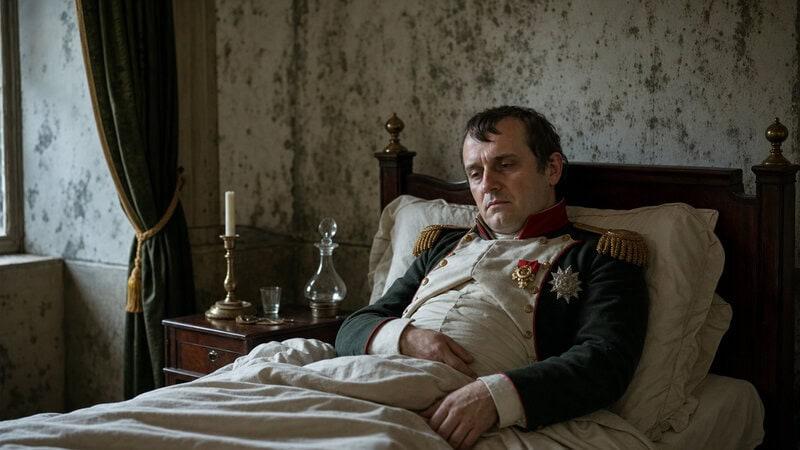

At 5:49 PM on 5 May 1821, as a storm rolled in off the South Atlantic and hammered the cliffs of Saint Helena, Napoleon Bonaparte — the man who had once commanded the fate of half of Europe — drew his last breath in a damp, mold-streaked bedroom at Longwood House. The official verdict came the next morning, neat and untroubling: stomach cancer. But a lock of his hair, snipped at the deathbed and scattered across the world in private collections and museum drawers, would spend the next two centuries quietly dismantling that verdict.
A Prisoner at the Edge of the World

Saint Helena was chosen for Napoleon’s imprisonment with brutal precision. A volcanic speck rising from the South Atlantic roughly 1,200 miles from the nearest continent, it was patrolled by the Royal Navy following his defeat at the Battle of Waterloo in June 1815 and was, for all practical purposes, inescapable. The British government wanted Napoleon contained, and Saint Helena was as close to the edge of the world as a living man could be placed.
Longwood House, the residence assigned to him on the island, offered a different kind of cruelty — slow, ambient, and deniable. Its walls wept with moisture. Rats moved through its rooms at night. The prevailing winds off the ocean were cold and relentless, and the climate conspired to keep everything perpetually sodden. Napoleon reportedly described the atmosphere as “the damp of the tomb.” The British administrator Hudson Lowe, a rigid and humorless man whom Napoleon despised, was accused by the French entourage of wielding these miserable conditions as a form of punishment that required no decree and left no fingerprints.
Around Napoleon in his final years moved a small, loyal court in miniature: his physician Barry O’Meara, who quarreled so persistently with Lowe over the adequacy of Napoleon’s medical care that he was eventually expelled from the island; French courtiers who had followed their emperor into exile; and a rotating cast of British officials whose role was as much surveillance as administration. Napoleon was the most famous prisoner alive, and Britain had powerful reasons — diplomatic, symbolic, practical — to want his story resolved quietly.
When the autopsy was carried out on 6 May 1821, a team of physicians, both British and French, gathered at Longwood and spent hours examining the body. Their conclusion was stomach cancer complicated by bleeding gastric ulcers — a diagnosis that was, for the British government, almost too convenient. Cancer was nature’s verdict. It implicated no one. It closed the file.
But the cracks appeared almost immediately. O’Meara had warned years earlier of liver disease. Several French physicians at the autopsy quietly dissented from the cancer conclusion, suspecting hepatitis or another condition tied to the island’s pestilential climate. And Napoleon himself, in his final dictated memoirs, accused the British of poisoning him — a claim contemporaries largely dismissed as the bitter theater of a humiliated emperor who could not accept that history had simply moved on without him. Without modern toxicology, the doctors of 1821 had no instrument capable of tracing what had been accumulating in his tissues for years. That instrument would eventually exist. And it would speak through his hair.
The Hair Evidence: Arsenic in Extraordinary Quantities
The forensic rupture came in the 1960s, when Scottish toxicologist Hamilton Smith applied neutron activation analysis — a technique that bombards a sample with neutrons to identify elemental composition — to a lock of Napoleon’s hair. What he found was not a trace, not a minor anomaly. The arsenic levels were reported to be far above what is considered normal in a healthy person. The official story had just been thrown into serious doubt.
Subsequent studies confirmed it was not a fluke of a single contaminated lock. A multi-laboratory analysis conducted around 2001 examined hair samples held in collections across Europe and the United States — hair taken from Napoleon at different points in his life and after his death — and found the same alarming arsenic concentrations recurring across them. The consistency across independent samples and institutions made simple laboratory contamination an implausible explanation.
What chronic arsenic poisoning actually does to a human body is, in retrospect, almost grotesquely consistent with what Napoleon’s doctors recorded in his final years. It causes swollen legs, persistent nausea, dramatic fluctuations in body weight, and a pallor of the skin that observers noted with unease. It mimics, with cruel precision, a range of other conditions — including symptoms associated with gastric disease. A nineteenth-century physician armed only with observation had no reliable way to distinguish arsenic’s slow signature from the presentation of cancer or liver failure.
More troublingly, the arsenic levels found in different segments of the hair — each segment representing a different period of time — spiked and receded rather than running uniformly high. This pattern is consistent with repeated exposures across months or years, not a single acute dose. That irregularity is what transformed the forensic finding from a curiosity into a genuine historical argument, because it forces a direct question: if something was introducing arsenic into Napoleon’s body repeatedly over time, what was it, and was it deliberate?
Murder, Medicine, or Moldy Wallpaper?

The deliberate poisoning theory has a prime suspect. Charles de Montholon, a French courtier who remained close to Napoleon throughout his Saint Helena exile, has been identified in some analyses as the most plausible agent of intentional poisoning. He had financial motivations — Napoleon’s will treated him generously — and he had the access and proximity to administer arsenic gradually, most plausibly through the wine that Napoleon drank regularly. In this reading, Napoleon’s death on Saint Helena was not the verdict of nature or illness but a slow assassination executed by someone sleeping under the same leaking roof.
A counter-theory arrived in the early 2000s that shifted the argument considerably. Researchers pointed to the wallpaper of Longwood House, which was colored with Scheele’s Green — an arsenic-based pigment fashionable in nineteenth-century interior decoration. In the chronic damp of Saint Helena, a mold called Scopulariopsis brevicaulis could colonize that wallpaper and convert the arsenic pigment into a volatile gas. Napoleon slept in those rooms night after night, breathing whatever the walls exhaled. In this version, no assassin was required — just mold, moisture, and the era’s casual indifference to the toxicity of its own aesthetic choices.
A third angle complicates everything further. Napoleon’s doctors, in his final days, dosed him heavily with tartar emetic — antimony potassium tartrate — as treatment. The medical practices of the early nineteenth century were, by modern standards, often as dangerous as the diseases they addressed. Some researchers argue that the real cause of Napoleon’s death was not cancer, not deliberate poisoning, and not wallpaper alone, but a lethal combination: a body already weakened by chronic low-level arsenic exposure, then battered by aggressive medical intervention that finished what the island had started.
None of these theories has achieved scientific consensus. The arsenic in his hair is real and well-documented. The source remains genuinely disputed. And that unresolved tension — murder, accident, or slow environmental poisoning — is precisely what has kept this case alive across more than two centuries of forensic argument.
What Modern Science Has — and Hasn’t — Resolved

A 2021 study revisited Napoleon’s stomach tissue, preserved since the 1821 autopsy, and found no definitive evidence of cancer cells — a finding that seriously weakened the original verdict and reopened the cause-of-death debate. The gastric cancer diagnosis, once presented as settled science, is now far less certain than the confident physicians of Longwood House ever intended it to be.
Forensic hair analysis is a powerful but limited instrument. It can establish, with real precision, that a substance entered the body and approximately when. What it cannot do is identify the source. Arsenic in Napoleon’s hair tells us arsenic was present; it does not tell us whether it arrived via wallpaper, wine, medicine, or some overlapping combination of all three. That interpretive gap is where historians and forensic scientists continue to argue most fiercely.
There is also a broader context that any responsible reading of the evidence must acknowledge. Arsenic was so ubiquitous in nineteenth-century daily life — present in medicines, dyes, cosmetics, preserved foods, and cheap candles — that elevated levels in a person of that era, while alarming by modern standards, cannot by themselves prove deliberate poisoning without corroborating evidence. Napoleon’s arsenic levels were dramatically elevated, but he lived in a world that was, by our current measures, poisoned at the baseline.
Further testing is now almost impossibly difficult. Napoleon’s remains were returned to France in 1840 and interred beneath a massive sarcophagus at Les Invalides in Paris, making additional physical sampling politically and practically impractical. The physical record, for all intents and purposes, is largely exhausted. What remains are the hair samples already in circulation, the preserved tissue from 1821, and the arguments they continue to generate.
Why the Question Still Refuses to Die

Napoleon’s death on Saint Helena was never only a medical event. It was a political one, and the manner of his dying shaped how he was mythologized across the nineteenth century and beyond. A Napoleon killed by stomach cancer is a Napoleon defeated by his own body, by time, by the ordinary cruelty of biology. A Napoleon poisoned — by his captors, by a treacherous courtier, by the very house in which he was imprisoned — is something closer to a martyr: a man destroyed by enemies who could not beat him in the field and so resorted to slower weapons.
The arsenic debate matters, in part, because the story we tell about how Napoleon died is inseparable from the story we tell about what his life meant. Britain’s reputation, the loyalty of the French imperial court, the justice or injustice of the Saint Helena exile — all of it shifts depending on which version of events you accept. These are not merely academic questions. They have shaped how France and Britain remembered the Napoleonic era and how the man himself has been portrayed across two centuries of biography, film, and nationalist mythology.
The case also illuminates something more universal about how forensic science and history collide. A lock of hair, a scrap of green wallpaper, a stomach biopsy sealed in a jar for 200 years — these improbable artifacts can overturn the confident verdicts of official medicine and official history alike. They keep reopening doors that powerful institutions tried to close.
What persists, beneath all the competing theories, is an image that is genuinely difficult to shake: the man who reshaped the map of Europe, who survived campaigns across Egypt, Italy, Russia, and a hundred smaller catastrophes, spending his last years pacing the rooms of a moldy house on a speck of rock in the middle of an empty ocean — his body slowly accumulating a poison whose precise source we still, after everything, cannot name with certainty. Napoleon’s hair is now among the most forensically examined artifacts of his entire reign. Cut at his deathbed, distributed to followers and collectors, scattered across the world in museum vaults and private cases, it is still giving up secrets — still refusing, stubbornly and almost willfully, to let the story end.

 Arabic
 French
 Spanish
 Portuguese
 Deutsch
 Turkish
 Dutch
Dutch
 Italiano
 Russian
 Romaian
 Portuguese (Brazil)
 Greek
Greek