


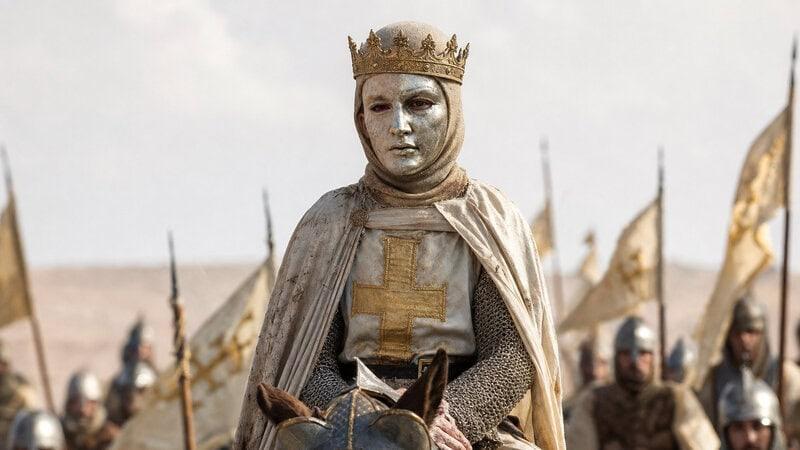

He was sixteen years old, half-blind, his hands so ravaged by disease that he could not grip a sword — and yet on a desert plain south of Jerusalem in November 1177, he had himself strapped to his saddle and led a charge that would make one of history’s greatest generals turn and run.
A King on Horseback, Barely Held Together

The plain of Montgisard, November 25, 1177. Saladin’s army — tens of thousands strong, flushed with confidence and moving fast — had effectively bypassed the small Crusader force and was bearing down on Jerusalem itself. The calculation seemed simple: the young king of Jerusalem was sick, his body breaking down in ways visible to anyone who looked at him, and his kingdom was held together by little more than stubborn will and the loyalty of men who refused to stop believing in him. Saladin believed the moment had finally come.
He was wrong.
Baldwin IV of Jerusalem — born around 1161, crowned king at thirteen, dead at twenty-four — spent his entire reign in a race he knew he could not ultimately win. Leprosy was consuming him in real time: first the numbness in his limbs, then the loss of sensation in his hands, then his sight dimming and finally failing, and eventually the near-complete collapse of his body’s ability to protect itself from infection. Every year of his reign, the disease advanced. Every year, by all reasonable expectation, should have been his last effective year as a ruler. And yet armies followed him, courts bent to his will, and enemies — including Saladin himself — were recorded as recalibrating their plans when they learned he was personally present in the field.
This is not, at its core, a story about suffering. It is a story about what a human being can refuse to surrender.
The Diagnosis That Should Have Ended Everything

The first sign came quietly, as the worst things often do. Baldwin was still a boy when his tutor, the chronicler William of Tyre, noticed something unsettling during play: the boy felt no pain when his arm was pinched or scratched. In a healthy child, that might be a curiosity. In the context of the medieval Mediterranean world, it was an alarm bell that never stopped ringing. The loss of sensation was among the earliest recognizable symptoms of leprosy — a disease that would, in the years ahead, systematically dismantle his body from the nerves outward.
Medieval society’s understanding of leprosy extended far beyond the medical. It was widely regarded as a kind of living death — associated with moral corruption, divine punishment, and a contagion so feared that lepers across Europe and the Levant were legally stripped of property rights, barred from public spaces, and in some jurisdictions treated as civilly dead. A diagnosis was not simply bad news; it was, for most people, social obliteration.
Except Baldwin was already heir to the throne of Jerusalem, the most embattled crown in Christendom. Nobody could simply look away, reassign him, or pack him off to a leper colony. The kingdom needed a king, and he was the king it had. His reign from 1174 onward was never structured around whether the disease would worsen — it would, and everyone knew it would — but around how much he could accomplish before it did.
The Kingdom He Inherited: A Crown Made of Pressure

To understand what Baldwin walked into at thirteen, you have to understand the geography of desperation that was the Crusader Kingdom of Jerusalem in the 1170s. It was a thin coastal strip of Christian-held territory — ports, fortresses, and the holy city itself — surrounded by a Muslim world that was, for the first time in decades, unifying under a single, extraordinarily capable leader. Saladin had consolidated power in Egypt and Syria and was methodically tightening his grip around every Crusader-held position.
Inside the kingdom, the situation was no less volatile. The court was a nest of competing ambitions: powerful barons who had spent years maneuvering around a sick king assumed that whoever controlled the boy controlled the throne. Many expected a short regency followed by a rapid collapse. They underestimated him badly.
Even as a teenager, Baldwin IV refused the role of figurehead. He asserted royal authority, played factions against each other with a sophistication that surprised men twice his age, and positioned himself as a genuine ruler rather than a symbol to be managed. The survival of Crusader Jerusalem in those years depended on this boy holding fractious noblemen together through force of personality and political intelligence — a task made almost surreally harder by the fact that his body was visibly failing him the entire time.
Montgisard: The Battle That Made a Legend

Which brings us back to that desert plain, and the moment that would define how history remembers the leper king of Jerusalem.
Saladin’s army in November 1177 was operating on the reasonable assumption that Baldwin could not respond effectively. The Crusader force available was small — roughly five hundred knights and a modest infantry — against an enemy that dwarfed them in every measurable way. The logical move, by conventional military thinking, was to avoid engagement and protect what could be protected.
Baldwin made the illogical move. He gathered his knights, drove them hard through the desert, and launched a surprise assault that caught Saladin’s formation strung out and unprepared near Ramla. The attack shattered the Muslim force, triggering a rout that left Saladin’s army severely damaged and the general himself fortunate to escape. It was one of the most stunning upsets of the entire Crusades period — delivered by a teenage king whose leprosy had already advanced far enough that he required physical support to remain in the saddle at all.
The Battle of Montgisard became legendary almost immediately, and not only because of the tactical audacity involved. It was legendary because of who won it. Every soldier on that field could see what was happening to their king. They followed him anyway — and they fought, by every account, with a ferocity that reflected something beyond normal military discipline.
Saladin’s Reluctant Respect — and His Hesitation

Something important happened in the years that followed Montgisard, something that speaks to Baldwin’s impact beyond any single engagement. Saladin — one of the most calculating and strategically disciplined commanders the medieval world produced — was documented by contemporaries on both sides as a leader who recalibrated his plans when he knew Baldwin IV was personally present in the field. Not out of superstition. Out of tactical reality.
Baldwin’s presence unified Crusader forces in a way that no amount of strategic positioning could replicate. It signaled, concretely and visibly, that the kingdom had not collapsed inward. It sent a message to every knight on the field: if this man can be here, you have no excuse to falter. The morale effect of his presence was measurable in the behavior of his enemies as much as his allies.
There is a cruel irony woven into this: as Baldwin’s body failed more completely — as he lost his sight, the use of his hands, and eventually the ability to walk — his symbolic power paradoxically grew. The worse he visibly became, the more profound the statement his presence made. A man who could no longer see the enemy, who had to be carried to the field, who had not been able to grip a weapon in years — and who still showed up. That is not something an enemy general can easily calculate around.
Governing While Dying: The Politics of a Failing Body

By his early twenties, Baldwin was effectively blind, unable to use his hands, and being carried on a litter to councils and courts that were expected to defer to him. And they did defer to him — because even in that condition, he governed. He made decisions. He navigated the vicious factional politics of a court that circled him like wolves waiting for the moment of final weakness.
The question that consumed his later reign was succession. He had no children and could not produce heirs. The pressure from nobles and the church to resolve this — to name someone, to arrange a marriage, to secure the future of the kingdom — was relentless, and the options available to him were all deeply flawed. The marriage of his sister Sibylla to Guy of Lusignan, a match Baldwin reportedly opposed and ultimately could not prevent, planted the seed of a political crisis that would outlive him. Within two years of his death, Guy’s military failures would contribute directly to the catastrophe at the Battle of Hattin and the fall of Jerusalem to Saladin.
Baldwin understood, with the clarity that dying people sometimes achieve, that his death was coming fast and that it would very likely trigger the collapse he had spent everything holding back. He ruled Jerusalem from 1174 until near the end of his life, never abdicating, never retreating behind the curtain of his illness. More than a decade of almost continuous crisis, managed by a man whose body was being systematically destroyed the entire time.
March 1185: What He Left Behind
Baldwin IV died in March 1185, from infection arising from his leprosy. He was twenty-four years old and had been king for more than a decade.
The reckoning came quickly. Within two years, Saladin crushed the Crusader army at the Battle of Hattin — a catastrophic defeat that Baldwin had spent his entire reign maneuvering to prevent — and retook Jerusalem. The kingdom that the leper king had held together through will, tactical brilliance, and sheer refusal to stop functioning came apart almost as soon as he was no longer there to hold it.
History has not been kind to many of the figures who surrounded Baldwin IV — the scheming barons, the ill-chosen regents, the commanders who failed where he had succeeded. But it has remembered him with something that functions very much like awe. Among the crusader kings of Jerusalem, he stands apart not despite his affliction but, in some strange way, because of the contrast it created: the more the disease took from him, the more he seemed to give back in defiance.
He could not hold a sword in his final years. He could not see the armies he commanded. He could not feel the ground beneath feet that could no longer carry him. And one of the medieval world’s most formidable generals still hesitated when he heard the leper king was on the field — because the man who could not hold a sword had already proven, on a desert plain in November 1177, that he didn’t need one.

 English
 Arabic
 French
 Spanish
 Deutsch
 Turkish
 Dutch
Dutch
 Italiano
 Russian
 Romaian
 Portuguese (Brazil)
 Greek
Greek