


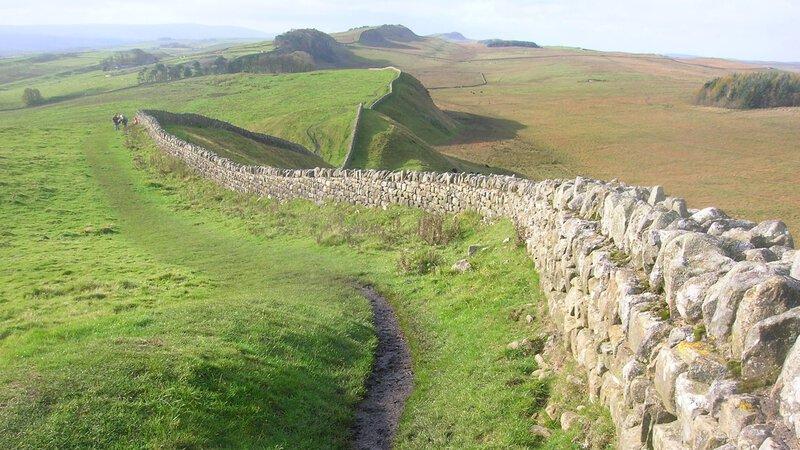

In AD 122, the Emperor Hadrian stood somewhere on the windswept spine of northern Britain — peat underfoot, grey sky pressing down, the distant glitter of moorland streams cutting through a landscape that looked nothing like Rome — and gave an order that would reshape the island for centuries. His legions were to cut stone, haul timber, and draw a line across the width of the entire country. What they built would become the longest continuous Roman defensive barrier in the empire: Hadrian’s Wall, stretching 73 miles from the Solway Firth in the west to the mouth of the River Tyne in the east, coast to coast, ridge to ridge, an act of imperial will made permanent in limestone and turf.
The Myth Worth Retiring

Ask almost anyone why Hadrian’s Wall was built, and you’ll hear a version of the same story: it kept out the Scots. It’s a tidy answer, and it’s wrong in almost every meaningful way. The people living north of the wall in the second century AD were Caledonian and Pictish tribal groups — culturally and politically distinct peoples who had nothing to do with the Scots as a nation or an identity. The word “Scot,” and the kingdom it eventually described, wouldn’t attach to that territory for several more centuries. Projecting modern national labels onto ancient tribal Britain is roughly equivalent to calling the legions who built the wall “Italians.”
But there’s a deeper problem with that myth, one any Roman military commander would have recognised immediately: walls don’t stop armies. A determined force can go around a wall, over it, or through it at a point of weakness. Roman generals understood this perfectly. Static barriers were never designed to repel invasion the way a castle gate repels a battering ram. So if Hadrian’s Wall wasn’t a sealed military fortress shutting out northern tribes, what was it actually for? The real answer is more interesting — and more revealing about how the Roman Empire functioned in practice — than the schoolbook version allows.
The Empire Hadrian Inherited

To understand Hadrian’s Wall and its place in Roman history, you have to understand the empire Hadrian inherited. His predecessor, Trajan, had been an expansionist in the grand tradition: he pushed Rome’s borders into Dacia (roughly modern Romania), into Mesopotamia, and into Arabia. By the time Hadrian came to power in AD 117, the empire was enormous — and dangerously overstretched. Supply lines were long, garrisons were thin, and freshly conquered territories were restless. Hadrian made a decision that would define his reign: Rome would stop expanding and start consolidating.
This wasn’t a military retreat so much as a strategic maturation. Hadrian travelled the frontiers of his empire in person — an extraordinary act for a sitting emperor — inspecting defences, reforming armies, and commissioning permanent barriers where natural geography didn’t already provide them. The wall in Britain was part of a continent-wide reimagining of what Rome’s edges should look like and how they should function. Along the Rhine and Danube, Rome relied on river barriers and timber palisades known collectively as the limes. In Britain, Hadrian chose stone.
Britain itself had been a particular headache. The conquest begun under Claudius in AD 43 had never been completed in the north. The far reaches remained ungoverned, contested, and expensive to police with roving legionary columns that consumed supplies without delivering lasting control. Hadrian’s Wall, begun in AD 122, was the Roman answer to a frontier management problem that had nagged at the province of Britannia for the better part of a century. The construction itself was carried out by legionary soldiers — primarily the Second, Sixth, and Twentieth Legions already stationed in Britain — working in sections from east to west. The original plan called for a width of ten Roman feet in stone, though portions were later built narrower as the project was modified during construction, a sign that the design evolved as work progressed.
A Border Control System, Not a Fortress Wall

Here is the detail that changes everything: Hadrian’s Wall had gates. Lots of them. Every Roman mile along the wall’s length, a small fortified gatehouse called a milecastle was built, each with a gate on both its north and south faces. Between milecastles, pairs of observation towers called turrets kept watch over the surrounding landscape. At larger intervals, full auxiliary forts — eventually around sixteen of them, including well-preserved sites such as Housesteads and Chesters — held garrison troops ready to respond to trouble or to process significant movements of people and goods.
This is the architecture of a customs system, not a sealed barrier. Traders, herders moving livestock between seasonal pastures, tribal leaders coming to negotiate, travellers seeking markets — all of them could pass through designated checkpoints under Roman oversight. The wall controlled and regulated movement rather than eliminating it. In this sense it functioned less like a fortress rampart and more like a heavily administered international border, complete with the friction, the tolls, and the bureaucratic logic that borders have always carried.
The soldiers who staffed this system were themselves a remarkable cross-section of the Roman world. The garrisons along Hadrian’s Wall were not Roman legionaries in the traditional sense but auxiliary troops drawn from across the empire — Batavians from the Rhine delta, Gauls from what is now France, Tungrians from modern Belgium, and Syrians from the eastern provinces, among many others. Altars and inscriptions found along the wall record these men worshipping their home gods alongside Roman deities and writing dedications in languages spoken across three continents. One famous group of wooden writing tablets discovered at Vindolanda, a fort just south of the wall, preserves the domestic texture of garrison life in extraordinary detail: requests for warm socks and underwear sent home, birthday dinner invitations, complaints about road conditions, and shopping lists. The wall was a lived world — cold, muddy, provincial, and intensely human.
One more structural feature deserves careful attention. The wall did not stand alone in the landscape. To its north ran a V-shaped ditch, an obvious defensive feature oriented toward potential threats from outside Roman territory. But to the south of the wall ran a separate and distinct earthwork — a broad, flat-bottomed channel flanked by raised banks known as the vallum. This southern barrier controlled access to the wall from within Roman Britain itself. Its existence suggests the Romans were managing their own population as carefully as any northern threat — regulating who could approach the military zone, preventing smuggling, and enforcing order in both directions. The wall, in other words, faced inward as much as it faced outward.
The Softer Power Behind the Stone

Roman imperial architecture was never purely functional. A wall stretching from sea to sea, cutting the entire island of Britain in two, announced something to everyone who encountered it: here is where Roman civilisation ends, and something else begins. That announcement was aimed as much at Rome’s own subjects as at any northern tribe. Hadrian needed to demonstrate that pulling back from perpetual conquest was not weakness — that defining a frontier permanently was itself an expression of power and deliberate intent rather than an admission of failure.
The northern tribes were not a monolithic enemy, either. Some groups beyond the wall were Roman client peoples — allies who traded, who sometimes furnished soldiers for Roman units, who navigated relationships of mutual advantage with the province. The wall helped Rome manage those relationships by providing a fixed physical point of engagement, a place where diplomacy and commerce could occur on Roman terms and under Roman oversight. Empire, in practice, is rarely a clean story of us against them.
A Wall That Kept Revising Its Own Story

The history of Hadrian’s Wall after its construction is a story of constant revision. Within roughly two decades of the wall’s completion, the Romans pushed further north into what is now Scotland and began constructing a second barrier — the Antonine Wall — across a narrower isthmus between the Firth of Forth and the Firth of Clyde, a distance of approximately 39 miles. For a period, Hadrian’s Wall became a secondary line, its purpose temporarily superseded by Roman ambitions further north.
But the Antonine Wall was abandoned within a generation — by around AD 160 under the Emperor Marcus Aurelius — and Hadrian’s Wall was recommissioned as the active frontier. This cycle of advance, retreat, reactivation, and modification repeated itself across the roughly three centuries during which Roman Britain existed as a functioning province. The wall was not a fixed answer to a fixed problem. It was a tool the empire picked up, put down, and reshaped as political and military circumstances demanded. Major rebuilding took place under Septimius Severus in the early third century after significant damage, and the garrison forts were reconfigured and expanded more than once over the wall’s operational life.
The end, when it came, was not dramatic. As Roman authority in Britain unravelled in the early fifth century, the garrisons were not overwhelmed in some climactic battle. They were simply not replaced, not paid, not reinforced. The wall was walked away from. Local communities later quarried its stones for churches, farmhouses, and field boundaries — which is why some sections survive remarkably intact while others have almost entirely disappeared. The stretches that remain most complete today, particularly the central section running through the Northumberland uplands near Housesteads and Steel Rigg, tend to be those crossing terrain remote and rugged enough that medieval builders found it simpler to leave the stones where they lay. The wall’s current status as a UNESCO World Heritage Site, designated in 1987 as part of the Frontiers of the Roman Empire inscription later extended to include the Antonine Wall and the German limes, reflects both its exceptional preservation and its significance as a document of Roman frontier strategy at continental scale.
Visiting and Walking the Wall Today

For those who want to experience Hadrian’s Wall directly, the options range from a short afternoon visit to a full multi-day walk. The 84-mile Hadrian’s Wall Path National Trail runs the length of the frontier from Wallsend in the east to Bowness-on-Solway in the west, passing through open moorland, farmland, and riverside towns along the route. Key sites managed by English Heritage — including Housesteads Fort, Chesters Fort, and Birdoswald — offer on-site museums with original altars, inscriptions, and everyday objects recovered from excavations. The Vindolanda Trust, which manages the site immediately south of the wall, continues active excavation and has produced some of the most significant finds in Roman archaeology in recent decades. Practical visitor information, including seasonal access, guided walk programmes, and transport links, is available through Hadrian’s Wall Country, the official destination resource for the region.
The best stretches for dramatic scenery follow the Whin Sill — a ridge of hard volcanic dolerite whose steep northern escarpment the Romans exploited as a natural defensive advantage — between Housesteads and Cawfields. Walking here in low winter light, with the stone coursework rising and falling over the crags and the moorland dropping away to the north, makes the scale of the engineering achievement viscerally clear in a way that photographs do not quite capture.
What the Wall Really Tells Us
Hadrian’s Wall is not, in the end, a monument to Roman military might. It is a monument to Roman imperial calculation — to the moment when the most powerful state in the Western world acknowledged that it could not govern everything, and chose instead to define precisely the shape of what it could. The wall was built not to keep barbarians out but to manage a complex, expensive, and perpetually unstable frontier through infrastructure, surveillance, regulated commerce, and the projection of permanent, visible intent.
That is a recognisably old human story. Borders constituted from stone, law, and identity rather than from pure military force have been a feature of organised societies for as long as organised societies have existed. Hadrian’s Wall forces a question that the emperor himself may have stood on that windswept ridge turning over: where does the world you govern actually end, and what does it cost to pretend the answer is simple?
Walk the wall on a cold afternoon, with the wind coming in hard off the north and the stone glowing dull gold in the last of the light, and that question doesn’t feel historical at all. It feels immediate — which is, perhaps, exactly why a second-century emperor’s frontier problem is still worth thinking carefully about today.

 English
 Arabic
 French
 Spanish
 Portuguese
 Deutsch
 Turkish
 Dutch
Dutch
 Italiano
 Russian
 Portuguese (Brazil)
 Greek
Greek