


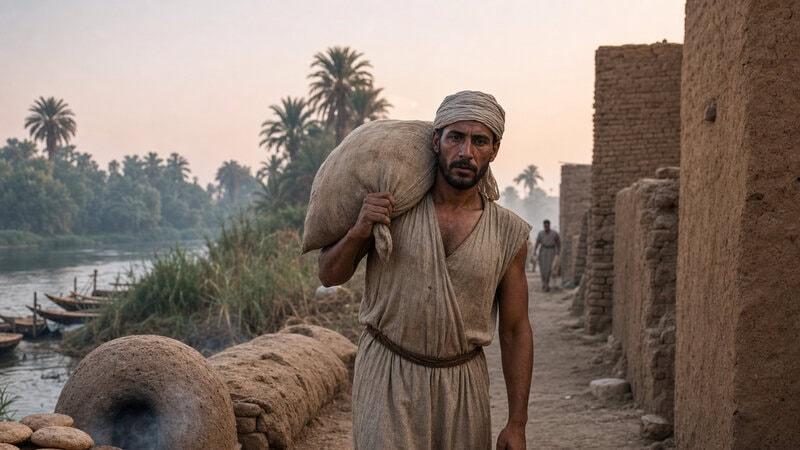

The smell hits you first — warm bread baking in clay ovens before the sun has fully cleared the eastern desert, mixing with the green, muddy breath of the Nile as it slides past in the grey-pink light of early morning. A man is already moving through the narrow lane between mudbrick walls, a sack balanced on one shoulder, heading toward the grain stores before the day grows too brutal to bear. He will not handle a single coin today. He never has.
Who You Would Actually Meet

Forget the pharaohs for a moment. Forget the gold death masks and the vast stone faces staring out of temple walls. If you could somehow achieve the impossible — if time travel to ancient Egypt became real — the odds are almost certain that you would land not in a palace but in a village like this one: a cluster of low houses beside an irrigation channel, smelling of baking bread, animal dung, and river water. You would be surrounded not by priests and nobles but by farmers, potters, weavers, and grain-workers who kept an entire civilization fed.
This is where ancient Egyptian life actually lived — in the ordinary hours, the daily transactions, the quiet fears and small pleasures of people whose names were almost never carved in stone. Understanding what daily life in ancient Egypt looked like for these people changes everything about how we see those monuments shimmering on the horizon.
It also corrects several persistent distortions. Ancient Egypt lasted for roughly three thousand years — longer than the gap between Julius Caesar and today — so no single portrait captures every era or region. What follows draws primarily on the New Kingdom period (approximately 1550 to 1070 BCE), when the archaeological and documentary record is richest, while noting where practices differed across time.
What They Actually Ate and Drank

The grain-worker heading out at dawn will eat bread. He will eat it at midday. He will eat it again in the evening. This is not poverty — this is ancient Egyptian nutrition, and bread was its absolute backbone. Archaeologists and historians have documented dozens of distinct varieties of bread in ancient Egypt, ranging from the coarse, gritty loaves made from emmer wheat that fueled manual laborers to the fine, carefully shaped pastries reserved for temple offerings and royal tables.
The coarseness of worker bread was significant in the worst way: millstone grit regularly ended up in the flour, wearing down teeth to the root over a lifetime. Egyptian skeletal remains show this damage with startling consistency. Dental attrition so severe it exposed the pulp cavity has been documented across multiple excavation sites, including burials at Giza associated with the pyramid workforce.
Alongside bread, there was beer. Not as a treat or a vice, but as a daily staple consumed by adults and children alike. The ancient Egyptian word for it was heqet, and it was thick, slightly sour, nutritionally substantial, and far safer to drink than Nile water drawn near settlements. Workers engaged in state building projects were issued documented daily rations of grain, bread, beer, and vegetables — effectively a salary denominated in calories rather than currency. Papyri and ostraca from multiple sites confirm that payment in grain and goods was standard practice across the working population throughout most of Egyptian history.
Onions, garlic, leeks, lentils, and fish rounded out the everyday diet. The Nile was extraordinarily generous with fish, and dried or salted varieties were common across all social levels. Meat — duck, cattle, goat — appeared at festivals and on wealthy tables but was genuinely rare for most families. Ancient Egypt’s food culture revolved around what the river and the flood-enriched soil could reliably provide, and for most people that meant a plant-heavy, grain-centered existence that was reasonably nutritious, if monotonous by any modern measure.
The Economy of Everyday Life: No Coins, No Problem

Here is one of the most disorienting ancient Egypt facts for a modern reader: coined money did not exist in Egypt for the vast majority of its dynastic history. Coinage arrived only very late, becoming significant under the Ptolemaic rulers after 305 BCE. For the thousands of years before that, the entire Egyptian economy — from grand temple construction to a village woman buying a new clay pot — ran on barter and a system of standardized weight-value equivalencies using a unit called the deben.
A worker paid in grain could carry a measured portion to an open market and trade it directly for sandals, linen cloth, a fish, or a wooden stool. Prices were understood and negotiated in terms of copper or grain weight, so a skilled tradesperson could calculate the value of their goods against a reference commodity. Barter was not a primitive fallback — it was the deliberately engineered system of exchange, and it worked with considerable sophistication across a complex, stratified society.
The village of Deir el-Medina, occupied roughly between 1550 and 1070 BCE, gives historians their clearest window into working-class Egyptian economics. Built to house the craftsmen and workers who carved and decorated the royal tombs in the Valley of the Kings, its inhabitants left behind an extraordinary archive of ostraca — inscribed pottery shards and limestone flakes — recording wages, debts, personal disputes, and complaints in granular detail.
When grain rations ran late, the workers of Deir el-Medina did something remarkable: they walked off the job. They gathered at a temple enclosure and refused to work until their overdue payments arrived. They sent formal complaints up the administrative chain. Historians now recognize this as one of the earliest recorded labor strikes in human history, documented from the reign of Ramesses III in approximately 1158 BCE. Their grievances — late pay, inadequate rations, broken promises from management — are recognizably ours.
What They Wore, and Why It Wasn’t What You Picture

The fabric of ancient Egypt was linen, not cotton. It was produced from flax cultivated along the Nile, then spun and woven into cloth ranging from coarse sacking to something almost transparently fine — the latter a luxury that wealthy Egyptians wore with visible pride and that survives in remarkable condition in tomb collections. Most working Egyptians wore a simple draped kilt, often a single piece of linen wrapped and tucked at the waist. Women typically wore a straight sheath dress. In the brutal heat, male workers frequently went bare-chested, as tomb paintings and figurines document consistently.
One of the most counterintuitive details of ancient Egyptian daily life is cosmetics. Both men and women — at every social level — wore kohl eyeliner. The black pigment, made from galena or stibnite ground fine, was believed to protect the eyes from solar glare and to carry spiritual protective power. But research published in peer-reviewed chemistry journals, including work drawing on the Louvre’s collection of ancient Egyptian cosmetic containers, has also found that lead compounds in kohl at low concentrations may have stimulated the production of nitric oxide, offering a genuine if modest antimicrobial benefit. Protective magic and practical medicine were, in the ancient Egyptian mind, not separate categories at all.
Jewelry completed the picture at every level of society. Amulets of faience — a glazed quartz-based ceramic in brilliant blues and greens — copper bangles, and beaded broad collars were worn by the wealthy and the ordinary alike. These were not decorative accessories in the modern sense. They were wearable religion: each piece intended to attract divine protection, deflect illness, and keep the wearer safe in a world that felt comprehensively dangerous. The same blue-green faience bead that adorned a noblewoman’s collar might also hang around the neck of a child in a mudbrick house two streets from the river.
What Ordinary Egyptians Feared

The deepest anxiety in an ordinary Egyptian’s life was not political. It was hydrological. The Nile flooded every year between June and September, and the height of that flood determined whether families ate or starved. A flood too shallow left fields unwatered and unsilted, guaranteeing a thin harvest and real hunger. A flood too violent swept away villages, drowned livestock, and destroyed the irrigation infrastructure that made large-scale agriculture possible. An ordinary Egyptian watching the Nile rise in midsummer was watching the year’s verdict arrive, and there was nothing to do but make offerings, pray, and wait.
More immediately, the physical world bristled with mortal threat in very specific ways. Scorpions hid in sandals left outside overnight. Cobras moved through grain stores. Crocodiles were a genuine danger at the river’s edge — and the river was also where people washed, collected water, and fished. Surviving magical texts on papyrus and amulets show that spells against snakebite and scorpion sting vastly outnumber almost any other protective category. These were not exotic ceremonial concerns. They were urgent, repeated needs across thousands of years and countless villages up and down the valley.
Disease and infant mortality shaped daily life with terrible consistency. Skeletal evidence and medical papyri — including the Ebers Papyrus, dated to around 1550 BCE, which documents hundreds of remedies and diagnoses — reveal a population dealing chronically with intestinal parasites, eye infections, malaria, and childhood illness. Families prayed to Bes, a fierce dwarf deity depicted with a lion’s features and tongue extended, and to Taweret, shown as a pregnant hippopotamus standing upright, to protect mothers during childbirth and guard newborns through their most fragile months. The specificity of these gods is itself evidence: divine protection was concentrated precisely where human fear was most acute.
And beyond life, there was the urgent concern about death. Even poor families saved and planned for proper burial, for protective amulets to be placed with the body, for the funerary texts needed to navigate the afterlife’s judgment. The Book of the Dead — more accurately translated as the Book of Coming Forth by Day — existed in versions affordable to people well below the elite. Dying without spiritual protection was not an abstract theological worry for these communities. It was the ultimate catastrophe, and ordinary people treated it accordingly.
A Day in the Life: Dawn to Dusk on the Nile

Work began at first light and stopped in the crushing midday hours when the heat became genuinely dangerous to sustain physical labor. Records from Deir el-Medina, detailed enough to note individual absences and their stated reasons, show a workforce operating in two shifts with a midday rest, approximating what we might loosely call an eight-hour working day. Foremen recorded not just time and output but excuses — “ill,” “brewing beer,” “with the scribe,” and in one memorable ostracon, “stung by a scorpion.” Afternoons were for cooling, household tasks, and tending small kitchen gardens.
Home for most Egyptians was a mudbrick structure of two to four rooms. In rural and village settings, animals might occupy an attached pen or the ground level; the family lived above or alongside. In summer, the flat roof became sleeping space, catching whatever breeze the night offered. These homes were small and close together — genuine neighborhoods, where everyone knew the sound of their neighbor’s grinding stone before dawn.
Evenings brought leisure that might surprise anyone conditioned to think of ancient life as relentlessly grim. Storytelling was a beloved and sophisticated tradition; literary texts from the Middle and New Kingdoms survive that are clearly intended for entertainment, including tales of magic, adventure, and social satire. Music — harps, lutes, clappers, flutes, and percussion instruments — appears in countless tomb paintings depicting both formal banquets and informal household scenes.
Senet, a board game played on a grid of thirty squares, was pursued with something close to obsession across all social classes. Boards have been recovered from modest village contexts and from the tomb of Tutankhamun alike. The game combined strategy with a symbolic journey through the dangers of the underworld, making it simultaneously competitive entertainment and a meditation on mortality — a combination that would have seemed entirely natural to its players.
Festivals punctuated the calendar dozens of times each year and functioned as the great social equalizer. When temple doors opened and food was distributed publicly, when statues of the gods were carried through the streets in elaborate river processions, ordinary people were not spectators but active participants in the living drama of their world. These were official days off, occasions of free food, of color and noise and collective belonging that broke the monotony of agricultural routine.
Why This All Matters
Pull back now from the smells and sounds and look at the shape of a day in ancient Egypt — and notice how familiar it is. A man worrying about whether he will be paid on time. A mother pressing an amulet into her newborn’s wrappings. Workers deciding collectively that enough is enough and making their case to authority. Children playing in the dust outside a low doorway. The desire to eat well, rest adequately, protect what you love, and leave something behind when you go.
The calendar distance between that grain-worker moving through the pre-dawn lanes and any person reading this is enormous — three thousand years or more, across a world that has transformed beyond recognition. In terms of human nature, the gap closes to almost nothing. That is what makes the history of everyday life in ancient Egypt genuinely thrilling rather than museum-distant: the people were not alien. They were anxious, resourceful, superstitious, hardworking, capable of humor, and capable of collective action when pushed far enough.
The pyramids look different once you know this. They were not the product of some inhuman organizational force operating outside normal human experience, as fringe theories periodically insist. They were built by people who ate bread and drank beer, who grumbled about late rations, who went home in the evening to small mudbrick rooms and the sound of neighbors through thin walls. The achievement is not diminished by that knowledge. It becomes, if anything, considerably more astonishing — a monument not to mystery, but to what ordinary human beings, organized and motivated and fed, are capable of building.
The bread is coming out of the oven now. The Nile glitters under a sun that is just beginning to make the air above the fields shimmer. The grain-worker has reached the stores, set down his sack, and joined the line of others doing exactly what ordinary people have always done — showing up, getting on with it, and making a civilization in the hours between dawn and dark.

 English
 French
 Spanish
 Portuguese
 Deutsch
 Turkish
 Dutch
Dutch
 Italiano
 Russian
 Romaian
 Portuguese (Brazil)
 Greek
Greek