


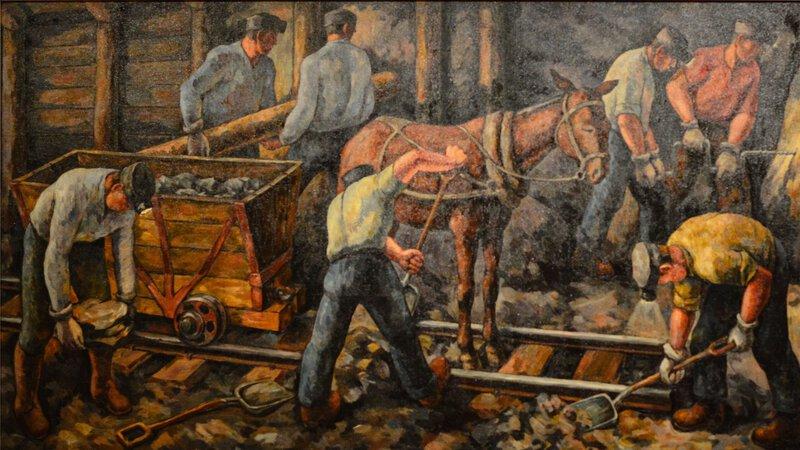

In 1939, residents of a small Georgia town packed into their local post office lobby and stared, furious, at a freshly unveiled painting on the wall. The mural showed Black and white cotton pickers working side by side — not as master and servant, not in the careful hierarchy the community considered natural, but as figures of equal compositional weight, equal human dignity. Letters flooded Washington. Demands were made. The paint, some insisted, had to go.
This was not an isolated incident. Across Depression-era America, in post offices from Georgia to Connecticut, newly hung government-commissioned paintings were provoking town meetings, congressional complaints, and threats of vandalism. The federal government had handed brushes and paychecks to thousands of out-of-work artists, dispatched them into the most democratic public spaces in the country, and then discovered — with apparent surprise — that art, real art, makes people profoundly uncomfortable.
How did a Depression-era jobs program become the unlikely battleground for American identity, race, and what the country dared to see of itself on a wall? The answer begins, as so many American stories do, with catastrophe.
America on Its Knees: The Crisis That Created the WPA

By 1935, roughly one in four American workers was unemployed. Breadlines stretched around city blocks. Men who had spent their lives as carpenters, teachers, painters, and engineers were selling apples on street corners or sleeping in makeshift shantytowns sardonically nicknamed Hoovervilles. President Franklin Roosevelt, facing enormous political pressure from both the left and the right, understood that writing relief checks was not enough — not economically, not psychologically, and certainly not politically.
On April 8, 1935, Congress approved the Emergency Relief Appropriation Act of 1935, releasing nearly five billion dollars — the largest single peacetime appropriation in American history to that point. Roosevelt used that authority to establish the Works Progress Administration that same year. The WPA’s founding logic was at once simple and radical: instead of a dole, give people work. WPA employees earned an average of $41.57 a month — modest by any measure, but a paycheck rather than charity, one that preserved dignity and kept skills alive during the worst economic collapse in American memory.
The agency’s ambitions were enormous. WPA workers built bridges, roads, public buildings, public parks, and airports. They mapped flood plains, catalogued folk songs, and inoculated children against disease. But one small, almost accidental subdivision — Federal Project Number One — would leave a mark on American culture that outlasted every road the agency ever paved.
Federal Project Number One: When Washington Decided Art Was Work

Federal Project Number One launched in 1935 and was divided into four wings: the Federal Art Project, the Federal Writers’ Project, the Federal Theatre Project, and the Federal Music Project. Each was led by directors who were working artists themselves — people who understood that creative labor was still labor, and that the unemployment of a painter was as real as the unemployment of a bricklayer.
The Federal Art Project alone employed roughly ten thousand artists at its peak, people who had been reduced, in many cases, to genuine destitution. The government’s position was brisk and unprecedented: artists are workers, unemployment is unemployment, and a mural is as much a public work as a bridge. The WPA’s broader mission was to employ millions through public projects, and art was simply one more form of public infrastructure.
The post office became the program’s signature canvas. Through a related Treasury Department initiative — formally the Section of Painting and Sculpture, later renamed the Section of Fine Arts — murals were commissioned for federal buildings across the country. Artists were dispatched to small towns most of them had never visited, tasked with painting “the American scene” for the communities that would live with the results for decades. The guiding ideology, shaped by Federal Art Project director Holger Cahill, encouraged artists to paint American life honestly and locally: farmers, factory workers, Indigenous peoples, the texture of everyday labor. This sounded safe and civic-minded until artists actually did it.
How a WPA Mural Actually Got Made

The process had a pleasing democratic architecture to it, at least on paper. An artist won a commission through a competitive federal review, received a modest fee, gained access to the building, and was expected to consult with the local postmaster about what the community might want to see. That consultation was frequently where the trouble started.
Post offices were, and remain, genuinely democratic spaces — among the few public buildings where Americans of every class and condition stand in the same line, breathe the same air, and wait for the same clerk. Painters understood this. They knew they were making work that sharecroppers and bank presidents would see at the same eye level, which gave the commissions an unusual social and moral weight. Many artists took that weight seriously, spending weeks or months researching their assigned towns — reading local histories, interviewing residents, sketching in fields and factories — before ever touching a wall.
Stylistically, the range was wide. Some murals embraced heroic Social Realist forms, their figures muscular and idealized, their landscapes golden. Others were quietly documentary, almost journalistic in their specificity. A few were darkly satirical. It was often impossible to predict which approach would land peacefully and which would ignite a town meeting. The variable that most reliably predicted controversy was not style. It was subject matter — specifically, who was in the painting, and how they were shown.
Race, Region, and What Towns Refused to See

The most explosive controversies erupted when artists painted racial realities honestly. Black workers depicted with dignity. Integrated labor scenes. Figures that refused the visual hierarchies Jim Crow demanded in everyday life. In communities across the South — and in some Northern cities, too — such images were not received as historical record or artistic interpretation. They were received as provocation, as propaganda, as an intolerable imposition by distant federal bureaucrats who did not understand local custom.
In multiple Southern post offices, murals showing Black and white figures in equal compositional weight prompted formal complaints to Washington, threats of vandalism, and demands from local congressmen that officials order the paintings removed or altered. In several documented cases, nervous administrators complied. Paint was applied over paint. History was, briefly, unmade.
The controversies were not exclusively racial. In agricultural communities across the Midwest, farmers who had expected romantic pioneer imagery were confronted instead with unglamorous pictures of their own contemporary poverty — cracked earth, worn faces, the machinery of hard labor — and they objected strenuously to seeing their circumstances rendered permanent on a federal wall. Some communities wanted myth. They got documentation instead.
This was the paradox coiled at the heart of the entire enterprise. The WPA believed public art should reflect real American life, but many Americans did not want their real lives — their poverty, their racial divisions, their unresolved contradictions — displayed on permanent, government-sanctioned view in the building where they picked up their mail. The post office mural asked its audience to see themselves. Not everyone was willing.
What the WPA Arts Projects Left Behind

Whatever its controversies, the Federal Art Project produced an output that staggers the imagination in retrospect. More than 2,500 murals. Roughly 17,000 sculptures. Upward of 108,000 easel paintings. Tens of thousands of prints and posters. The artists doing this work included, in their pre-fame years, figures who would go on to define American modernism: Jackson Pollock, Lee Krasner, and Alice Neel among them, their names now appearing on museum walls considerably more prestigious than small-town post offices.
The Federal Writers’ Project produced its own enduring archive. Writers including Saul Bellow, Ralph Ellison, Zora Neale Hurston, and John Cheever were employed by the project at various points. The American Guide Series — a set of state-by-state travel and cultural guides produced by FWP writers — remains one of the most detailed ethnographic portraits of Depression-era American life ever assembled, a resource still consulted by historians today.
Beyond individual works, the WPA arts programs established hundreds of community art centers in underserved areas across the country, bringing professional instruction and real gallery exhibitions to places that had never had access to either. A generation of American artists was trained, employed, and kept alive — creatively and sometimes literally — during years when the market for art had effectively ceased to exist.
The program’s political enemies ultimately won the institutional battle. Congress slashed Federal One’s funding repeatedly after 1939, driven by accusations of communist infiltration and a growing conviction that funding artists was a luxury the country could not afford — even as defense spending climbed steadily. The Federal Theatre Project was killed first, its productions deemed too radical. The others followed, starved of money and political support. The WPA itself was officially dissolved in 1943, its remaining mission absorbed into the wartime machinery of a country that had, for the moment, solved its unemployment problem by other means.
But the murals remained. The records and artifacts of the Work Projects Administration constitute one of the most remarkable archives of American life ever assembled, and the most visible portion of that archive is still hanging in post offices across the country — faded in places, unnoticed by most of the people who walk past them, but present. Stubbornly, permanently present.
The Argument the WPA Never Finished

The WPA’s arts experiment was, at its core, a live argument about who gets to make culture, who gets to be seen in it, and whether government has any legitimate role in answering those questions. That argument was never resolved. It was simply interrupted — by war, by politics, by the return of prosperity, by the easy consensus that some things are better left to the market.
The mural controversies were early, very public fights over representation that foreshadowed debates still animating American culture nearly a century later. Whose story goes on the wall? In whose community? Decided by whom, and subject to whose approval? The residents of that Georgia post office in 1939 were not asking abstract questions. They were asking urgent, local ones about power and visibility — and those questions did not become less urgent when the paint dried.
On a more practical level, the WPA demonstrated something that remains counterintuitive to some: investing in artists during economic catastrophe produces durable public goods that outlast the crisis by decades. A mural that employed a desperate painter for several months in 1937 is still speaking to the people who pass beneath it today, still earning its keep in ways that no accounting spreadsheet was ever designed to measure.
Next time you walk into a small-town federal building and notice a slightly faded painting above the service windows — a river valley, a crowd of workers, a farmer turning dark soil under a wide sky — pause for a moment. You are looking at a paycheck someone desperately needed in 1937. You are looking at a fight about what America was willing to see of itself. And you are looking at an argument about art, labor, race, and public life that is still, quietly, very much ongoing.

 English
 Arabic
 French
 Spanish
 Portuguese
 Deutsch
 Turkish
 Dutch
Dutch
 Italiano
 Russian
 Romaian
 Greek
Greek