


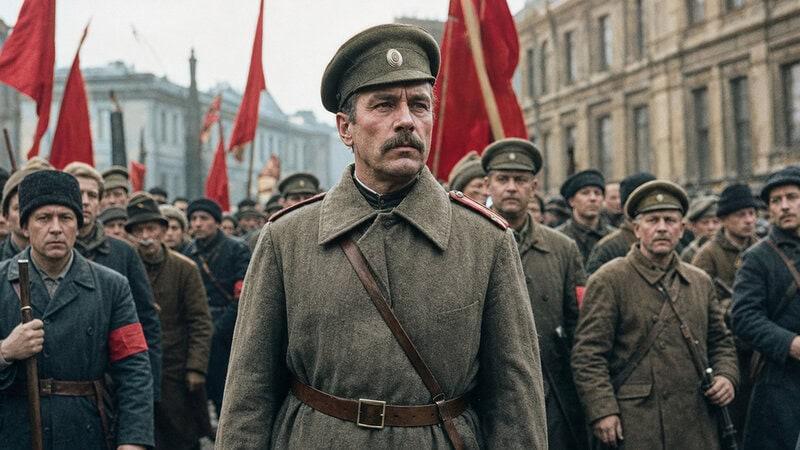

On the morning of March 8, 1917, women textile workers in the frost-bitten Russian capital of Petrograd set down their tools, pulled on their coats, and walked out into streets where breadlines had been snaking around corners for weeks. Within eight days, a dynasty that had ruled Russia for three centuries would be gone. And yet the revolution that began that morning remains one of the most misunderstood and misdated events in modern history — obscured by a calendar puzzle, a propaganda machine, and the habit of telling two stories as one.
Two Revolutions, One Year — and a Calendar That Makes It Worse

Ask almost anyone when the Russian Revolution happened, and they will picture the same scene: Bolsheviks storming the Winter Palace, red banners in the night, Lenin seizing power. That moment is real — but it was the second revolution of 1917, arriving nearly eight months after the first had already toppled the tsar. The Russian Revolution did not happen once. It happened twice, in the same year, in the same city, and the version that won got to write the history books.
Before either story can be told clearly, a calendar puzzle needs solving — because it has been tripping up readers for more than a century. In 1917, Russia still ran on the Julian calendar, known as the Old Style, which lagged thirteen days behind the Gregorian calendar that the rest of Europe and the modern world used. As a result, the revolution historians call the February Revolution actually began on March 8, 1917, by the calendar on your phone. The revolution called the October Revolution fell on October 24-25 by the old Russian reckoning — which translates to November 7, 1917 in modern terms. Both names are fossils of a timekeeping system Russia itself abandoned in February 1918, shortly after the Bolsheviks took power. The confusion is permanently baked into the revolution’s own identity. With that established, the two stories can finally begin.
The First Revolution: Eight Days Nobody Planned

The Russian Revolution did not erupt from nowhere. For years, pressure had been building from every direction. Russia’s catastrophic involvement in World War I had bled the army of men and the cities of hope. Food shortages turned the population sullen and hungry. Tsar Nicholas II, isolated inside a court that had long since lost touch with his people, clung to autocratic power even as his government forfeited the confidence of industrialists, reformers, peasants, and soldiers alike. The causes of the revolution, in other words, were not ideological abstractions — they were cold, hunger, and the unbearable weight of a war that seemed to have no end.
What no one predicted was how fast the structure would simply dissolve. When those textile workers walked out on March 8, 1917 (Gregorian), they were joined by hundreds of thousands of others across Petrograd within days. Troops ordered to fire on the crowds refused — and then joined them. An autocracy’s last weapon is the willingness of armed men to obey, and that willingness had quietly evaporated. There was no great siege, no single decisive battle. The tsarist regime did not fall so much as it stopped being believed in.
On March 15, 1917, Tsar Nicholas II signed his abdication — not in a throne room but in a railway carriage, reportedly in pencil. The gesture was almost mundanely anticlimactic for an act that ended three hundred years of Romanov rule. It captures something essential about the February Revolution: it was less a seizure of power than a collapse of the old order — rapid, nearly accidental, and unplanned by any single group or leader.
Into the vacuum stepped the Provisional Government, drawn from members of the old parliament. But it almost immediately found itself sharing the capital with the Petrograd Soviet, a council of workers’ and soldiers’ deputies who commanded real loyalty on the streets. This arrangement — known as Dual Power — was not a solution. It was an unstable, contradictory settlement that would function as an eight-month countdown. For a detailed Russian Revolution timeline, the sequence of events between the two upheavals is as important as the revolutions themselves.
The Dual Power Gap: Eight Months on a Knife’s Edge

The period stretching from mid-March to November 7, 1917 — the Dual Power era — is the most overlooked hinge of the entire story. Two rival authorities occupied the same city. Neither was strong enough to destroy the other. And Russia’s underlying crises — war, hunger, land inequality — remained entirely unresolved.
The Provisional Government made what history would judge its fatal error: it chose to keep Russia fighting in World War I. The decision drained its popular support with terrifying speed. Meanwhile, Vladimir Lenin returned to Petrograd in April 1917 from exile in Switzerland and immediately began hammering a message that cut through every political complication with brutal simplicity: peace, land, bread. The Bolsheviks were not the largest revolutionary faction in Russia. But they were the most disciplined, and they understood that the February Revolution had created an opening the Provisional Government was incapable of closing.
Through the summer and early autumn, the government lurched from crisis to crisis. An attempted coup by the military right — the Kornilov Affair of August 1917 — collapsed, but only after the government had been forced to arm the very Bolsheviks it feared. By October, the Provisional Government controlled little beyond its own meeting rooms. The Bolsheviks, meanwhile, had spent months quietly infiltrating the military committees that actually controlled Petrograd’s armed forces. The stage was set for the second revolution — the one the world would remember.
The October Revolution: A Coup Dressed as an Uprising

On the night of October 24-25 by the Julian calendar — November 7, 1917 by the Gregorian calendar — Bolshevik Red Guards and revolutionary sailors moved through Petrograd with practiced efficiency. Bridges were seized. Telegraph offices, railway stations, and the State Bank fell under their control before dawn. The operation was less a popular uprising than a carefully staged seizure of power, and it succeeded with surprisingly little bloodshed.
The famous storming of the Winter Palace, immortalized in Soviet propaganda films as a vast armed assault, was in reality a ragged and almost farcical affair. The palace was defended by a small women’s battalion and a number of military cadets — a far cry from the heroic battle scenes that communist cinema later manufactured. As the broader history of the Russian Revolution makes clear, the Bolsheviks prevailed not because of the drama of that single night but because of months of methodical political preparation that preceded it.
By dawn on November 7, 1917, the Provisional Government had ceased to exist. A new Soviet government was proclaimed. The revolution the world would remember — Bolshevik, communist, October — had begun. Understanding the distinction between the February Revolution and the October Revolution makes plain that these were not one continuous event. The first was a spontaneous popular explosion that no single group planned or controlled. The second was a calculated political seizure of power made possible only because the first had failed to resolve the crises that caused it.
What Came After: The Long, Violent Reckoning

The story did not end with a new government proclaimed at dawn. The October Revolution ignited a devastating civil war between the Bolshevik Reds and a loose, fractious coalition of Whites — monarchists, liberals, and foreign-backed forces — that tore across Russia for years. The human cost was staggering: millions died in combat, famine, and under the Red Terror, the Bolshevik campaign of political repression that offered a grim preview of the Stalinist horrors to come. The Russian Civil War did not end until 1922.
The Union of Soviet Socialist Republics was formally established in December 1922 — the institutional endpoint of a chain of events that had begun with hungry women walking off a factory floor in a frozen Petrograd street in early March 1917. Five years, two revolutions, a civil war, and millions of lives connected that opening scene to its conclusion.
The key dates, stripped of fog and calendar confusion, look like this:
- February Revolution: March 8-16, 1917 (Gregorian) — the fall of the tsar and end of Romanov rule
- Abdication of Nicholas II: March 15, 1917 (Gregorian) — signed in a railway carriage, reportedly in pencil
- Dual Power period: March 1917 – November 1917 — eight months of unresolved crisis between the Provisional Government and the Petrograd Soviet
- October Revolution: November 7, 1917 (Gregorian) / October 25, 1917 (Julian) — the Bolshevik seizure of power
- Russian Civil War: 1917-1922 — the violent consolidation of Soviet rule
- USSR founded: December 30, 1922 — the formal institutional outcome of the revolutions
Why the Calendar Names Still Matter
The names February Revolution and October Revolution are not mere historical shorthand. They are a daily reminder of how completely the Bolsheviks’ version of events displaced every other version. The revolution that actually began in March is remembered as February. The coup that happened in November is celebrated as October. Soviet Russia even renamed the months in popular memory, ensuring that the calendar of the people who lost would be forgotten along with them.
Russia formally adopted the Gregorian calendar in February 1918 by decree of the new Soviet government — skipping forward thirteen days overnight. It was a practical modernization, but it also quietly severed the link between the revolutionary calendar and the dates that anyone outside Russia could verify for themselves. The Old Style names survived anyway, fossilized in the historical record and in Soviet commemorations, which continued to mark the October Revolution on November 7 each year under the Gregorian system — a quiet acknowledgment that the calendar had changed but the mythology had not.
Why the Two-Revolution Story Still Matters
The Russian Revolution dates are not merely a calendar curiosity. They point to something deeper about how history actually moves. The February Revolution and the October Revolution were two separate, contingent events — not one inevitable upheaval marching toward a predetermined destination. The tsar fell because a desperate, hungry population had simply had enough. Soviet Russia was born because a disciplined, ruthless political organization was ready to fill the vacuum when no one else was. Those are very different stories, and collapsing them into one obscures both.
The centennial scholarship on 1917 has increasingly emphasized exactly this point: taking the causes of the Russian Revolution seriously means treating both moments — and the eight months of failure between them — as equally important. Had the Provisional Government made different choices, above all on the question of continuing the war, November might never have happened. The Bolsheviks did not inherit a revolution. They exploited one that had already run out of road.
History rarely arrives in a single dramatic instant. It often arrives twice — the second time wearing the first one’s clothes. The version that wins gets to name the whole event, set the dates in the history books, and decide which images go on the posters. That is why the revolution is called October, why it feels like one story instead of two, and why those breadlines in the March cold deserve to be remembered alongside every red banner and propaganda film that came after them.

 English
 Arabic
 French
 Spanish
 Deutsch
 Turkish
 Dutch
Dutch
 Italiano
 Russian
 Romaian
 Portuguese (Brazil)
 Greek
Greek