


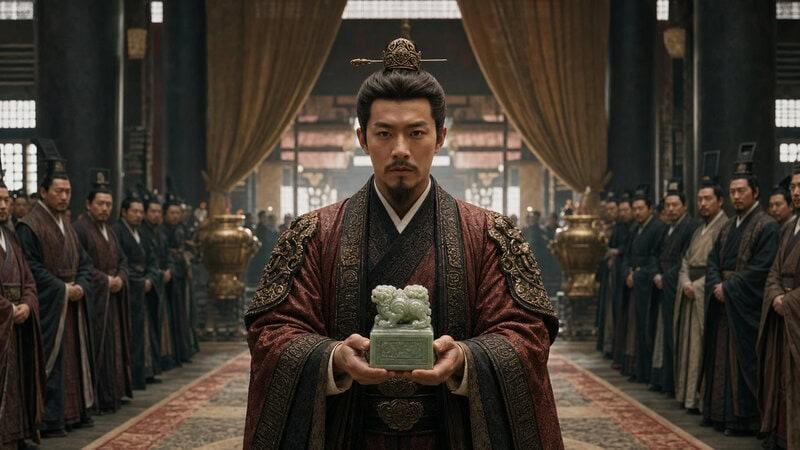

In the autumn of 265, a young general named Sima Yan stood in the imperial hall at Luoyang and accepted the jade seal of the Han successor state of Wei from an emperor who had no real choice in the matter. The ceremony was elaborate, the speeches magnificent — and the courtiers watching from the edges of the room, men old enough to remember the rivers of blood that had flooded through sixty years of civil war, kept their expressions carefully neutral.
The Day One Man Ended Three Kingdoms and Started the Clock on His Own Dynasty’s Doom

The Jin dynasty was born in a moment that looked like triumph and functioned like a trap. Sima Yan — who would reign as Emperor Wu — had not so much seized the throne as collected it, the way one collects a debt that has been owed for a very long time. His grandfather Sima Yi, his uncle Sima Shi, and his father Sima Zhao had spent three decades hollowing out the Cao Wei emperors: commanding armies in their name, making decisions without asking their permission, and slowly absorbing every instrument of real power until the Wei title was the only thing left to transfer. The proclamation of the Jin dynasty in 265 felt less like revolution than like a final formality — the last signature on a document everyone had already agreed to.
What followed was roughly fifty years of Western Jin rule — a period of genuine reunification, spectacular self-destruction, and then catastrophic collapse — and then another century of a rump court clinging to legitimacy south of the Yangtze River. The full arc of Jin dynasty China history runs from 265 to 420, nearly 160 years in total, but the Western Jin phase that was supposed to consolidate everything the Sima family had won lasted only until 316/317. Within a decade of Sima Yan’s death, the dynasty’s northern capital would fall to a Xiongnu-led state, and a Jin emperor would be paraded before a conqueror’s court. The mechanisms of that catastrophe were already coiled inside the founding ceremony, waiting.
Three Kingdoms, One Exhausted Empire: The World Jin Inherited

To understand why Jin collapsed so completely, you have to feel the weight of what came before it. When the Han dynasty disintegrated in the early third century, it left behind not a clean political vacuum but a slow-motion catastrophe — decades of warlordism, plague, famine, and interstate warfare that eventually crystallized into the Three Kingdoms standoff: Wei in the north, Shu Han in the southwest, and Wu in the southeast. These three states fought, raided, maneuvered, and exhausted each other for the better part of sixty years. By the time Sima Yan declared Jin, the accumulated damage to Chinese society was staggering.
The population figures, where they survive, tell a brutal story. The Later Han had registered tens of millions of subjects. Wei-era census records show a fraction of that — though historians note that registration systems themselves broke down during the chaos, so the numbers reflect administrative disruption as much as literal death. Still, the demographic wound was real: farmland was abandoned, cities had shrunk, and the human infrastructure of a functioning empire had to be rebuilt almost from the foundation. Jin inherited not a going concern but a convalescent.
It also inherited a structural problem baked into the political system itself. The Nine-Rank system, introduced during the Wei period, determined official appointments based on aristocratic pedigree rather than examination or demonstrated talent. This locked political power inside a relatively small number of great clans, made genuine meritocratic reform nearly impossible, and created a court culture in which factional maneuvering among noble families was the primary form of politics. The Jin dynasty’s internal architecture was designed to preserve elite privilege, not to govern effectively — a distinction that would matter enormously when the pressure came.
Sima Yan’s Reign: Reunification, Prosperity, and the Seeds of Disaster

Emperor Wu’s reign opened with a genuine achievement worth pausing over. In 280, Jin forces conquered the Wu kingdom in the south, reunifying China under a single court for the first time since the Han collapse. For anyone alive at that moment, this was not a trivial bureaucratic milestone — it was the end of roughly six decades of division, the closing of wounds that had defined the entire adult lives of everyone in the empire.
The contradiction at the heart of Sima Yan’s reign is that he understood history well enough to win and not well enough to hold what he won. His public persona was Confucian — learned, measured, the image of a sage ruler. His private conduct, as historical sources describe it, was something else: a court of extraordinary luxury, a large imperial harem, and an emperor who increasingly delegated governance to favorites and powerful relatives while the machinery of state drifted. The portrait that Jin dynasty sources consistently paint of the Western Jin rulers is not one of monsters or tyrants but of men who confused the performance of imperial dignity with its substance.
His most consequential decision was also his most counterintuitive one. The Wei dynasty, burned by the experience of powerful regents — namely, the Sima family itself — had kept imperial princes deliberately weak, granting them titles and stipends but no armies. Sima Yan looked at this policy and decided it had been a mistake. His own family had exploited those weak princes; therefore, strong princes with their own military commands and territorial fiefs would protect the throne. The reasoning had a certain logic. It was catastrophically wrong.
When Sima Yan died in 289, he left the empire to a son described across multiple sources as intellectually incapable of rule — Emperor Hui, a man genuinely unable to perform the political navigation his position required. Real power immediately began fracturing among the princes, their networks, and the powerful clan of Empress Jia. The clock, already running since 265, began to accelerate.
The War of the Eight Princes: When the Dynasty Destroyed Itself

From 291 to 306, eight imperial princes prosecuted a rolling civil war across the North China heartland that historians call the War of the Eight Princes. It is not a clean narrative with heroes and villains — it is a cascade of betrayals, shifting coalitions, assassinations, and temporary alliances that left no real winners. Each round of fighting produced a new faction briefly on top and a devastated landscape beneath. Farmland along the Wei River valley and the North China Plain was abandoned as armies marched and counter-marched across it. Famine followed soldiers the way it always does. The population that had only just begun recovering from the Three Kingdoms era collapsed again.
This is the internal dimension of the Western Jin dynasty collapse that often gets overshadowed by the more dramatic story of outside forces: the dynasty did not simply fall to invaders. It was pushed off a cliff it had spent fifteen years building. And in their desperation, the competing princes made the decision that would prove truly fatal. To tip the military balance in their favor, multiple factions recruited cavalry forces from the non-Han confederacies that had been settling inside the empire’s northern borders for generations — Xiongnu, Xianbei, Di, Jie, and others. They armed them, paid them, and in doing so handed those groups weapons, battlefield experience, and an intimate understanding of exactly how vulnerable the Jin state had become.
Emperor Hui drifted through the chaos in apparent incomprehension. One anecdote — probably apocryphal but too resonant to ignore — describes him asking, during a famine, why starving people did not simply eat meat if they had no grain. Whether he said it or not, the story captured something contemporaries recognized immediately: the gulf between the Jin court and the reality beyond its walls had become unbridgeable.
The Uprising of the Five Peoples: The Barbarians Were Already Inside the Gate

The forces that destroyed Western Jin are often described, in older histories, as a barbarian invasion — northern hordes sweeping in from outside. The reality is considerably more complicated. The groups collectively called the Five Peoples, or Wuhu, had been living within Jin borders for generations. They had served in Jin armies, learned Chinese administrative practices, traded in Jin markets, and in some cases received classical Chinese educations. They were not outsiders who breached a wall. They were long-term residents who had just watched the people who recruited them tear the state apart from the inside.
In 304, a Xiongnu leader named Liu Yuan made a move of extraordinary political sophistication. Raised at the Jin court and educated in classical Chinese texts, Liu Yuan understood the symbolic grammar of Chinese legitimacy as well as any Han aristocrat. When he declared his independence, he did not present himself as a foreign conqueror — he claimed to be the heir of the Han dynasty, reframing his rebellion as restoration. The move drew Han Chinese defectors to his banner and recast the Jin as the usurpers. It was political branding of the highest order.
What followed was the irreversible unraveling of Western Jin. In 311, Luoyang fell. The imperial capital — the city where Sima Yan had accepted that jade seal forty-six years earlier — was sacked. Emperor Huai was captured and later executed. The imperial library burned. The psychological rupture was as significant as the military one: if Luoyang could fall, nothing was secure.
The last Western Jin emperor was captured at Chang’an in 316. With that, the North China Plain — the cradle of Chinese civilization, the agricultural and cultural heartland of everything the Han and Jin had built — passed out of Han Chinese imperial control. It would not return for over a century.
Survival South of the River: The Eastern Jin Court

A fragment of the Jin court escaped south of the Yangtze, reestablished itself at Jiankang — modern Nanjing — and declared the continuation of the dynasty under Emperor Yuan in 317. Technically it was the same dynasty. Practically, it was a refugee government operating on the memory of legitimacy. The Eastern Jin phase, running from 317 to 420, is in many ways defined by a single unresolvable tension: northern émigré aristocrats who had lost everything dreamed of reconquest, while southern clans who had never lost anything had no particular interest in funding expensive campaigns to recover territory that had never been theirs.
Figures like Zu Ti and, later, Huan Wen led northern expeditions that generated extraordinary personal reputations and occasionally recovered significant ground. But the structural weakness of the Eastern Jin court — the same aristocratic paralysis, the same factional maneuvering, the same gap between ceremonial grandeur and effective governance — always pulled it back. As historians examining the Jin dynasty rise and fall consistently note, northern recovery efforts were more theatrical than territorial, more about preserving the idea of Jin than reconstructing its reality.
The Eastern Jin period was not without cultural achievement. The court at Jiankang became a center of calligraphy, landscape poetry, and philosophical Buddhism. Wang Xizhi, widely regarded as China’s greatest calligrapher, lived and worked during this period. The south, sheltered from the worst violence of the north, became the custodian of Han Chinese literary and artistic traditions — a role it would hold for generations. Survival, it turned out, had its own kind of productivity.
In 420, a general named Liu Yu deposed the last Jin emperor with almost casual efficiency, founding the Liu Song dynasty and beginning the era historians call the Southern Dynasties. The Jin dynasty ended not with a battle or a siege but with a formality — the same genre of military coup dressed in ceremonial language that had opened it in 265. The symmetry was grim and exact.
Why Jin Matters: The Hinge That Broke and Made Medieval China
The Jin dynasty is rarely the first story people tell about Chinese history. It lacks the philosophical grandeur of the Han, the cosmopolitan drama of the Tang, the romantic tragedy of the Song. On its surface, it is a story of elite failure — of men who had every structural advantage and squandered it through arrogance, factionalism, and a near-total refusal to govern rather than merely reign. That reading is accurate as far as it goes.
But Jin’s collapse is also a crucible that shaped everything that came after it. The non-Han kingdoms that replaced Western Jin in the north were not simple destroyers. Over the following century and a half, they absorbed Chinese administrative structures, intermarried with Chinese aristocratic families, and patronized Buddhism in ways that permanently reshaped Chinese religious and artistic culture. The long synthesis of peoples and traditions that took place across the Northern and Southern Dynasties period eventually produced the Sui and Tang empires — arguably the most cosmopolitan and powerful states China would ever see. Jin had to break for that to happen.
The collapse also permanently reshaped China’s economic and demographic geography. The center of Chinese economic gravity shifted south toward the Yangtze delta during and after the Jin period, and it never fully returned. The north, devastated by decades of civil war and the fighting that followed, was rebuilt under new rulers and new cultural frameworks. The south, comparatively sheltered, preserved and elaborated what the émigré courts brought with them. These shifts proved more durable than any of the dynasties involved.
For anyone curious about how a civilization survives the collapse of its own state, the Jin dynasty offers a clear and sobering answer: not through military brilliance, not through political genius, but through the slow accumulation of texts, rituals, and cultural memory in whatever territory remains — and through the hard-won understanding that the dynasty carrying a civilization and the civilization itself are not the same thing at all.

 English
 Arabic
 French
 Spanish
 Portuguese
 Deutsch
 Turkish
 Dutch
Dutch
 Russian
 Romaian
 Portuguese (Brazil)
 Greek
Greek