


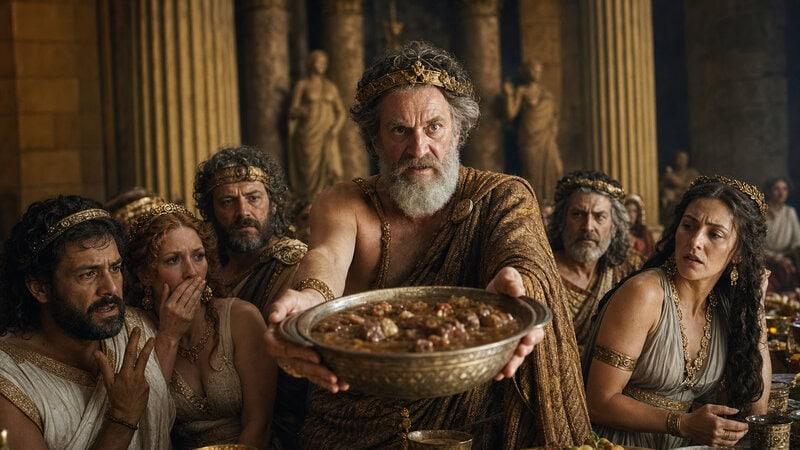

The gods were seated. The feast was laid. And Tantalus, king of Sipylus, wanted to test whether the Olympians were truly omniscient — so he butchered his own son Pelops, boiled the flesh, and served it in a stew. Most of the gods recoiled in horror. Only Demeter, distracted by grief over Persephone, ate a piece of the shoulder before realizing what she had consumed. The boy was reassembled, the missing shoulder replaced with ivory, and Tantalus condemned to eternal torment in the underworld — standing in a pool that receded whenever he stooped to drink, beneath fruit that rose beyond his reach whenever he stretched to eat. It is one of the most viscerally disturbing scenes in all of ancient literature, and for roughly two centuries it was quietly excised from almost every classroom in the English-speaking world.
That excision was not an accident. It was a policy — and understanding it requires going back to what the word mythos actually meant before Victorian editors got their hands on it.
What ‘Mythos’ Actually Meant to the Greeks

The Greek word mythos did not mean fairy story. It did not mean charming legend or entertaining fable. In its fullest ancient and modern sense, mythos denotes a pattern of beliefs that expresses, often symbolically, the characteristic and prevalent attitudes of an entire culture — a living framework through which a civilization understands fate, justice, identity, and the divine. For the Greeks, myths were simultaneously what scripture, law, psychology, and philosophy would later become for other cultures. Homer and Hesiod were not bedtime-story writers. They were something closer to theologians.
Aristotle drew a careful distinction between mythos — narrative, plot, the shape of events — and logos, which belonged to rational argument and systematic reasoning. Crucially, he regarded both as serious intellectual tools. Neither was considered entertainment in the trivial modern sense. The stories Greeks told about Cronus, Medea, or Dionysus were not decorative. They were operational: they explained why the world worked the way it did, why suffering was distributed so unevenly, and what happened when human beings overreached the limits the gods had drawn around them.
There was also no single canonical version. Greek myths existed in dozens of competing regional iterations, many of them wildly inconsistent with one another. Zeus appears across the corpus as cosmic lawgiver, jealous patriarch, serial predator, and tender father — sometimes within the same poet’s work. The Greeks were not troubled by the contradiction. The multiplicity was the point. A pantheon that contained every possible moral register, from serene justice to savage cruelty, reflected a cosmos that genuinely worked that way. The darkness was not a literary accident. It was the theological argument.
What the Unedited Corpus Actually Contains

Consider what survives in the primary sources. Cronus castrates his father Uranus with a sickle, scattering the severed genitals into the sea, from whose foam Aphrodite is born — this is Hesiod’s Theogony, not a marginal fragment. Medea, in the version Euripides made definitive, murders her own children to wound her faithless husband Jason. Apollo flays the satyr Marsyas alive after beating him in a musical contest, a god exercising unlimited cruelty as a straightforward assertion of divine prerogative. The Maenads, frenzied female worshippers of Dionysus, tear King Pentheus limb from limb in Euripides’s Bacchae, his own mother Agave leading the dismemberment in a state of religious ecstasy. These are not footnotes. They are the main event, present in Hesiod, Ovid’s Metamorphoses, Apollodorus’s Library, and across the Athenian tragic stage. They encode real Greek anxieties about the relationship between power and violence, between civilization and its suppressed underside.
The myth of Erysichthon — cursed by Demeter with an insatiable hunger that drives him to devour everything he owns and eventually himself — maps addiction and compulsive self-destruction with clinical precision that no sanitized version can preserve, because the horror of the ending is precisely the point. Freud and Jung did not mine Greek mythology for its uplifting episodes. They mined the full, unedited corpus for exactly the content that Victorian schoolbooks had removed: infanticide, incest, murderous ambivalence, and the intractable conflicts between desire and prohibition.
Even the Greek creation story begins with violence. Hesiod’s Theogony opens in chaos, proceeds through castration, moves through the swallowing and regurgitation of children, and arrives at Olympian order only after a war of cosmic brutality. The Greeks were making a philosophically specific claim: that order is always constructed on prior chaos, that civilization does not emerge from benevolence but from the containment of catastrophic force. That is a serious cosmological idea, and it vanishes completely from the parlour-table version.
A History of Deliberate Omission
The sanitization did not begin with the Victorians. It proceeded in identifiable phases across several centuries, each shaped by the cultural anxieties of its moment.
Renaissance humanists, working roughly between 1400 and 1600, were the first systematic allegorizers. They needed Greek and Roman myth to be teachable in schools run by or answerable to the Church, and the solution was to read disturbing material as encoded moral philosophy. Ovid’s Metamorphoses — a poem saturated with assault, transformation, and divine violence — was repackaged in the tradition of the Ovide moralisé as Christian allegory, in which pagan stories anticipated or illustrated Christian truth. The darkness was not removed; it was explained away, which had the same practical effect in the classroom.
Enlightenment editors, working through the eighteenth century, prized civic virtue and rational order. A pantheon of gods who behaved like jealous, lustful, vengeful aristocrats was philosophically embarrassing for an age that wanted to use classical antiquity as a model of reason. The solution was to present the gods as metaphors for natural forces — Apollo as the sun, Poseidon as the sea — rather than as characters with genuine agency, appetite, and malice. This was intellectually tidy and almost completely false to how the Greeks had actually understood their divinities.
Thomas Bulfinch completed the transformation for the English-speaking world. His Bulfinch’s Mythology, published in 1855, stated its editorial purpose plainly: he wanted to make the myths suitable for the parlour table, accessible to readers who might be offended by the sexual or violent dimensions of the original material. Charles Kingsley’s The Heroes, published in 1856 and aimed specifically at children, applied the same filter even more aggressively, producing a corpus heavy on heroic quest and stripped of anything that might require difficult explanation. These two books effectively created the template most English-language schools would follow for the next hundred years.
By the early twentieth century the cycle had become self-reinforcing. Teachers who had learned the sanitized version taught it onward. The original sources — Hesiod’s Theogony, Apollodorus, the full text of Euripides — gathered dust outside university classics departments. Students graduated believing they knew Greek mythology when they had, in fact, encountered an elaborate Victorian renovation of it.
The result was a radically impoverished mythology. Perseus slew Medusa. Heracles performed his labors. Theseus navigated the labyrinth. The heroes were brave, the monsters were defeated, and the gods occasionally intervened to help the righteous. What disappeared was everything that made the original stories philosophically serious: the divine capriciousness, the unpunished cruelty, the myths in which the hero is also the monster, the stories in which no moral lesson softens the outcome.
The Oresteia and the Argument the Sanitizers Removed

No example makes the cost of sanitization clearer than the Oresteia cycle. Agamemnon sacrifices his daughter Iphigenia to secure favorable winds for Troy. His wife Clytemnestra murders him on his return. Their son Orestes kills Clytemnestra in revenge. The Furies — ancient goddesses of blood vengeance — pursue him regardless of his justification. Aeschylus understood that there was no clean resolution available. His trilogy ends not with moral clarity but with an uneasy institutional compromise: a law court standing in for the old blood-feuds, and the Furies transformed into something barely less terrifying than they were before. That ambiguity was the argument. The trilogy is a systematic and philosophically serious examination of how justice, vengeance, gender, and political power interact and conflict. Remove the ambiguity, and you remove the argument entirely.
This matters for how we read Western literature more broadly. Almost every significant engagement with Greek mythology in Keats, in Nietzsche, in Freud, in Eugene O’Neill assumes knowledge of the unedited stories. Nietzsche’s entire argument in The Birth of Tragedy depends on understanding Dionysus not as a cheerful wine god but as the deity of ecstatic dissolution and irrational violence — precisely the content Victorian editors had quietly excised. Without the real corpus, the references become decorative rather than meaningful: quotations from a book you have never actually read.
The Modern Reclamation
When Stephen Fry published Mythos in 2017, it arrived as something the culture had apparently been waiting for without knowing it. Drawing directly on the Greek root and its full meaning as a living pattern of cultural belief, Fry restored the unedited texture of the myths for a general audience. The castration of Uranus is there. The full grotesquerie of Tantalus and Pelops is there. The sexual violence, the divine cruelty, the myths in which no one behaves well and no lesson is comfortably extractable — all of it returned, handled with the same honest engagement a serious literary reader would bring to Shakespeare or Dostoevsky. The book became an international bestseller.
It was not alone. Madeline Miller’s Circe returned full moral complexity and interiority to a character Homer had rendered as a minor obstacle on Odysseus’s journey home. Pat Barker’s The Silence of the Girls gave sustained voice to the women of the Trojan War whose suffering the original texts recorded but did not particularly mourn. Together, these books accomplished something scholars had struggled to do for decades: they returned Greek mythology to what it had always been — not a children’s entertainment but a record of how a sophisticated civilization thought about power, suffering, desire, and the indifference of the universe.
The commercial success of these retellings carries its own argument. Readers responded not with shock but with recognition — a widespread sense that the schoolroom version had always felt incomplete, that the sanitized myths had been too neat, too morally convenient, too scrubbed of the qualities that made them feel true. The appetite for restoration is itself evidence of how much the two-century project of omission had cost.
Why the Darkness Belongs Back in the Room
The sanitized mythology that dominated English-language education for so long taught generations a specific and distorting lesson: that ancient civilizations were essentially proto-Christian morality tales, that the Greeks believed in a benevolent divine order that rewarded virtue and punished vice, and that the purpose of myth was to illustrate the kind of upright conduct a Victorian schoolchild was expected to emulate. Restoring the full, unedited corpus reveals something incomparably more interesting: a civilization that looked directly at cruelty, chaos, and moral failure and incorporated them honestly into its understanding of how the world worked.
There is also a civic dimension to the argument. Myths that take seriously the capacity of gods and heroes for cruelty, self-deception, and catastrophic moral failure are better preparation for understanding power — its temptations, its corruptions, its tendency to justify itself — than myths that present divinity as uniformly wise and benevolent. The Greek gods were terrible partly because the Greeks understood that power frequently is. Tantalus is condemned not because the gods are just but because they are powerful. The distinction matters enormously, and the parlour-table version obscures it entirely.
The word mythos, in its full sense — a pattern of beliefs expressing often symbolically the characteristic and prevalent attitudes of a group or culture — reminds us that choosing which myths to tell is never an innocent act. Every selection reflects a set of values, a set of anxieties, a set of things a culture is willing to look at and things it would prefer to leave in the dark. The Victorians chose to leave quite a lot in the dark. Bringing it back out is, equally, an act of cultural will — and a more honest reckoning with what the Greeks were actually trying to say.

 English
 Arabic
 French
 Portuguese
 Deutsch
 Turkish
 Dutch
Dutch
 Italiano
 Russian
 Romaian
 Portuguese (Brazil)
 Greek
Greek