


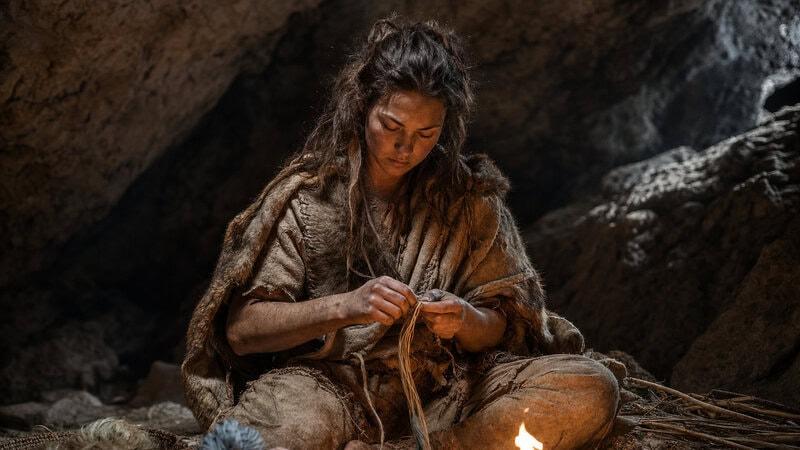

Thirty thousand years ago, deep in a cave in the Caucasus Mountains, a human hand gathered twisted strands of wild flax and pressed them together by firelight — coloring them gray, turquoise, pink, black — and in doing so, quietly invented one of the most consequential technologies our species has ever produced. That person left no name, no grave, no monument. What they left was a thread.
A Discovery That Rewrote the Timeline

The cave is called Dzudzuana, tucked into what is now the republic of Georgia. When archaeologists excavated its deeper layers, they recovered something almost impossibly fragile: dyed flax fibers, twisted and processed, dated by multiple methods to somewhere between 27,000 and 34,000 years ago. The colors were not accidental staining. They were chosen. Someone — likely many someones, across many generations — had looked at a plant stem, imagined it could become something beautiful, and then made it so.
That discovery lands with the force of a rewritten textbook. Before the wheel. Before writing. Before agriculture, before cities, before any of the developments we reflexively call “the dawn of civilization” — humans were already working fiber into structured, colored, intentional cloth. The ancient history of weaving reaches so far back into the Ice Age that it forces a fundamental revision of what we think early humans were capable of and, more importantly, what they cared about.
This is not a footnote in the story of human progress. Weaving is, in many ways, the hidden spine of that story — running from Ice Age caves through Egyptian burial chambers, from the looms of imperial China to the mountaintop workshops of the Andes, and eventually into the punch-card mechanisms that seeded the digital age. Follow that thread long enough and you find it woven through almost everything.
What Weaving Actually Is — And Why It’s Ingenious

At its structural core, weaving is a method of textile production in which two distinct sets of yarns or threads are interlaced at right angles to form a fabric or cloth. Warp threads run vertically, weft threads run horizontally — each pass of the weft interlacing over and under the warp threads in sequence, each row locking the one before it into place, building strength and structure from the accumulated logic of thousands of small crossings.
Think of it as binary code rendered in fiber: over, under, over, under — a repeating rhythm that encodes not just structure but pattern, not just function but meaning. Change the sequence, alter the spacing, or introduce a second color into the weft, and suddenly that binary pulse generates tapestries of staggering complexity. The same elemental grammar that holds together a piece of rough sackcloth also underlies a Flemish tapestry, a silk kimono, and a Kevlar vest.
This distinguishes weaving from simpler fiber techniques — knotting, twisting, braiding — in ways that matter cognitively. To weave is to hold a complex, interlocking spatial system in the mind and execute it with the hands simultaneously. It demands planning, sequencing, and pattern recognition of a high order. When those dyed flax fibers were processed in Dzudzuana Cave, whoever made them was not performing a rote survival behavior. They were engineering.
It is also worth being precise about terms beginners often encounter. The shed is the temporary gap created between raised and lowered warp threads through which the weft passes. The shuttle is the tool that carries the weft thread through the shed. The beater presses each completed weft row firmly against the previous one. These three elements — shed, shuttle, beater — are the mechanical heartbeat of virtually every loom ever built, from the simplest backstrap frame to a fully automated industrial machine.
The Ice Age Evidence: Older Than Anyone Imagined

The Dzudzuana find is remarkable not only for its age but for what the colored fibers imply. Dyeing plant material in multiple distinct hues requires sourcing pigments, understanding which plants or minerals produce which colors, and applying them with enough consistency to achieve a result that reads as intentional. Gray. Turquoise. Pink. Black. These are not the choices of a mind focused purely on warmth and survival. These are aesthetic decisions — evidence that tens of thousands of years ago, humans were already thinking about how things looked, not just what they did.
The deeper frustration for archaeologists studying the ancient origins of textile making is that organic fibers almost never survive. Cloth rots. Thread dissolves. The archaeological record of early weaving is not merely incomplete — it is a ruin of a ruin, a ghost story told through the rarest of survivals. Every fragment we have represents thousands of years of production that left nothing behind.
That is what makes the impressions found at Pavlov in the Czech Republic so haunting. At sites dated to roughly 25,000-27,000 years ago, the geometry of woven patterns pressed into fired clay has survived long after the textiles themselves vanished — the ancient equivalent of a footprint in concrete, recording the shape of something that no longer exists. The pattern geometry is clear: interlaced fibers, right angles, structured grids. Weaving, or something very close to it, was already happening across a wide geographic range during the depths of the last Ice Age.
Consider who these people were. They were contemporaries of the artists who painted the walls at Lascaux — equally modern in their cognitive architecture, equally capable of abstraction and aesthetic intention, equally human. They simply chose a medium that time has almost entirely consumed.
The Neolithic Revolution Supercharges Everything

The Neolithic transition — roughly 10,000 to 5,000 BCE — did not invent weaving. But it turbocharged it beyond recognition. As humans began domesticating flax, cotton, and wool-bearing animals across the Near East, the Indus Valley, and East Asia, the raw materials for weaving became reliably, abundantly available for the first time. What had been an act of ingenuity dependent on gathered wild fibers became something closer to industry.
Looms proliferated and diversified. Simple backstrap looms — in which the weaver’s own body provides tension by leaning against the warp — appear to have been among the earliest, and they remain in continuous use today in Guatemala, Indonesia, and Mexico, largely unchanged in their essential mechanics. Ground looms spread across the ancient Near East. Upright looms emerged in Egypt. Each represented a different regional solution to the same engineering problem: how to hold warp threads taut at a consistent tension while a weft thread is passed through them repeatedly at speed.
At Çatalhöyük in modern Turkey, one of the world’s earliest large proto-urban settlements (occupied from around 7,500 BCE), evidence of woven wool cloth places textile production at the very birth of communal sedentary life. This is not coincidental. Surplus woven cloth was one of humanity’s first reliable trade goods — durable, portable, universally needed, and variable enough in quality to carry economic meaning. The earliest commercial networks were threaded together, quite literally, by cloth.
Weaving Across the Ancient World: Egypt, China, and the Andes

By 3,000 BCE, Egyptian linen weaving had reached a technical refinement that still astonishes textile historians. Royal mummies were wrapped in fabric woven so finely — sometimes exceeding 200 threads per inch — that 19th-century European scholars, examining the cloth under magnification for the first time, initially refused to believe it was linen at all and assumed it must be silk. Modern industrial looms struggle to replicate it. The hands that made it worked without mechanized assistance of any kind.
In China, silk weaving carries its own legendary origin story, traditionally attributed to the Empress Leizu around 2,700 BCE. Mythologized or not, the technology that emerged was real and world-altering. The Silk Road — the most consequential long-distance trade route in pre-modern history, connecting China to Rome across thousands of miles of desert and mountain — took its name entirely from a woven textile. Merchants, diplomats, and armies followed a path first drawn by the loom.
In the Andes, the weaving traditions of pre-Inca and Inca cultures represent perhaps the most intellectually ambitious use of textile in human history. Working with the extraordinarily fine fiber of alpaca and vicuña, Andean weavers produced tapestries of such structural complexity that modern textile scholars use them as primary sources — reading the pattern hierarchies to decode political relationships, religious beliefs, and social status in a civilization that never developed a written script. In the absence of writing, the loom became the archive. Cloth was text.
The pattern across these civilizations is consistent: wherever weaving reaches a high level of technical mastery, it correlates directly with social complexity, economic power, and cultural prestige. Cloth is not a byproduct of civilization. It is one of civilization’s engines.
From Backstrap to Jacquard: The Loom’s Long Revolution

The history of the loom is the history of human ingenuity layering onto itself across millennia. Each mechanical advance increased either the speed of production, the complexity of achievable patterns, or both — and each advance set the stage for the next.
The most conceptually dazzling leap came not in antiquity but in 1804, when a French silk weaver named Joseph-Marie Jacquard introduced a system of punched cards to control the raising and lowering of individual warp threads. Each hole in the card corresponded to a thread; the presence or absence of a hole determined over or under. It was, in the most literal sense possible, a binary programming system — and it did not go unnoticed by the mathematicians of the age. Charles Babbage studied the Jacquard loom while designing his Analytical Engine. Ada Lovelace drew explicit analogies between weaving patterns and computational operations. The conceptual seed of the digital computer was planted inside a weaving machine.
The Industrial Revolution’s power looms, arriving from the 1780s onward, transformed weaving in a darker register. They shattered the cottage-weaving economy that had sustained rural families across Britain for generations, triggering the Luddite rebellions of the early 19th century — a movement of skilled weavers who destroyed machinery not out of ignorance but out of the very rational recognition that their livelihoods were being mechanically eliminated. The ancient link between the individual human hand and the cloth it produced was severed, perhaps permanently, in the space of a generation.
Today, automated looms can produce fabric at a pace no hand weaver could approach. And yet handwoven textiles command premium prices in every global market precisely because the human hand — performing the same essential gesture it performed 27,000 years ago — has become the rarity rather than the norm.
Weaving Today: Craft, Community, and a Quiet Revival
Contemporary weaving occupies a peculiar and interesting position in the cultural landscape. On one end of the spectrum, industrial textile manufacturing is almost entirely automated, producing billions of meters of fabric annually for global supply chains. On the other end, a growing movement of hand weavers — many of them working on rigid-heddle or four-shaft floor looms in home studios — has quietly accelerated over the past decade, driven partly by a broader interest in slow making and partly by the meditative quality of the work itself.
Rigid-heddle looms, which combine the heddle and beater into a single sliding frame, are the most accessible entry point for beginners: they are relatively inexpensive, compact enough for a kitchen table, and capable of producing scarves, table runners, and simple yardage within a first session. Four-shaft floor looms unlock considerably more structural complexity, including twill weaves, herringbone, and basic tapestry work. Eight-shaft and multi-shaft looms approach the pattern versatility of the Jacquard mechanism, though they require proportionally more planning and setup time.
Indigenous weaving traditions — Navajo, Guatemalan backstrap, West African kente, Japanese nishiki — have also experienced renewed international attention, though that attention brings its own tensions around cultural appropriation, fair compensation, and the difference between genuine engagement and aesthetic extraction. The communities keeping these traditions alive are largely the same ones that have maintained them for centuries, often in the face of significant economic pressure.
What unites all of these contexts — industrial, artisan, indigenous, and experimental — is the same structural logic that someone worked out in the Caucasus Mountains during the Ice Age: warp and weft, over and under, the accumulated strength of countless small crossings.
What 27,000 Years of Weaving Says About Who We Are
The extraordinary age of weaving dismantles a persistent and condescending myth about early humans: that they were purely reactive creatures, focused entirely on immediate survival, incapable of the abstraction and long-range planning we associate with modern intelligence. The dyed fibers of Dzudzuana Cave say otherwise, loudly and clearly. Those ancient weavers were not just keeping warm. They were making choices about color and pattern and structure that served no immediate survival function. They were, by any reasonable definition, artists and engineers simultaneously.
The cognitive demands of weaving — holding a complex spatial pattern in mind, sequencing actions across time, coordinating fine motor control with abstract planning — belong to the same mental toolkit that produces language, mathematics, and music. It is no coincidence that the oldest evidence for these capabilities tends to cluster in overlapping archaeological periods. The mind capable of weaving a patterned cloth is the mind capable of composing a sentence, solving an equation, writing a melody.
Every time a contemporary weaver passes a shuttle through a warp, they are performing a gesture with a 27,000-year pedigree — the same over-under rhythm, the same intent, the same marriage of utility and beauty that someone enacted by firelight in a Georgian cave during the Ice Age. The technology has evolved beyond recognition. The fundamental human act has not.
Weaving didn’t just clothe civilization. In a very real sense, it wove civilization together — one interlaced thread at a time.

 English
 Arabic
 French
 Spanish
 Portuguese
 Deutsch
 Dutch
Dutch
 Italiano
 Russian
 Romaian
 Portuguese (Brazil)
 Greek
Greek