


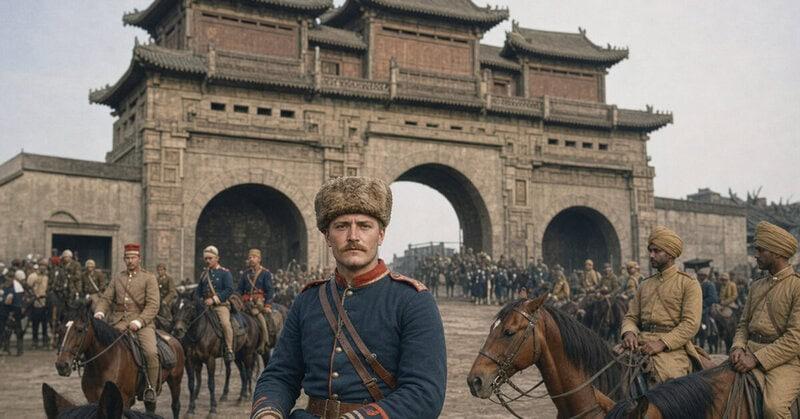
In August 1900, the gates of Beijing stood open to conquerors who could barely stand the sight of one another. Russian Cossacks watered their horses at the same canals where British Indian cavalry watered theirs. Japanese infantry drilled in courtyards that American soldiers had claimed the day before. French Zouaves and German hussars patrolled streets still smelling of smoke — eight nations, one ruined imperial capital, and not a single shared idea about what came next.
The Central Irony of a Strange War

The coalition that marched to rescue besieged foreign diplomats was not an alliance in any meaningful sense. It was eight rival empires temporarily pointed in the same direction, each carrying its own agenda like a concealed weapon. The moment Beijing fell, the cooperation began unraveling with almost comic speed. What had started as a peasant uprising in the drought-cracked fields of Shandong had somehow produced one of history’s strangest multinational occupations. The story of how it got there — and what it left behind — is one worth telling carefully.
The World That Made the Boxers: Drought, Railways, and Wounded Pride

To understand the Boxer Rebellion, you have to stand in Shandong province in the late 1890s and look at the land. Harvests had failed. The Yellow River had flooded, then the rains had stopped altogether, leaving cracked earth and empty grain stores. Cutting straight through ancestral farmland — through fields and family burial grounds worked for generations — were the gleaming steel rails of foreign-funded railways, symbols of everything that had gone wrong with China’s encounter with the outside world.
The Yihequan, meaning “Righteous and Harmonious Fists,” were a secret society whose members practiced a ritualized form of martial arts they believed granted supernatural protection — that their drills and incantations could make them impervious to foreign bullets. Western journalists, watching their elaborate exercises, called them the Boxers, and the name stuck. But to dismiss them as credulous fanatics is to miss what was actually happening in the villages of the North China Plain.
Decades of unequal treaties following the Opium Wars had stripped China of territory, tariff control, and dignity. Christian missionaries operated under foreign legal protection — a system called extraterritoriality — meaning Chinese converts to Christianity effectively answered to a different law than their neighbors. Rural communities watched profits flow outward and local authority hollow out. The Boxers gave that diffuse, burning resentment a focus and a uniform. The uprising began in 1899 with attacks on Western-funded railways, assaults on missionaries, and the murder of Chinese converts — violence that started in Shandong and swept north across the plain before anyone in Beijing had fully grasped its scale.
The Qing Court’s Catastrophic Gamble

The imperial court’s response was one of the great miscalculations of modern history. The Qing government initially labeled the Boxers bandits — the sensible position, legally speaking. Then it quietly tolerated them. Then, in the spring of 1900, Empress Dowager Cixi made her fateful choice: she decided to ride the tiger. The Boxers, who had been marching north, were effectively endorsed by the court and encouraged toward Beijing.
In June 1900, thousands of Boxers entered the capital. Foreign diplomats watched from their compounds as men in red sashes performed martial-arts rituals in the streets outside and sent increasingly frantic cables to their governments. Cixi’s calculation was not entirely irrational — she had been humiliated repeatedly by foreign powers and saw the Boxers as leverage, a way to push back against a century of encroachment. Instead, she handed the great powers a legal pretext for full military intervention. The Qing court formally declared war on all the foreign powers that summer, instantly transforming a domestic crisis into an international one and triggering consequences the court had fatally underestimated.
The Siege of Beijing: 55 Days Inside the Legation Quarter
The siege of the Legation Quarter that followed was claustrophobic and surreal. Roughly 900 soldiers and civilians of various nationalities — British, American, French, Russian, German, Japanese, Italian, and Austro-Hungarian — found themselves barricaded inside a compound roughly the size of a few city blocks. They rationed tinned food, built barricades from furniture and sandbags, and at night could hear the Boxer drums.
The social world inside the walls was strange in its own right. Class hierarchies dissolved under necessity. Diplomats who had never held a shovel dug trenches beside their servants. Nationals of countries that regarded one another with suspicion shared the same defensive perimeter and, eventually, the same black humor about their situation. Outside, the Qing army’s involvement was erratic — some units attacked the compound aggressively, while others appeared to fire deliberately high, a confusion that reflected the divided counsels inside the imperial court itself, where factions argued fiercely about how far to push the confrontation.
The communications blackout added a layer of unreality. Cut off from the outside world, the legations could send no word of their survival. London newspapers — drawing on rumors and dispatches from the Boxer side — printed premature reports of a massacre. Obituaries were written. Memorial services were planned. The diplomats inside were declared dead weeks before the relief force arrived to prove otherwise.
The Eight-Nation Alliance: An Uneasy Army Marches on Beijing

The Eight-Nation Alliance that marched to relieve the siege comprised Britain, the United States, Japan, Russia, France, Germany, Italy, and Austria-Hungary — less a unified military force than eight national contingents sharing a march route while pursuing incompatible goals. Japan contributed the largest and best-organized force, a fact that surprised and unsettled the European powers. Russia was already maneuvering to deepen its grip on Manchuria, treating the crisis as an opportunity for territorial expansion. Germany arrived late, its reputation preceded by Kaiser Wilhelm II’s inflammatory speech urging his troops to show no mercy — language so extreme it scandalized even allied governments.
The relief of Beijing on August 14, 1900, had an almost farcical quality. Different national columns advanced through different city gates at nearly the same moment, each eager to claim the honor of the rescue. Once inside, systematic looting began almost immediately, with individual soldiers and entire national units stripping the imperial palace and the surrounding city of treasures that would end up scattered across museums, private collections, and government buildings in Europe, America, and Japan — losses whose repatriation remains a live diplomatic dispute today.
Eight Armies in One City, Falling Out in Real Time

The weeks after the relief were the strangest chapter of all. Beijing was carved into national occupation zones, each power setting its own rules, none fully recognizing the others’ authority. There was no unified command, no agreed chain of authority, no shared vision of what the occupation was actually for.
Russia refused to withdraw its troops from Manchuria despite pressure from nominal allies, having decided the crisis was an excellent opportunity for territorial consolidation. Germany launched punitive expeditions into the surrounding countryside — harsh, sometimes brutal operations — that other allied governments publicly condemned while privately calculating their own advantages. Japan’s conduct was, by contrast, notably disciplined, and deliberately so. Tokyo understood that it was on trial before a Western audience and wanted to establish itself as a civilized power that belonged at the great-power table. Within five years Japan would go to war with Russia and win; the seeds of that ambition were visible in every carefully ordered Japanese patrol through the streets of occupied Beijing.
The competition among the allies shaped the eventual peace terms in predictable ways. The Boxer Protocol of 1901 imposed reparations of 450 million taels of silver on China — a figure calibrated to be so enormous that China would need foreign loans to pay it, deepening precisely the financial dependency the Boxers had tried to destroy. The rebellion that aimed to expel foreign influence ended by cementing it more deeply than before.
What the Boxers Were Actually Fighting Against
It is worth pausing to reframe the Boxers before moving to the aftermath. They were not simply fanatics. They were people reacting to genuine dispossession — to drought and crop failure, to economic disruption caused by foreign imports undercutting local trades, and to a legal system that treated foreign residents as a separate and superior class on Chinese soil. Their beliefs about bullet immunity were tragically mistaken, and the violence they chose ultimately destroyed the cause they served. But the grievances that animated them pointed at real structural injustices in the treaty-port system that governed China’s relationship with the outside world. Understanding that distinction matters, both historically and for making sense of what came after.
Why the Boxer Rebellion Still Echoes
The long aftermath ran in several directions at once. The Boxer indemnity crippled Qing dynasty finances and accelerated the dynasty’s collapse, which came in 1911. The humiliation fed Chinese nationalist memory of what would come to be called the “century of humiliation” — a formulation that remains politically resonant in Beijing today, shaping how Chinese leaders talk about sovereignty, foreign military presence, and national dignity.
The rebellion also shaped Japan’s trajectory toward its own imperial overreach — its military reputation burnished on the road to Beijing, its appetite for continental power sharpened by success. And the alliance that defeated the Boxers began fracturing almost immediately into the national rivalries that would, within fifteen years, produce the First World War. The eight nations that briefly shared a city became, in various combinations, enemies in the most destructive conflict the world had yet seen.
The Forbidden City today is fully restored, crowded with millions of visitors each year. Somewhere in the British Museum, the Smithsonian, and dozens of other institutions across Europe, America, and Japan, objects taken from Beijing in the days after August 14, 1900, sit in display cases or storage drawers, catalogued and conserved. The Boxer Rebellion has been over for more than a century. Its last chapter, in that sense, remains quietly open.

 English
 Arabic
 French
 Portuguese
 Deutsch
 Turkish
 Dutch
Dutch
 Italiano
 Russian
 Romaian
 Portuguese (Brazil)
 Greek
Greek