


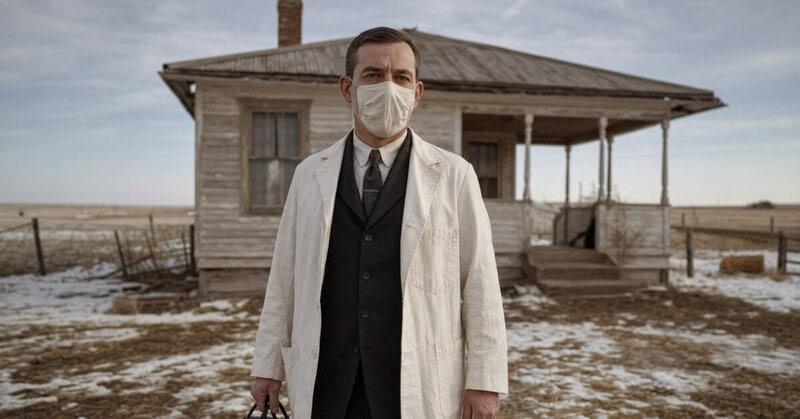
On a bitter January morning in 1918, somewhere on the wind-scoured flatlands of Haskell County, Kansas — a place so remote its nearest town barely registered on most maps — a local physician began recording something that alarmed him. The farm families arriving at his door weren’t suffering from ordinary winter illness. This was faster, harder, and more dangerous, moving through households with an urgency he couldn’t quite explain. He wrote it down anyway. Almost no one listened.
That moment of ignored vigilance sits at the center of one of the most consequential and least understood catastrophes in modern history: the 1918 influenza pandemic, still commonly known by a name that points to entirely the wrong country, still debated by virologists and historians, and still directly relevant to how the world tries to prevent the next one.
Why the Name “Spanish Flu” Is a Wartime Accident

The pandemic that killed an estimated 50 to 100 million people — in a world of roughly 1.8 billion — has carried Spain’s name for more than a century. It is one of history’s most consequential mislabelings, and the story of how it happened reveals as much about wartime censorship as it does about virology.
In 1918, the United States, Britain, France, and Germany were locked in the final grinding year of the First World War. Every one of those governments understood that a devastating illness sweeping through their troops could embolden enemies and shatter civilian morale. Newspapers on all sides, operating under wartime censorship agreements, stayed largely silent. Soldiers fell ill by the thousands in training camps from Kansas to the Western Front, and the press looked away.
Spain was different. Neutral in the war, the Spanish government had no comparable censorship apparatus, and Spanish journalists reported freely on the sick and the dying. When King Alfonso XIII fell gravely ill in May 1918, it made front pages. When the disease spread through Madrid, the papers said so plainly. To the outside world — reading only what wartime governments permitted to be printed — Spain appeared to be the epicenter of a terrifying new plague. It was, in fact, simply the most transparent country in Europe.
The label “Spanish flu” was never a scientific designation. It was a rumor that calcified into received history, a name born from who was allowed to tell the truth rather than where the virus actually originated. Attaching disease names to places has always been a fraught practice, and the 1918 pandemic remains the most costly example of how badly that habit can mislead.
A Doctor’s Warning That Vanished Into Bureaucracy

The physician watching his Haskell County patients struggle was named Loring Miner. What he observed in late January and early February 1918 was severe enough that he took the unusual step of filing a report with U.S. Public Health Service officials — one of the earliest documented warnings of an abnormal influenza outbreak anywhere in the world. The report was received. And then, in the way bureaucratic systems have always processed inconvenient signals, it effectively disappeared.
What Haskell County had in abundance, beyond wide skies and wheat fields, was young men of draft age. As winter deepened, those men were called up and routed into the U.S. Army’s massive training infrastructure. Many traveled to Camp Funston, located at Fort Riley in central Kansas — one of the largest military installations in the country, packed with tens of thousands of soldiers sharing mess halls, barracks, and the particular misery of a Kansas winter.
On March 4, 1918, an army cook named Albert Gitchell reported to the camp infirmary with fever and severe symptoms. He is now considered the conventional starting point of the pandemic’s recorded history. Within days, hundreds of soldiers at Camp Funston were ill. By March 11, cases had appeared at other U.S. military installations across the country. And then the troop ships began sailing for Europe.
The soldiers who boarded those vessels carried more than their rifles and their fears. They carried the virus into the crowded, malnourished, exhausted world of the Western Front — into the trenches, the field hospitals, the Allied staging areas — and from there it spread into the civilian populations of France, Britain, and beyond. A localized outbreak in an obscure American county had gone global, accelerated by the logistics of a world war.
The Virology: Why This Influenza Killed Differently

Most influenza strains follow a predictable pattern: they hit hardest at the very young and the very old, whose immune systems are least equipped to fight back. The 1918 virus broke that pattern in a way that terrified physicians at the time and continues to fascinate virologists today.
The pathogen was an H1N1 strain with genes of avian origin — a genuinely novel influenza for which virtually no human being carried meaningful pre-existing immunity. But what made it distinctively lethal was who it killed most efficiently: healthy young adults in their twenties and thirties, precisely the people whose immune systems should have been best positioned to fight it off. The leading explanation, developed through decades of retrospective research, is that the virus may have triggered a catastrophic overreaction of the immune system — what scientists call a cytokine storm — in individuals with the strongest immune responses, effectively turning the body’s own defenses into the mechanism of death.
The conditions of 1918 amplified an already catastrophic situation. Troop ships crossing the Atlantic were floating incubators: thousands of men crammed below decks, breathing recycled air, sleeping in rotation on the same bunks. The trenches of the Western Front offered no better odds. Malnutrition, battlefield wounds, and four years of accumulated physical punishment had left millions of people with almost no physiological reserve. The virus moved through them with devastating efficiency.
The pandemic arrived in waves. The spring 1918 surge — the one that began at Camp Funston — was relatively mild compared with what followed. The catastrophic second wave struck in the autumn of 1918, killing at a rate that overwhelmed morgues and coffin-makers from Philadelphia to Cape Town. A third wave continued into 1919 and early 1920 before the pandemic finally exhausted itself. The full human cost remains almost impossible to comprehend.
The Rival Theory: A Chinese Origin?

The Kansas origin story is the most widely accepted among historians and virologists, but it has a serious challenger that intellectual honesty requires examining carefully.
Some researchers have proposed that the 1918 pandemic may have originated in southern China — specifically in Guangdong province — a region that has historically functioned as a biological mixing zone for avian and human influenza strains, given the density of human and animal populations living in close proximity. The mechanism most often cited by proponents involves Chinese laborers transported into Europe to support Allied war efforts behind the front lines. The hypothesis is that an early form of the virus may have traveled with them.
The theory deserves neither dismissal nor uncritical acceptance. The genetic and epidemiological evidence remains inconclusive, and critics have noted that the China hypothesis has at times been shaped more by geopolitical assumption than by verified laboratory data. The documentary record from Haskell County — Dr. Miner’s report, the Camp Funston outbreak, the precise chronology of subsequent military cases across multiple installations — gives the Kansas theory a specificity that the Guangdong hypothesis currently cannot match.
The honest answer, more than a century later, is that there is no definitive scientific consensus on the precise geographic origin of the 1918 pandemic. The Kansas theory is the frontrunner. The question is not entirely closed.
What Fifty Million Deaths Actually Looked Like

Numbers like “50 million dead” flatten the reality they are meant to convey. To give that figure genuine weight: in a world of roughly 1.8 billion people, the pandemic killed somewhere between one in every eighteen and one in every thirty-six humans alive. Average life expectancy in the United States fell by approximately twelve years in 1918 alone — a single-year statistical collapse with no modern parallel.
The geography of suffering was brutally uneven. In some Indigenous communities in Alaska and across Pacific island populations — groups with limited prior exposure to circulating influenza strains — mortality rates were staggering, as the virus moved faster than any medical response could follow. In Philadelphia, one of the hardest-hit American cities, bodies accumulated faster than coffins could be built and gravediggers could be found. Mass graves became, briefly, a feature of American urban life.
By the autumn of 1918, the pandemic and the war had become inseparable catastrophes. Influenza was thinning armies on both sides of the conflict even as the military campaigns of that final year reached their climax. When the Armistice arrived in November 1918, the flu was still killing. The relationship between the pandemic’s toll and the war’s conclusion remains a subject of historical debate, but the two catastrophes were always entangled.
Perhaps the strangest consequence of all this was how thoroughly the pandemic faded from collective memory within a generation. The war, with its memorials, its poetry, and its seismic political aftermath, consumed most of the available cultural space for grief. The influenza pandemic — which killed more people than the war — became the catastrophe that a traumatized world somehow forgot to mourn. It took the arrival of COVID-19 in 2020 to trigger a widespread reckoning with what 1918 had spent a century trying to teach.
Why the Origin Question Still Matters Now

Asking where the 1918 influenza began is not merely an exercise in historical curiosity. It is a question with direct consequences for how scientists design pandemic surveillance systems today. Understanding the precise conditions that allowed a novel influenza strain to jump from animals to humans, circulate undetected through a rural population, and then accelerate into a globalized military machine is exactly the knowledge that shapes how the world attempts to detect the next pandemic before it becomes unstoppable.
The story of Dr. Loring Miner’s ignored report from Haskell County is cited by public health researchers to this day — not as a historical footnote but as a case study in what happens when early warning signals are absorbed by bureaucratic silence rather than met with urgent action. The signal existed. The system failed to act on it. The consequences were measured in tens of millions of lives.
The H1N1 strain that emerged in 1918 did not simply vanish. A descendant lineage caused the 2009 swine flu pandemic, spreading globally before a targeted vaccine could be deployed at scale. The ongoing scientific effort to trace the 1918 virus to its ultimate source continues because virologists understand that the conditions enabling the emergence of a dangerous novel influenza have not disappeared from the world. The question of where the next great pandemic begins is not whether. It is when — and whether, this time, the first doctor to file the first report will find anyone who is actually listening.

 English
 Arabic
 French
 Spanish
 Portuguese
 Deutsch
 Dutch
Dutch
 Italiano
 Russian
 Romaian
 Portuguese (Brazil)
 Greek
Greek