


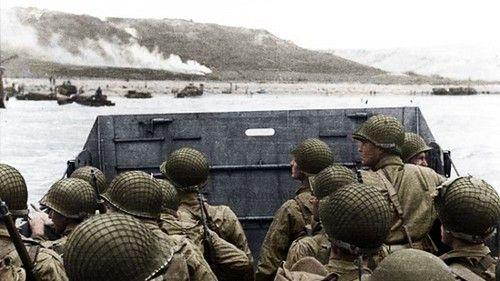
At 6:30 on the morning of June 6, 1944, the ramp of a Higgins boat dropped into the grey surf off a stretch of French coastline code-named Omaha Beach, and men who had been soldiers for years discovered, in a single second, that nothing they had trained for had prepared them for this.
A Killing Ground by Design: The Geography of Omaha Beach

The water was chest-deep where the boats grounded, sometimes deeper, and the German machine guns on the bluffs above were already firing before anyone could see the shore through the smoke. Men drowned under the weight of their equipment. Men were cut down before they cleared the ramp. Some companies of the 1st and 29th Infantry Divisions suffered casualties above 90 percent within the first hour — not over the course of a prolonged engagement, but within a single, catastrophic morning.
The central irony of Omaha Beach — the one that haunts every serious attempt to reconstruct the Normandy invasion in film or in history — is that Allied planners had not rated it the most dangerous of the five landing zones. Geography had driven the decision to assault it: Omaha sat between the British sectors to the east and Utah Beach to the west, and the gap had to be bridged. But the intelligence assessments had classified the defenses as manageable. That assessment was catastrophically wrong, and understanding why it was wrong is the key to understanding everything serious D-Day films have been trying to tell us for more than sixty years.
The terrain was merciless even before a single shot was fired. The beach itself was a three-hundred-yard killing field of open sand, backed by a shingle embankment and then 150-foot bluffs riddled with bunkers, gun emplacements, and carefully sited machine-gun nests that covered every yard of the approach. There was almost no natural cover. Aerial photography had also missed a critical last-minute redeployment: the battle-hardened German 352nd Infantry Division had moved to positions on those bluffs in the weeks before the invasion, replacing the lighter garrison Allied planners had been expecting. The soldiers who stepped off those landing craft walked into interlocking fields of fire from a force that had been specifically positioned, on elevated ground, to destroy them.
The plan had called for amphibious DD — Duplex Drive — Sherman tanks to be launched offshore and swim in under their own power, arriving alongside the infantry and providing crucial armored support. Most sank within minutes of launch in seas too rough for their design. The infantry went in alone.
The 24 Hours That Changed Everything: A Timeline of June 6, 1944

The battle for Normandy had begun before dawn. In the hours after midnight, paratroopers of the 82nd and 101st Airborne Divisions dropped behind German lines, their mission to secure the flanks of the invasion and prevent armored counterattacks from reaching the beaches before the seaborne forces could establish a foothold. The drops were scattered and chaotic — navigational errors, anti-aircraft fire, and cloud cover spread men across miles of French countryside — but the confusion itself carried an unintended benefit, convincing some German commanders that the drops were too disorganized to represent a major invasion.
At dawn, Allied naval vessels opened a sustained bombardment of the German defenses. On most beaches it did significant damage. On Omaha, the heavy bombers assigned to crater the beach obstacles and suppress the bunkers released their loads up to three miles inland, unwilling to risk hitting the approaching fleet through the cloud cover. The fortifications were left largely intact. When H-Hour arrived at 0630, German defenders looked down from undamaged positions at the most concentrated target they had ever faced.
By mid-morning the situation on Omaha had the character of a catastrophe rather than a battle. Units had lost their officers. Radio communications had collapsed almost immediately. Men who had trained for coordinated assault were crouching behind bodies or clinging to the narrow strip of sand below the high-water mark, unable to advance and unable to retreat. It was not generals who broke the deadlock. It was sergeants and lieutenants making individual decisions in local chaos — small groups who stopped waiting for orders that would never come and began, one by one, to climb the bluffs.
Among the figures who helped galvanize the survivors was Brigadier General Norman Cota, deputy commander of the 29th Infantry Division, who moved through the carnage urging men forward. His presence and direct orders helped transform paralysis into motion at several critical points along the beach.
The contrast with Utah Beach, just fifteen miles away, is striking. A navigational error had landed American troops in a lightly defended sector, and the assault at Utah succeeded with fewer than two hundred casualties — a figure that underscores how radically geography and circumstance could reshape the course of a single day. On Omaha, American casualties numbered roughly two thousand. Across all five beaches, Allied losses on June 6, 1944 — killed, wounded, and missing — are estimated at between ten thousand and twelve thousand. These are the facts that numbers alone struggle to contain.
Saving Private Ryan and the Revolution in War Cinema

When Steven Spielberg’s Saving Private Ryan opened in 1998, it did something no D-Day film had previously achieved: it made audiences physically afraid. The opening sequence — handheld camera, desaturated color, sound design stripped of heroic music and filled instead with the percussion of impacts and the gasps of drowning men — placed viewers inside a landing craft on Dog Green sector, Omaha Beach, with a fidelity that veterans who attended early screenings described as the closest cinema had come to their actual experience. Some left the theater. Many wept. Most said it was right.
The precision was not accidental. Spielberg and cinematographer Janusz Kamiński studied actual combat footage extensively and worked with historians and veterans to choreograph the geography of the assault with documentary care. The sequence functions not as spectacle but as testimony — each cut timed to the rhythm of survival rather than the rhythm of drama.
The film’s central plot device — a squad dispatched behind enemy lines to retrieve a single surviving soldier — never happened and is an acknowledged fiction. But historians have largely noted that this fictional frame serves a deliberate purpose: it forces the audience to weigh one life against the thousands spent to open the beach, and to ask why the sacrifice at Omaha mattered at all. Inside that structure, the D-Day texture is as historically grounded as a studio film has achieved. Saving Private Ryan remains the benchmark against which all debates about historically accurate D-Day films are measured.
For a broader sense of where it sits among its peers, this curated guide to the best D-Day movies provides useful context for how filmmakers across generations have approached the same story.
From The Longest Day to Band of Brothers: How the Storytelling Evolved

The Longest Day, released in 1962 and adapted from Cornelius Ryan’s meticulous oral history of the same name, was the first attempt to render the full panoramic scope of June 6 on screen. Shot in black-and-white with an enormous multinational cast — John Wayne, Robert Mitchum, Henry Fonda, and dozens of European actors playing their respective sides — the film’s strength is its breadth. It moves between Allied and German command, between paratroopers in the dark and infantrymen at the waterline, and it captures the structural complexity of the operation with real ambition. Its weakness is the sanitizing effect of its era’s conventions: the human cost is present but softened, death rendered as dramatic punctuation rather than as the overwhelming arithmetic it actually was.
A war historian’s assessment of how The Longest Day and nine other essential films handle the material — what each illuminates and where each inevitably simplifies — is worth reading in this considered ranking of classic D-Day films by a World War II historian.
Band of Brothers, the HBO miniseries produced by Spielberg and Tom Hanks and broadcast in 2001, shifted the frame entirely. Rather than attempting Omaha again, it followed the 101st Airborne’s Easy Company from their parachute drop on the night of June 5 through months of subsequent combat across France, the Netherlands, and Germany. The decision proved revelatory. By narrowing to a single unit over a sustained period, the series achieved a granular accuracy in tactics, equipment, psychological texture, and unit relationships that no two-hour film could sustain. Veterans of Easy Company who consulted on the production reported that specific details — the way ammunition was carried, the way commands were given, the way men talked to each other before a drop — were precisely right. It remains among the most celebrated works in the D-Day and World War II screen canon.
A less familiar but important dimension of the story is the agonizing meteorological decision that preceded everything else. Eisenhower’s chief meteorologist, Group Captain James Stagg, had to advise the Supreme Commander on whether a narrow and imperfect weather window in early June would permit a Channel crossing. Eisenhower made the final call to proceed on June 6. Had he been wrong, the story of D-Day would be entirely different. The National WWII Museum’s account of the real meteorological drama behind the film Pressure is a reminder that the most consequential decisions of the Normandy invasion were made not on the beach but in a briefing room in southern England, forty-eight hours before the ramps dropped.
Taken together, the arc from The Longest Day to Band of Brothers to smaller, more specialized productions like Pressure traces a clear filmmaking evolution — from heroic spectacle toward moral, logistical, and human complexity. Each generation of filmmakers has added a layer the previous one could not, or would not, show.
What the Films Still Get Wrong — and Why It Matters
Even the best D-Day movies carry significant omissions. The most consequential is the near-total absence of any dramatization of Allied air power’s failure on Omaha. The decision by American heavy bombers to delay their release and drop through cloud cover — leaving German fortifications intact while depositing craters in empty French farmland miles from the beach — is one of the most significant tactical failures of June 6. It is documented in after-action reports and acknowledged in every serious historical account. It is almost never shown on screen, perhaps because it implicates Allied command decisions rather than enemy ferocity, and is therefore harder to fit into a narrative of heroic sacrifice overcoming overwhelming odds.
There is also the persistent problem of national tunnel vision. English-language D-Day films overwhelmingly focus on the American experience at Omaha and Utah. British and Canadian forces on Gold, Juno, and Sword beaches faced fierce resistance of their own, and the French commando units who landed at Ouistreham on the morning of June 6 are almost entirely absent from cinema’s version of Normandy. The popular understanding of D-Day has been shaped, to a degree most viewers do not realize, by which stories the most commercially dominant film industry chose to tell — and which it chose to leave out.
Finally, nearly every film imposes a coherence on command that the reality did not possess. Generals in these films make decisions that visibly ripple down to the beach. What the historical record actually shows is that radio communications on Omaha collapsed within minutes of H-Hour, and that the battle was turned — to the extent it was turned at all — by the accumulated individual choices of junior officers and non-commissioned officers who had no way of knowing whether anyone else was moving. The best D-Day documentaries, including those produced by PBS and the National WWII Museum, fill these gaps with archival footage, firsthand testimony, and structural context that even a three-hour fiction film must compress or omit entirely.
Why This Story Still Commands Our Attention

The reason Omaha endures in cinema and in memory — the reason filmmakers keep returning to it and audiences keep watching — is precisely because it refuses a clean story. The plan failed. The technology failed. The intelligence failed. Communications failed. And then, out of that accumulated failure, ordinary men climbed the bluffs anyway, one small group at a time, and by evening the beach was taken.
The best D-Day movies work not because they are perfect history — none of them are — but because they make audiences feel the weight of contingency. It almost didn’t happen. It almost failed completely and irreversibly. The margin between the Normandy invasion that succeeded and the one that might have been driven back into the sea was measured in individual acts of motion in the face of paralysis. Every serious Normandy film is ultimately about that margin.
For readers who want to go further, the Eisenhower Center oral histories, the after-action reports held at the National Archives, and the interpretive resources at the American Cemetery at Colleville-sur-Mer above Omaha Beach preserve the record in the words of the people who lived it. Cinema is a powerful introduction to that material — but it works best when it sends viewers toward the primary sources rather than substituting for them.
Above Omaha Beach, on a headland overlooking the same water where the ramps dropped eighty years ago, there are 9,388 white marble markers. Each one carries a name. The films can gesture toward those names — can make us feel, for two hours or ten, something close to the weight of what they represent — but they cannot contain them. Which is exactly why we keep making these films, keep arguing about their accuracy, and keep coming back to watch them. The markers remain. The argument about how to honor what they represent is still very much alive.

 Arabic
 French
 Spanish
 Portuguese
 Deutsch
 Turkish
 Dutch
Dutch
 Italiano
 Russian
 Romaian
 Portuguese (Brazil)
 Greek
Greek