


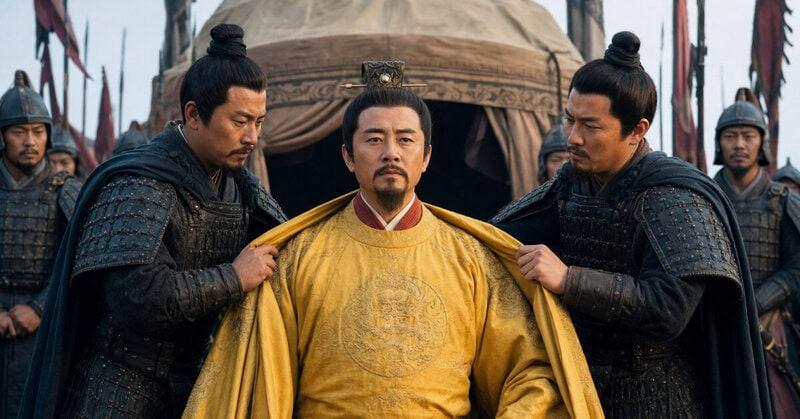
On a cold January morning in 960 AD, soldiers camped outside the city of Chenqiao made a decision that would change the world. They seized their commanding general, Zhao Kuangyin, while he slept, draped a yellow imperial robe over his shoulders, and acclaimed him emperor before he could protest — a theatrical coup so swift and bloodless it almost felt scripted.
A General in a Yellow Robe: The Accidental Empire

Zhao Kuangyin had every reason to refuse. The Five Dynasties era he was inheriting had churned through five short-lived regimes in just over fifty years, each collapsing in blood and betrayal. Emperors were made and unmade by the men who served them. He knew the game. And yet he accepted, rode back to the capital, and became Emperor Taizu of Song — founding a dynasty that would endure for more than three centuries and produce, arguably, the most sophisticated civilization on Earth before the Industrial Revolution.
The stakes of that January morning were staggering. The dynasty Zhao Kuangyin launched would give the world paper money, movable-type printing, explosive gunpowder weapons, and ocean-navigating compasses. Its capital, Kaifeng, would swell to over a million people at a time when London and Paris could barely claim fifty thousand. The Song dynasty, ruling China from 960 to 1279, stood centuries ahead of medieval Europe in almost every measurable dimension of urban and commercial life. Then the Mongols came, and it was gone. To understand how something so brilliant could fall so completely, you first have to understand exactly how brilliant it was.
Two Acts, One Dynasty: Northern Song, Southern Song, and the Geography of Anxiety

The Song story divides into two acts of very different emotional registers. The Northern Song (960-1126) was an expansive, ambitious empire centered on Kaifeng, a city threaded by canals choked with barges, lit at night by blazing lanterns, and humming with a commercial energy that no city on Earth could match. Night markets ran until dawn. Merchants traded in silk, porcelain, and spices. The world’s first recognizable consumer culture was assembling itself in real time.
Then the Jurchen Jin dynasty swept down from the north, seized Kaifeng in 1127, and captured the reigning Emperor Huizong along with his son and heir. What remained of the Song court fled south of the Yangtze River and reestablished itself at Lin’an — present-day Hangzhou — beginning the Southern Song (1127-1279). This southern retreat was a trauma: the loss of ancestral lands, the humiliation of a captured Son of Heaven. But it was also, paradoxically, a catalyst. Refugees flooded south with capital, skills, and desperation. The Yangtze delta’s river networks and coastline supercharged maritime trade. The dynasty that had lost its heartland became the era’s dominant commercial sea power.
Yet the dynasty carried a structural wound from its very founding. Emperor Taizu, mindful of exactly the kind of coup he had just executed, deliberately weakened his own military class. He bought back the land and power of his generals with comfortable retirements, replacing a warrior aristocracy with a civilian bureaucracy selected through rigorous examinations. It was a rational choice for internal stability. It was a costly choice for external defense. The Song would spend the next three centuries trying to compensate for the cavalry armies it no longer cultivated, and it would do so — brilliantly and tragically — through technology.
The Innovation Engine: How Song China Rewired the Medieval World

Understanding Song dynasty innovations requires seeing them not as isolated curiosities but as a coherent, interlocking system. A commercializing economy demanded new tools. A state hungry for tax revenue had every incentive to fund and spread those tools at scale. Advances in agriculture, iron-working, and printing fed each other in feedback loops that look startlingly modern.
Printing is the best place to start, because it powered everything else. Bi Sheng developed movable-type printing using ceramic type during the reign of Emperor Renzong, roughly between 1041 and 1048 — the first such system in the world. This innovation drove down the cost of books and drove up literacy among merchants, officials, and craftsmen. Knowledge circulated faster than it ever had. The civil examination system, the keju, opened government careers to men of talent rather than birth, producing a meritocratic bureaucracy of remarkable sophistication. A literate merchant class and a merit-selected civil service together created the administrative and intellectual infrastructure that made large-scale commerce possible.
Iron and steel production scaled to levels that would not be matched in the West for centuries. Song furnaces, particularly in the Hebei region, reportedly produced quantities of iron annually that rivaled the output of early Industrial Revolution Britain — supplying tools, ships, coins, and weapons in vast quantities. Columbia University’s Asia for Educators module on the Song dynasty describes this period as one of the most dynamic economic transformations in premodern history, a characterization that is difficult to dispute when the output figures are examined. Agricultural productivity rose in parallel, driven by the adoption of fast-ripening Champa rice strains from Vietnam, which allowed double and sometimes triple cropping in southern paddy fields and freed surplus labor for urban manufacturing and trade.
On the water, Song navigators refined and systematically deployed the magnetic compass on ocean-going vessels that reached Arabia and the coast of East Africa. Chinese ceramics, silk, and copper coins functioned as a kind of reserve currency across Indian Ocean trade networks. The Song did not merely participate in global commerce — they largely organized it.
Paper Money, Restaurants, and the Birth of Consumer Culture

The story of paper money begins, appropriately enough, with merchants complaining. In Sichuan province, traders dealing in iron coins faced a maddening logistical problem: the coins were extraordinarily heavy. Lugging enough iron currency to conduct serious business was literally back-breaking. So merchants began issuing private deposit certificates — paper notes representing coin left with a trusted commercial house. You could trade the paper and redeem it later for metal. The system worked until it didn’t, when some issuers ran short of the metal backing their promises and confidence collapsed.
The Song state saw both the obvious solution and the obvious opportunity. Around 1023, during the Northern Song period, the government took control of the concept and issued the world’s first state-backed paper currency, known as the jiaozi. It was a stunning conceptual leap: money as a promise and an institution rather than a physical commodity. The system carried real risks — and the Song eventually printed more currency than their economy could absorb, triggering inflationary crises in later decades — but the foundational idea proved so powerful that no major economy on Earth operates without it today.
The restaurant is another Song contribution to modern life, and it is easy to underestimate how radical it was. Establishments in Kaifeng and later in Lin’an offered something genuinely new: printed menus listing dishes from different regional cuisines, professional kitchens cooking to individual order, takeout service for busy city-dwellers, and hours that extended deep into the night. These were not inns serving whatever happened to be hot. They were restaurants in the fully modern sense — commercial spaces engineered around the pleasure and convenience of eating out. They served a population with disposable income, limited domestic cooking space, and demanding expectations. Teahouses, pleasure boats on the city canals, professional storytellers, a thriving trade in printed books: Song dynasty China had assembled a recognizably modern urban culture seven centuries before the steam engine.
The paradox embedded in all of this affluence was also a strategic liability. A society this wealthy and this trade-dependent generated enormous tax revenues and, with them, the means to fund sophisticated defense. But it also generated a population with a great deal to lose and, perhaps, a diminished cultural appetite for the grinding sacrifices of prolonged total war. Commerce and military conquest have always made uneasy partners.
Fire and Thunder: The Gunpowder Arms Race Song China Lost

Gunpowder itself was a Tang dynasty discovery — experimenters mixing sulfur, charcoal, and potassium nitrate who were almost certainly pursuing something else entirely when the mixture ignited. The Song transformed it into a systematic weapons program. Fire arrows. Catapult-launched bomb clusters. The fire lance — a bamboo tube packed with gunpowder that projected flame and shrapnel at close range — which is widely regarded as the direct ancestor of the gun. By the thirteenth century, Song arsenals were manufacturing true metal-barreled fire-arms and ceramic-cased explosive grenades in substantial quantities.
The bitter irony is legible in the logic of the program itself. Song engineers developed these weapons precisely to compensate for their cavalry deficit. They lacked the horses, the open grasslands, and the nomadic military tradition that made northern enemies so formidable in open-field engagements. Technology was intended to be the equalizer — a substitute for the military culture the dynasty’s founder had deliberately unwound. For a time, it worked. Gunpowder weapons gave Song defenders real and documented advantages in defensive sieges and river battles.
But the Jurchen Jin, and then the Mongols, were not static opponents. They observed, captured, recruited, and adapted with ruthless efficiency. The siege of Xiangyang, which ran from 1267 to 1273, became the hinge on which the dynasty’s fate turned. Xiangyang was the Song’s most strategically vital fortress city, commanding the Han River corridor into the heart of the southern empire. Mongol forces, supplemented by Muslim siege engineers from Persia and equipped with massive counterweight trebuchets — a design that Song defenders had not encountered before — reduced the city after nearly six years of relentless pressure. When Xiangyang fell, the outcome of the broader war was, in practical terms, settled.
The Mongol Reckoning: Why the Song Held Longest — and Still Fell

Context is essential for appreciating just how extraordinary the Song’s resistance actually was. By the time Kublai Khan turned his full military attention southward, the Mongols had already destroyed the Jin dynasty, sacked Baghdad and ended the Abbasid Caliphate, and reduced the cities of Kievan Rus to ash. They were the most formidable military force the medieval world had produced. The Song held out against them for decades longer than almost any other major power they targeted, and the primary reason was geography.
The Yangtze River network and the rice-paddy landscape of the south neutralized the Mongols’ defining advantage: cavalry. Horsemen who could sweep across the Eurasian steppe in terrifying mobile formations were not terrifying in a landscape of rivers, marshes, and estuaries. The Song possessed a substantial navy. The Mongols, at the outset, did not. Kublai Khan’s campaign against the Southern Song was not a swift conquest but a grinding, decades-long combined-arms war that required the Mongols to essentially reinvent themselves as a maritime power — constructing river fleets, recruiting experienced Chinese and Korean naval commanders, and learning amphibious warfare from the ground up.
The final act came in 1279 at the Battle of Yamen, a naval engagement fought in the Pearl River estuary near present-day Guangdong. The last Song loyalists had gathered around the seven-year-old Emperor Bing, the dynasty’s final claimant to the throne. When the battle turned decisively against them, the official Lu Xiufu reportedly took the child emperor in his arms and leaped into the sea rather than surrender to the Mongols. Thousands of Song loyalists followed. The dynasty that had invented paper money, printed menus, explosive weapons, and precision ocean navigation ended in the water, holding a child.
Legacy: What the Song Built, Lost, and Gave the World
The fall of the Song inaugurated the Yuan Dynasty under Kublai Khan — the first time in Chinese history that the entirety of China had been ruled by a foreign power. The psychological rupture echoed across centuries in Chinese historical consciousness, shaping how subsequent dynasties thought about military preparedness, foreign relations, and the potential dangers of prioritizing commercial wealth over martial strength.
Historians continue to debate whether the Song represented an interrupted early modernity — proto-capitalism, mass literacy, meritocratic government, technological leadership — that the Mongol conquest derailed and partially dismantled. The question remains genuinely open and genuinely important. Song dynasty China offers one of history’s most compelling and uncomfortable case studies in the relationship between civilizational achievement and military vulnerability. The dynasty’s founder deliberately subordinated military power to civilian control in order to secure internal stability. His successors paid for that structural choice with the empire itself, three centuries later.
But the inventions did not perish at Yamen. Paper money, movable-type printing, gunpowder weapons, and the magnetic compass traveled through the Mongol trade networks — the Pax Mongolica that briefly stitched Eurasia into a single connected corridor — into the Islamic world and eventually into Europe. There, in different hands and different contexts, they helped enable the Renaissance, the Age of Exploration, and a transformation of the military and commercial balance of the world that continues to unfold. The Song built the most sophisticated civilization of their age, lost it to the most powerful military force their world had ever seen, and in losing it, inadvertently equipped everyone else with tools that would reshape global history. Whether that is the greatest tragedy of the medieval world or its most consequential irony is a question worth sitting with — because it is, quite plausibly, both.

 English
 Arabic
 French
 Spanish
 Deutsch
 Turkish
 Dutch
Dutch
 Italiano
 Russian
 Romaian
 Portuguese (Brazil)
 Greek
Greek