


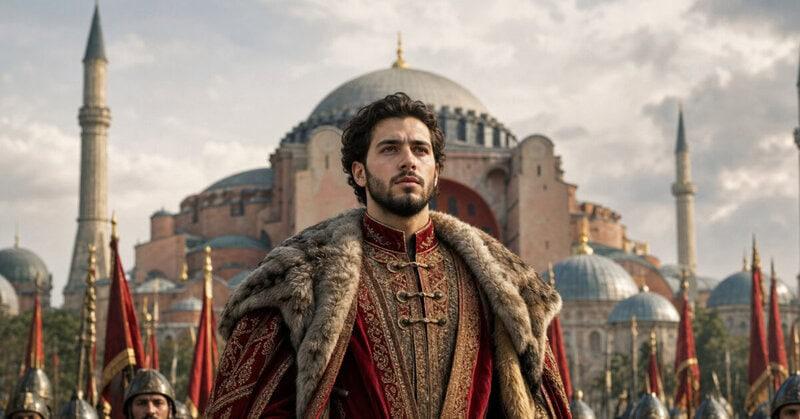
The cannon smoke had barely cleared when a twenty-one-year-old rode through the shattered gates of a city that had called itself Rome for a thousand years. It was the morning of 29 May 1453, and Mehmed II — sultan, strategist, and once-deposed teenager — had just done what Attila, the Umayyads, the Bulgars, and a dozen other conquerors had failed to do: he had ended the Roman Empire.
The Morning the Ancient World Ended

Dawn broke over the Golden Horn in a haze of smoke and ash. The Theodosian Walls — fortifications that had held for over a thousand years and had become almost mythological in their impregnability — were finally breached. Inside the city, Constantine XI Palaiologos, the last emperor of Rome in any form, died fighting somewhere in the chaos near the gate, his body never conclusively identified. Outside, a young sultan born in Edirne on 30 March 1432 prepared to ride into the greatest prize in the medieval world.
The detail that history tends to skim past is the age. Mehmed II was twenty-one years old. The Byzantine Empire — the Eastern Roman Empire, Rome’s direct legal and institutional heir — had outlasted every rival civilization it had ever encountered, and it fell to a man who was, by modern standards, barely out of adolescence.
But his age alone is not the strangest part of the story. The strangest part is that Mehmed had already been sultan once before — and had already been stripped of that title, sidelined, and humiliated by his own court — before he ever laid eyes on Constantinople’s walls as a conqueror. This is not the story of an unstoppable prodigy riding a wave of unbroken success. It is the story of a boy who was handed an empire, had it taken away, and spent years quietly and furiously preparing to make sure it never happened again.
Born Into a World That Could Kill You for Being a Prince

The Ottoman dynasty in the fifteenth century was not a family in any warm sense of the word. It was a succession machine, and the machine’s first principle was that too many viable heirs created instability. Fratricide was not merely tolerated — it was, effectively, policy. A prince who seemed weak, or who attracted the wrong faction’s loyalty, could find himself not just out of favor but out of existence. Mehmed grew up inside this logic, and it shaped him into something watchful and ferociously disciplined from his earliest years.
His father, Murad II, was a capable and serious sultan whose temperament ran toward consolidation rather than dramatic expansion. He fought hard to defend what the Ottomans already held and was less interested in grand gestures of conquest. Mehmed, from what contemporaries recorded, was almost his father’s opposite — restless, intellectually voracious, and fixed from a young age on Constantinople as both a strategic objective and something close to a personal obsession. Islamic tradition held that the city’s conqueror would be especially blessed; Mehmed had absorbed that tradition and, characteristically, intended to fulfill it himself.
By his early teens he had already been sent to govern provinces — first Amasya, then Manisa — as an apprenticeship in administration and command. It was the Ottoman equivalent of being thrown into the deep end, and Mehmed did not drown.
First Reign, First Fall: The Teenager Who Lost an Empire

In 1444, something extraordinary happened: Murad II abdicated. The reasons were complex — exhaustion, political pressure, possibly a genuine desire to step back from power — but the result was that a boy of twelve found himself on the Ottoman throne. The first reign of Mehmed II had begun.
It lasted barely two years. The court was not an empty stage for a child ruler to command; it was a layered, faction-ridden world, and the most powerful figure in it was the grand vizier Çandarlı Halil Pasha, a man who had served loyally under Murad and who viewed the boy-sultan as a dangerous inexperience waiting to collapse into disaster. Halil Pasha and his allies maneuvered steadily to bring Murad back. By 1446, Murad II had returned to the throne, and Mehmed had been removed — not killed, but set aside, which in some ways was a slower wound.
The humiliation was real and lasting. Mehmed was a deposed sultan, a prince who had held supreme power and lost it not to an enemy army but to his own court. Contemporary accounts and later historians agree that this period hardened him in ways that would define every decision he made afterward. The deposition did not break him — it clarified him. He retreated into study: military strategy, engineering, history, and languages. He reportedly became fluent in several tongues, including Greek, and read the histories of Alexander and Caesar not as distant legends but as operational texts.
The Second Chance: 1451 and a Sultan With a Plan

Murad II died in February 1451. Mehmed was nineteen, and this time there would be no returning from retirement. He reclaimed the sultanate and would hold it until his death on 3 May 1481 — thirty years of uninterrupted rule that would transform the political geography of three continents.
He moved quickly and with clear purpose. Almost immediately he began planning the assault on Constantinople, overriding cautious advisors who counseled patience. Çandarlı Halil Pasha — the same grand vizier who had helped engineer his earlier deposition — once again urged restraint. Mehmed listened and proceeded anyway.
In 1452 he commissioned the construction of Rumelihisarı, a fortress on the European shore of the Bosphorus completed in just four months. It was a logistical statement as much as a military one: the new fortress controlled the strait, strangling Constantinople’s supply lines and announcing to anyone paying attention that this sultan was not consolidating — he was advancing.
He also invested in firepower the medieval world had never quite seen. Mehmed commissioned enormous bronze cannons — including the massive gun known as the Basilica, engineered specifically to crack stone walls that had resisted every previous attacker — and assembled an army that contemporaries estimated in the tens of thousands. Against this force, Constantinople could muster perhaps seven to eight thousand defenders. The mathematics were brutal before the siege even began.
The Walls, the Cannons, and the Fifty-Three Days That Rewrote History

The siege began in April 1453. The Theodosian Walls, built in the fifth century and repeatedly strengthened, had repelled Avar, Arab, Bulgar, and Rus assaults across the centuries. They were not simply fortifications; they were a symbol — almost a theological argument — that Constantinople was inviolable. Mehmed’s cannon fire began dismantling that argument section by section.
He was not content to simply batter at the walls from one direction. He executed one of the most audacious logistical maneuvers of the medieval period: he had a portion of his fleet hauled overland on greased logs, bypassing the great chain that blocked the Golden Horn harbor, and launched those ships into the harbor behind Byzantine lines. Suddenly the defenders — already desperately thin on the ground — had to cover a second front they had never anticipated. The psychological pressure alone was enormous.
On the night of 28-29 May, Ottoman forces launched their final assault. The walls were breached. Constantine XI, refusing to flee or surrender, died in the fighting — the last Roman emperor, meeting his end in the most Roman way imaginable. Mehmed the Conqueror rode into the city he had dreamed about since childhood. He was twenty-one years old.
What He Did With What He Won

It would be a misreading of Mehmed to see the conquest of Constantinople purely as an act of destruction. He moved the Ottoman capital to the city, set about rebuilding its depleted population by resettling communities from across the empire, converted the Hagia Sophia into a mosque, and — in a move that reveals the depth of his historical self-consciousness — styled himself Kayser-i Rum: Caesar of Rome. He was not claiming to have destroyed the Roman tradition. He was claiming to have inherited it.
The decades that followed confirmed he meant the inheritance seriously. He extended Ottoman power into Serbia, Bosnia, and toward the Adriatic coast, and conducted campaigns as far as the Crimea and the Albanian highlands. He patronized arts and scholarship with genuine enthusiasm, inviting Venetian Renaissance painters — including Gentile Bellini — to his court, and he reportedly engaged with Greek and Latin historical texts in the originals, drawn not to erase classical civilization but to locate himself within its continuum.
Shortly after the conquest, in a settling of accounts so quiet and absolute that it speaks volumes about the kind of man Mehmed had become, he had Çandarlı Halil Pasha arrested and executed. The grand vizier who had helped depose a twelve-year-old sultan did not survive the conqueror’s first weeks of victory. Whether this was principally political necessity or something more personal, Mehmed never explained. He rarely needed to.
The Legacy of Fatih: What One Life Changed
Mehmed II died on 3 May 1481, at age forty-nine — possibly from illness, possibly poisoned, the question remains disputed — while organizing yet another military campaign. In less than thirty years of his second reign he had taken Constantinople, reshaped the Balkans, codified Ottoman law through the Kanunname, reorganized the imperial administration, and transformed a regional sultanate into something that would remain one of the world’s dominant empires for centuries to come.
His title — Fatih, the Conqueror — was not ceremonial. It described a life defined by the understanding that power, once lost, must be reclaimed through preparation, patience, and absolute will. For anyone tracing the arc of Mehmed II’s history, the fall of Constantinople in 1453 is the hinge event — but the deposition of 1446 is the origin story. The boy who was stripped of a throne at twelve and handed it back at nineteen did not waste the years in between. He used them to become, at twenty-one, the man who ended Rome.
That is the detail worth sitting with. Not just the conquest — not just the cannons and the breached walls and the last emperor dying in the rubble — but the fact that the person who pulled it off had already been told, by the most powerful men in his own empire, that he was not ready. He remembered. He was always going to remember.

 English
 Arabic
 French
 Spanish
 Portuguese
 Deutsch
 Turkish
 Dutch
Dutch
 Italiano
 Russian
 Portuguese (Brazil)
 Greek
Greek