


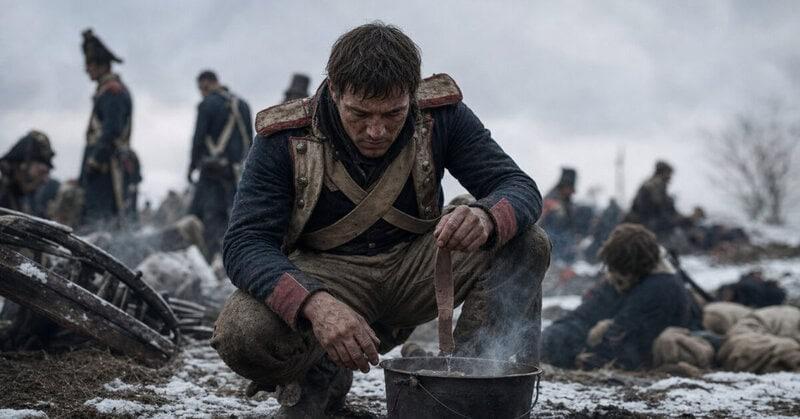
Somewhere east of Vilna in July 1812, a French infantryman of the Grande Armée crouched over a small fire and dropped a strip of leather boot strap into boiling water. He was not yet six weeks into the Russian campaign. The worst was still months away. And his emperor, four hundred miles back along the road, had no idea.
The Commander Who Devoured Information — and the Truth He Never Received

Napoleon Bonaparte was, by almost every account, a man who devoured information. He read reports at midnight by candlelight, dictated orders at a gallop, corrected his marshals’ arithmetic from memory. He had reshaped the art of war itself — the rapid corps system, the psychological dominance over slower-thinking opponents, the relentless pursuit that turned battlefield victory into the annihilation of entire armies. So the central, almost unbearable irony of the 1812 Russian campaign is this: the most information-hungry commander in European history was being systematically fed a lie, one softened dispatch at a time, while his army dissolved beneath him on the roads east of Warsaw.
The question historians have returned to again and again — why did Napoleon lose Russia? — tends to unspool into grand strategic answers. The vastness of the country. The stubbornness of Tsar Alexander. The winter. All of those things are true. But beneath them lies a grimmer, more mundane answer: his soldiers were starving, sick, and dying by the tens of thousands before a single major battle had been fought, and the reports reaching his headquarters described an army that existed almost entirely on paper.
The War That Remade a Continent

To understand how catastrophic the Russian disaster really was, you have to understand what Napoleon had already built and what he had already broken. The Napoleonic Wars, which ran from 1803 to 1815, grew directly out of the convulsions of the French Revolution — a revolution that had already shattered the old monarchical order of Europe and produced, in Napoleon, perhaps the most militarily gifted leader the continent had ever seen. Over more than a decade of near-constant conflict, he fought shifting coalitions of every major European power and beat most of them, repeatedly, sometimes with bewildering speed.
The War of the Third Coalition in 1805 and 1806 had ranged Britain, Russia, Sweden, and the Holy Roman Empire against him. He dismantled them at Austerlitz in December 1805, one of the most tactically perfect battles ever fought, luring the Allied commanders into precisely the flank attack he had invited them to make, then shattering their center while they were committed to it. By 1812, he had rearranged the map of Europe to suit himself, installed his brothers on foreign thrones, and reduced Austria and Prussia to sullen client states. His confidence in the Russian venture was not arrogance so much as a historically earned expectation. He had done this before. He had done it to these very people.
What he assembled for Russia reflected that confidence on a terrifying scale. Roughly 685,000 men crossed into Russia in June 1812 — the largest invasion force Europe had ever seen. It was almost certainly too large to feed using the roads, wagons, and supply systems of the era. But that consideration appears to have been neither prominently raised nor prominently heard at imperial headquarters. Accounts of the Napoleonic Wars consistently note the logistical ambition of the campaign; what they often understate is how completely the supply system failed before the army had fired a significant shot.
The Logistics Fantasy Nobody Would Name

Napoleon’s supply doctrine rested on a principle that had served him brilliantly in Italy and central Europe: armies should live off the land. Requisition from local villages, forage from fields, move fast enough that the enemy cannot strip the route ahead of you. It worked in the fertile plains of northern Italy. It worked in the grain-rich heartland of Germany. It rested, however, on a silent assumption that no one in his entourage had the courage to state plainly — that the land had to actually have food on it.
Russia did not cooperate. The Russian army’s withdrawal, partly a deliberate scorched-earth strategy and partly the result of terrified peasants burning their own barns rather than feed the invader, stripped the route east of anything useful. The supply wagons designed to follow the army — already an inadequate system for a force of this size — began breaking down on the sandy Lithuanian roads within weeks of the crossing. Horses died. Axles snapped. Grain rotted in wagons that had fallen too far behind the march to be useful. The system had never been adequate for a force of this scale; it became catastrophic almost immediately.
By the time the Grande Armée reached Smolensk in mid-August, some divisions had already shed between a fifth and a third of their strength — not to Russian muskets, but to dysentery, heat exhaustion, and starvation. Men who had marched into Russia in June in good health were dying in roadside ditches in August without ever seeing a battlefield. And Napoleon’s maps showed none of it.
The structural reason was as human as it was institutional. Corps commanders competed fiercely for Napoleon’s favour and lived in documented fear of his fury when they brought bad news. The informal norm that developed throughout the command structure was straightforward: present optimistic figures. Soften the losses. Bury the worst details in footnotes no one would read. A general who had 5,000 effective soldiers might report 8,000, knowing that to report the truth was to invite the emperor’s explosive displeasure and, worse, the suspicion that the shortfall was the commander’s own fault.
Marshal Berthier, Napoleon’s chief of staff and the man responsible for synthesizing army-wide reports into a coherent picture, was a logistical genius — meticulous, tireless, brilliant at organization. He was also, by the consistent judgment of historians, constitutionally incapable of bringing Napoleon unwelcome realities. His returns overstated effective troop strength. The picture they created was a fiction, and it was a fiction everyone at headquarters had a personal incentive to maintain.
Contrast this with the headquarters culture of Arthur Wellesley, the Duke of Wellington, who actively demanded accurate field returns from his staff and treated optimistic misreporting as a professional failure rather than a comfortable courtesy. It is a difference in command culture that would matter enormously when the two commanders finally faced each other — alongside Marshal Blücher’s Prussian army — at the Battle of Waterloo on 18 June 1815. By then, Napoleon was commanding a hollowed-out army with distorted intelligence once again, and the habit of institutional dishonesty had followed him all the way to Belgium.
Moscow Burns, and the Peace Offer Never Comes

The Grande Armée entered Moscow in September 1812 to find it largely abandoned and, within days, on fire. The Russians had torched their own city — or significant portions of it — rather than leave it as comfortable winter quarters for the invader. Napoleon installed himself in the Kremlin and waited. The silence was extraordinary. No Russian delegation came to negotiate. No riders arrived from Tsar Alexander with peace proposals. The city that was supposed to be the price Russia would not pay turned out to be a price Alexander had already decided he could afford.
The arithmetic of those weeks in Moscow was brutal. An army of this scale required enormous daily quantities of bread and fodder simply to remain functional. Moscow’s burning granaries supplied almost none of it. The supply lines stretching back through Smolensk to Poland were under constant harassment from Cossack cavalry, who proved devastatingly effective at cutting foraging parties and wagon trains. Horses that had not already died were being slaughtered for food. Soldiers who were still healthy were consuming reserves that could not be replaced.
Napoleon waited five weeks. He waited because his intelligence picture — fed by those same softened, optimistic reports — told him that Russia was close to the breaking point. Alexander, in reality, had made a private resolution to fight until France itself was invaded if necessary, a commitment he had communicated to those closest to him throughout the campaign. The information gap between those two realities — between what Napoleon’s reports described and what was actually happening in the Tsar’s mind and in the Russian countryside — was catastrophic. The decision to linger in Moscow is often listed among Napoleon’s greatest military errors. It was also the logical endpoint of an information system that had been deceiving him since June.
The Retreat, and the Numbers Finally Made Flesh

The retreat began in October 1812 and accelerated into one of the most catastrophic withdrawals in military history. The Napoleonic Wars timeline records the Russian campaign as lasting roughly six months; it is the return journey that lives in historical memory as something approaching hell made physical. Soldiers ate their horses, then fought each other for rations, then collapsed in the snow. The November crossing of the Berezina River became an emblem of the whole catastrophe: French engineers working chest-deep in freezing water to construct bridges while thousands of soldiers drowned or were crushed in the panicked press behind them.
By December, when the remnants of the main invasion force staggered back across the Polish border, no serious historian places the number of survivors anywhere near the force that had entered Russia six months earlier. The cold receives the blame in popular memory — the Russian winter as an almost supernatural adversary that defeated the undefeatable. But historical research has increasingly shifted the emphasis. The cumulative collapse of supply, disease, and malnutrition that preceded the worst winter weather was the primary killer. Men who crossed the Berezina in late November were already physically destroyed. The cold finished what starvation had started.
This distinction matters beyond the merely academic. If the winter was the cause, then Napoleon was unlucky — a great commander undone by geography and climate. If collapsing supply and systemic information failure were the cause, then Napoleon was undone by a management culture he had himself created, one that rewarded the telling of comfortable lies and punished the telling of uncomfortable truths. The evidence points firmly toward the second explanation.
What One Broken Information Chain Taught Military History

The shadow the Russian disaster cast over the remaining years of the Napoleonic Wars was fatal to the French imperial project. The Napoleonic Wars entered their final phase as Prussia, Austria, Sweden, and Russia reunited against France with a confidence they had entirely lacked before 1812. The repeated, humiliating defeats those powers had suffered across a decade of war had always been followed by French restraint at the peace table — restraint calculated to leave enemies wounded but not destroyed, available as future allies or at least non-belligerents. After 1812, those powers drew a different conclusion: that Napoleon could, in fact, be beaten, and that the way to beat him was to never again face him alone.
The French army that finally faced Wellington and Blücher at Waterloo in June 1815 was a fraction of its former self, led by a commander whose health had visibly deteriorated and whose command culture had never repaired its fundamental dysfunction. The optimistic reporting that had obscured the truth about the Grande Armée’s dissolution in Russia did not disappear in the intervening years; it simply found a smaller army to misrepresent.
The lesson that military historians draw from the Russian campaign sits at an uncomfortable intersection of tactics and organizational psychology. Napoleon’s tactical genius was entirely real — the speed, the improvisation, the reading of terrain and operational momentum that made him genuinely unlike any commander before him. But he had built around himself a command structure that filtered reality rather than reported it. He had trained his generals, through years of explosive displeasure at unwelcome news, to tell him what he wanted to hear. And in Russia, what he wanted to hear was that the army was strong, the supply was adequate, and Alexander was nearly broken. None of those things were true. None of them appeared anywhere in his dispatches as flatly false, either. They were truths that had been rounded, softened, and adjusted at every level of the hierarchy until they no longer bore any relationship to what the men on the roads actually knew.
That infantryman boiling his boot strap east of Vilna in July 1812 knew the truth that Napoleon did not. He knew the bread wagons were not coming. He knew his regiment had already buried a fifth of its strength in Lithuanian sand. He knew the land ahead was empty and the land behind was burning. He knew, in the immediate and inarguable way that only a starving body can know, that something had gone catastrophically wrong. He just had no way to carry that knowledge from his roadside fire to the emperor’s headquarters. And the men between them — the sergeants who reported to the lieutenants, the lieutenants to the captains, the captains to the colonels, the colonels to the marshals, the marshals to Berthier, and Berthier to Napoleon — each of them, at each step, rounded the numbers upward and softened the edges and chose not to be the one who said the unsayable thing.
History remembers the Russian winter. It remembers the burning of Moscow, the Cossacks materializing from the frozen forest, the image of a great army staggering home in rags. But the campaign was lost in something quieter and more mundane than any of those images — in the space between what Napoleon’s generals knew and what, step by careful step, they chose to say.

 English
 Arabic
 French
 Spanish
 Portuguese
 Deutsch
 Turkish
 Dutch
Dutch
 Italiano
 Russian
 Romaian
 Portuguese (Brazil)