


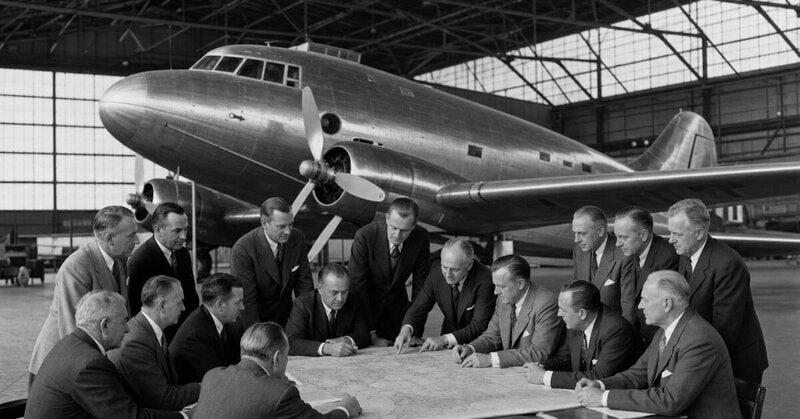
Somewhere in New York City in the spring of 1930, a deal was struck that most Americans have never heard of — and yet every time a passenger boards a flight at Dallas-Fort Worth International Airport, they are living inside its consequences. Eighty-two separate airlines, most of them flying secondhand biplanes on shoestring budgets, were folded into a single corporate structure almost overnight, and from that brutal act of consolidation, American Airlines was born.
A Sky Full of Wildcatters: American Aviation Before 1930

To understand why 82 airlines had to become one, you have to picture what the American sky looked like in the 1920s — chaotic, dangerous, and intoxicating in equal measure. The men who first commercialized flight were often barnstormers who had simply declined to come back down to earth after the First World War. They started companies with names like Robertson Aircraft Corporation and Colonial Air Transport, flew mail sacks through ice storms in open-cockpit planes, and kept their books balanced with little more than hope and a government contract.
That government contract was everything. The Kelly Air Mail Act of 1925 was the spark that ignited American aviation’s first gold rush. Congress, eager to privatize airmail delivery from the Post Office, handed lucrative route contracts to competitive bidders, and within months, startup carriers were scrambling across the country to claim a piece of the sky. The economics were simple and brutal: without an airmail contract, you had no revenue. With one, you had just enough to survive — provided your pilots didn’t die and your engines didn’t fail, neither of which was guaranteed.
Pilots flew for a few hundred dollars a month, often navigating by following railroad tracks below them, since instrument flying was more art than science. Crashes were not rare events but predictable costs of doing business. Most carriers were one bad winter season away from insolvency. The romance of early flight was real, but so was the smell of burning aviation fuel and the paperwork that followed an accident.
Into this fragile ecosystem walked Wall Street. By the late 1920s, financiers who had made fortunes in railroads and utilities began eyeing aviation the way their predecessors had once eyed transcontinental rail lines — as infrastructure waiting to be dominated. They didn’t need to love flying. They needed to see the pattern: fragmentation, desperation, and the possibility of scale. The holding-company era of American aviation had arrived.
The Aviation Corporation: Wall Street Builds an Airline

The Aviation Corporation, known as AVCO, was founded in 1929 by a syndicate of New York bankers and investors. These were not pilots or engineers. They were deal-makers, and they approached the airline business with the cold efficiency of men who understood leverage. Where aviation romantics saw daring adventure, AVCO’s founders saw undervalued assets and desperate sellers.
Their acquisition strategy was aggressive and fast. Within months of its founding, AVCO was absorbing small carriers across the South and Midwest, often buying them at distressed prices as the Great Depression began hollowing out airline balance sheets. The carriers that had scrambled to win airmail contracts in 1925 were now, just a few years later, scrambling to survive. AVCO offered a lifeline — or at least a way out — and dozens of operators took it.
The number that resulted was staggering in its operational implications: 82 semi-independent carriers operating under a single corporate umbrella. Routes overlapped in absurd ways. Aircraft fleets were a patchwork of incompatible types. Management structures varied wildly from one acquired company to the next. Running this collection was not a business — it was a bureaucratic emergency.
The solution, in 1930, was the creation of a unified brand: American Airways. The name was designed to project stability and national ambition onto what was still, in practice, a ramshackle assembly of secondhand planes and overlapping routes. It was the corporate equivalent of painting a fresh coat on a crumbling building. But it was also the beginning of something real — the slow, grinding process of turning chaos into a functioning airline. That process is central to understanding the full history of American Airlines and, by extension, the history of U.S. commercial aviation itself.
The Airmail Scandal and a Forced Reinvention

If consolidation built the structure, scandal supplied the stress test. In 1934, a congressional investigation exposed a secret that Washington insiders had long suspected: the major airline carriers, including American’s predecessor, had colluded with officials in the Hoover administration to divide airmail routes among themselves at a closed-door meeting in 1930, later nicknamed the “Spoils Conference.” The routes had not gone to the most competitive bidders. They had gone to the chosen few, arranged in private.
President Franklin Roosevelt’s response was swift and dramatic. He cancelled all private airmail contracts and ordered the U.S. Army Air Corps to fly the mail instead. The decision was morally satisfying and operationally catastrophic. Army pilots, trained for combat flying rather than the instrument navigation that commercial mail routes required, began dying in crashes within weeks. The public outcry was immediate and fierce. Roosevelt, recognizing the disaster, was forced to reverse course.
What emerged from the wreckage was the Air Mail Act of 1934, which required airlines to reorganize their leadership, rebid for contracts, and demonstrate they had genuinely reformed their corporate structures. American Airways, tainted by its association with the Spoils Conference, reincorporated under a new legal identity: American Airlines, Inc. — the name that endures to this day. The scandal, paradoxically, had accomplished what no market force had managed: it forced professional management standards, cleaner corporate governance, and a more coherent identity onto an industry that had been operating like a frontier operation.
C.R. Smith and the Plane That Changed Everything

The man who turned American Airlines from a reorganized mail carrier into a genuine passenger airline was Cyrus Rowlett Smith — C.R. to everyone who knew him — a tall, plainspoken Texan who took the helm in 1934 and immediately grasped something his predecessors had missed. Passengers, not airmail, were the future. But to carry passengers profitably, you needed an aircraft that didn’t exist yet.
What followed became one of the most consequential conversations in aviation history. Smith contacted Donald Douglas, the aircraft manufacturer, and pressed him to build a new plane: a longer, sleeper-equipped version of the existing DC-2 that could carry more passengers in genuine comfort across longer distances. The result was the Douglas DC-3 — widely considered the most important commercial aircraft ever built.
The DC-3 changed the arithmetic of air travel. It could carry 21 passengers, fly coast-to-coast with minimal stops, and — critically — generate a profit on passenger fares alone, without the airline depending on airmail subsidies as a financial backstop. For the first time in the short history of U.S. commercial aviation, the passenger was the product, not an afterthought bolted into a mail plane. American deployed the DC-3 aggressively across its rationalized route network, and by the late 1930s, it had become the dominant carrier in the country.
The DC-3’s legacy stretched far beyond American’s balance sheet. It made flight something that ordinary professionals — not just the wealthy or the daring — could realistically consider. The early history of U.S. commercial aviation, for all its drama and danger, had been pointing toward this moment: a plane that worked, on routes that made sense, run by a company that knew what it was doing.
From Regional Carrier to Continent-Spanning Network

The decades that followed wrote themselves in bold strokes. American Airlines played a significant logistical role during the Second World War, ferrying troops and supplies as commercial aviation temporarily became military infrastructure. The postwar jet age brought faster, higher, and farther. In 1960, American launched the SABRE computerized reservations system — a technology revolution disguised as a ticketing tool, one that reshaped how the entire travel industry sold seats and managed inventory long before the word “software” entered everyday conversation.
Deregulation arrived in 1978 with the Airline Deregulation Act, dismantling the government’s control over fares and routes and unleashing a new era of competition that winnowed the industry once again. American, under the leadership of Robert Crandall through much of the 1980s and 1990s, responded with the AAdvantage frequent flyer program — launched in 1981 and among the first of its kind — and an aggressive hub-and-spoke strategy centered on Dallas-Fort Worth. These were not cosmetic changes. They rewired the company’s relationship with its customers and defined how legacy carriers would compete for a generation.
The turbulence never fully stopped. September 11, 2001, struck American with particular ferocity: two of the four hijacked aircraft were American Airlines flights, and the carrier lost crew members, passengers, and a sense of invulnerability it had carried since the DC-3 years. The financial devastation that followed — accelerated by rising fuel costs and the broader post-deregulation price wars — ultimately forced American into bankruptcy protection in 2011. It emerged in 2013 through a merger with US Airways, creating what was briefly the world’s largest airline by several measures.
Today, American Airlines connects passengers across the United States and around the world, headquartered in Fort Worth, Texas, within the Dallas-Fort Worth metroplex. That geographic anchor is itself a piece of history — a reflection of a carrier that has always identified with the American interior as much as its coastal gateways. The airline approaching its centennial of continuous operation carries within its corporate DNA the full arc of early U.S. airline history, from canvas-winged biplanes navigating by railroad tracks to widebody jets crossing the Atlantic overnight.
What the Route Map Looks Like Now

American Airlines today operates one of the largest route networks of any carrier on earth, serving destinations across North America, Latin America, Europe, and Asia-Pacific. Its primary hubs anchor the network: Dallas-Fort Worth remains the flagship operation, handling more American departures than any other airport. Charlotte Douglas International Airport functions as the dominant gateway to the Southeast and a critical transatlantic hub. Philadelphia, Miami, Chicago O’Hare, New York’s John F. Kennedy, Los Angeles, and Phoenix Sky Harbor complete the hub structure, each serving a distinct geographic role.
The Miami hub deserves particular note. American built it into the preeminent U.S. gateway to Latin America and the Caribbean over several decades, a strategic position that no competitor has come close to displacing. For travelers moving between North and South America, Miami functions less like an airport hub and more like a dedicated border crossing — one that American engineered with deliberate patience.
The fleet that serves these routes has evolved continuously. American operates a mix of narrow-body aircraft — principally Boeing 737s and Airbus A319, A320, and A321 variants — alongside wide-body jets including Boeing 777 and 787 Dreamliner aircraft for longer international routes. Fleet decisions at American have historically carried industry-wide weight: the carrier’s order for Boeing 707 jets helped accelerate the commercial jet age, and its embrace of the fuel-efficient 787 reflected the post-2008 reckoning with energy costs that reshaped carrier economics globally.
Why the Story of American Airlines Still Matters
The birth of American Airlines is a masterclass in how fragmented, capital-hungry industries get rationalized. The process requires three ingredients that rarely arrive in comfortable sequence: crisis to force action, capital to enable it, and occasionally a visionary operator willing to press an aircraft designer to build something that has never existed and bet the company on the result. American’s early history had all three, often simultaneously.
That logic has never stopped applying. The airline industry continues to consolidate globally, and every wave of mergers — every absorption of a struggling regional carrier into a larger network — echoes the arithmetic of 1930. Scale matters. Route dominance matters. The relentless pressure to make flight economically viable has not eased in a century; it has only grown more complex, layered now with carbon accounting, post-pandemic demand volatility, and the perpetual tension between labor costs and ticket prices.
The next time a traveler boards an American Airlines flight at Dallas-Fort Worth, they are stepping into a machine whose genetic code was written in desperation, ambition, and 82 acts of corporate surrender that most Americans have never heard of. The planes are wider now, the reservation system infinitely more sophisticated, and the route map spans continents rather than mail routes. But the underlying logic — consolidate, rationalize, compete — is identical to what drove a group of New York bankers to start absorbing biplanes and broken balance sheets in 1929.
American Airlines did not survive nearly a century by cherishing its origins. It survived by building forward from each crisis rather than lingering over the wreckage. That instinct — restless, unsentimental, and persistently focused on the next route rather than the last one — has never left the industry it helped create.

 English
 Arabic
 French
 Portuguese
 Deutsch
 Turkish
 Dutch
Dutch
 Italiano
 Russian
 Romaian
 Portuguese (Brazil)
 Greek
Greek