


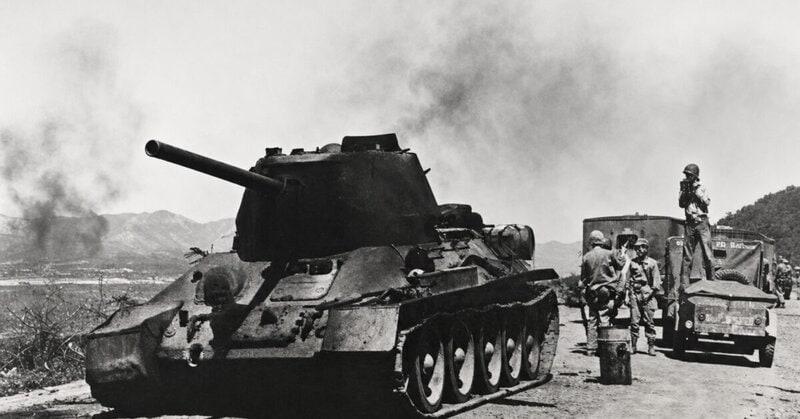
In the last hours before dawn on June 25, 1950, a line of Soviet-built T-34 tanks rolled south across a border that had been sketched onto a National Geographic map just five years earlier by two American colonels working against a deadline. What followed would kill an estimated five million people — soldiers, civilians, sons, daughters — and then, with almost indecent haste, vanish from the memory of the nation that fought it. Decades later, documentary filmmakers are still trying to recover what was lost.
The Border Nobody Chose

The line the tanks crossed — the 38th parallel — had been drawn in approximately 45 minutes in August 1945, a hasty administrative boundary meant to divide the surrender of Japanese forces between American and Soviet occupation zones. Nobody consulted the Koreans. Nobody imagined the line would harden into one of the most dangerous frontiers on earth.
South Korean conscripts in summer uniforms, many carrying rifles left over from the Second World War, found themselves directly in the path of a mechanized invasion force equipped and trained by the Soviet Union. The T-34 tank, which had helped stop the Nazi advance on the Eastern Front, now ground southward through rice paddies and river valleys on a peninsula wholly unprepared for its power. Seoul fell in three days.
Here is the central paradox that haunts every honest account of the Korean War: the conflict that began that morning would, in three years of fighting, produce casualty figures on the scale of a world war. Estimates of total dead — combining American, South Korean, North Korean, Chinese, and civilian losses — run as high as five million people. Yet within a generation, American culture had effectively erased the war from its moral landscape. No defining novels. Almost no major films. A memorial on the National Mall that did not open until 1995, more than four decades after the armistice.
The War That Inherited a World on Fire

To understand why Korea exploded when it did, you have to hold the whole volatile atmosphere of 1949 and 1950 in mind at once. The Soviet Union had tested its first atomic bomb in August 1949, shattering the American monopoly on nuclear weapons. Mao Zedong’s communist forces had completed their victory in China that October, placing a revolutionary government of 550 million people on Korea’s northern border. Western Europe was still a landscape of bombed-out cities and rationed food, dependent on American aid to stay out of the Soviet orbit. The Cold War was already running at dangerous pressure before a single tank crossed the 38th parallel.
Korea was never really a local conflict. It was a proxy arena where American resolve, Chinese revolutionary nationalism, Soviet strategic ambition, and the collective security commitments of the United Nations all collided simultaneously. Understanding that collision is essential for understanding the war itself — and for understanding every Cold War crisis that came afterward. The rhythms of Vietnam, the Berlin standoffs, the Cuban Missile Crisis all rhyme with what happened on the peninsula, because they grew from the same unresolved tension that Korea first made visible and lethal.
The PBS documentary Korea: The Never-Ending War reconstructs this context with particular care, framing June 1950 as the moment the Cold War turned from ideological posturing into grinding, industrial combat on steep Korean ridgelines. It is one of the most effective starting points available for viewers approaching the war for the first time.
Combat on a Scale That History Underreports

By November 1950, the war had already changed shape twice. The North Korean invasion had nearly driven United Nations forces into the sea at Pusan. General Douglas MacArthur’s amphibious landing at Inchon had reversed the tide and sent allied forces racing north toward the Chinese border. Then China entered the war, and everything changed again.
At the Chosin Reservoir in late November 1950, United States Marines found themselves encircled by Chinese forces in temperatures that dropped to minus 35 degrees Fahrenheit. Weapons froze. Morphine syringes had to be thawed in mouths before they could be injected. The column that fought its way out over seventeen days of continuous combat suffered thousands of casualties and became one of the defining episodes in Marine Corps history.
The full casualty figures reflect that brutality throughout. Roughly 36,000 American service members died in Korea. South Korean military dead reached into the hundreds of thousands. Chinese and North Korean military losses were similarly staggering. And then there were the civilians — millions of Korean men, women, and children killed by bombing, ground combat, displacement, famine, and the violence that armies on all sides visited upon the population caught between them. The five million figure for total dead is not rhetorical. It is the honest accounting of what three years of total war on a densely populated peninsula produces.
The United States Army recognized early that this story deserved documentation. The Korean War: The First Year, available through the Army University Press film catalog, covers the major events from June 1950 through June 1951, preserving on film what the Army itself understood to be a conflict of world-historical significance. The tragedy is that this documentation remained largely invisible to the American public — filed away while the culture moved on to other anxieties.
The disproportion between the war’s human cost and its cultural footprint is stark. More Americans died in Korea than in Vietnam. Yet Vietnam produced a canon of literature, film, and public reckoning that reshaped American culture — novels, major motion pictures, a black granite wall in Washington that draws millions of visitors a year. Korea produced M*A*S*H, a television comedy that used the war as a thin disguise for commentary about Vietnam. The actual Korean War, in all its specificity and grief, remained largely unrepresented.
Why the Forgetting Was Not an Accident

The erasure was structural, built into the war’s outcome and into the particular anxieties of Cold War America.
Korea ended in July 1953 not with victory but with an armistice — a ceasefire that restored the border to roughly where it had been before the invasion. After three years and millions of dead, the line on the map was essentially unchanged. For a country accustomed to the unambiguous triumph of 1945, a stalemate against a communist enemy was not a story that fit any comfortable national narrative. It was too costly to celebrate and too morally complicated to mourn. So it was quietly set aside.
The war’s position in historical sequence made the erasure easier. It came after World War II, with its mythic scale and unambiguous moral clarity, and before Vietnam, with its traumatic decade-long reckoning. Korea fell into the gap between heroism and guilt — too ambiguous for a triumphalist monument, too distant from the counterculture of the 1960s and 1970s to generate the art and protest that gave Vietnam its cultural permanence.
The label “The Forgotten War” became a self-fulfilling prophecy. Once the phrase entered common usage, it gave journalists, politicians, and textbook editors implicit permission to move on — as if naming the forgetting discharged the obligation to actually remember. Documentaries attempting to address the war go back decades, yet none broke through to mass cultural awareness. The gap between what the war deserved and what it received remained, year after year, almost perfectly intact.
What the Best Documentaries Actually Deliver

Documentary film has become, almost by default, the primary vehicle through which Korean War history now reaches general audiences. Hollywood has shown little sustained interest. The major studios have produced almost no significant Korean War features in decades, leaving the work of representation to documentary filmmakers willing to go where narrative film won’t.
Korea: The Never-Ending War, available on Apple TV, does what decades of cultural silence could not. Weaving together archival footage, survivor testimony, and historical analysis, it reconstructs both the battlefield experience and the geopolitical framework that surrounded it. The film’s title carries a double meaning the best historical work earns: the war is “never-ending” not merely because no formal peace treaty has ever been signed — the two Koreas remain technically at war to this day — but because its consequences continue to shape the present. A nuclear-armed North Korea. A democratic South Korea that became one of the most dynamic economies on earth. American troops still stationed on the peninsula more than seven decades after the armistice. These are not footnotes to history. They are the daily news.
For viewers who want to go further, discussions among history enthusiasts identify a range of documentary resources that together build a more complete picture than any single film can provide. Combat footage compilations available through streaming platforms preserve the raw visual record of what the fighting actually looked like — images that carry a weight no written description can quite replicate.
Watching these films now, against a backdrop of renewed great-power competition and rising tensions across the Pacific, feels less like a history lesson and more like reading a dispatch from a conflict that never fully resolved. Korea was a template for every proxy confrontation that followed: a small nation caught between great powers, local grievances weaponized by ideological competition, military escalation driven by miscalculation on all sides.
The Human Cost That Still Has No Memorial

The aggregate casualty figures are staggering enough. But the figure that most distinguishes Korea from public perception is not military dead — it is civilian suffering on a scale that has received almost no formal commemoration in the United States.
An estimated ten million Koreans were separated from family members by the war’s end — parents from children, siblings from siblings, spouses from each other — divided by a border that has remained sealed ever since. Many of those people lived out their entire lives without learning whether those they loved had survived. There is no wall on the National Mall with their names.
Large numbers are, paradoxically, easier to ignore than small ones. Without the novels, films, memoirs, and personal testimonies that make individual suffering visible and specific, five million dead becomes a statistic rather than a wound. This is precisely why the forgetting was so easy to sustain: the cultural infrastructure that might have kept the grief alive was never built in America. South Korea’s own reckoning with the war stands in sharp contrast — Korean film, literature, and public commemoration have engaged with the conflict’s legacy in sustained, serious ways for decades. The forgetting was not a universal response to overwhelming loss. It was specifically a feature of the discomfort felt by the side that fought to a draw and preferred not to examine the full cost of that outcome.
Why Remembering Now Carries Real Stakes
The Korean War is not ancient history. It is the unresolved backstory of the most dangerous geopolitical situation currently operating on earth. North Korea’s nuclear arsenal continues to develop. United States-China tensions carry unmistakable echoes of the Cold War dynamics that collided on the peninsula in 1950. The armistice line — drawn in 1953, still armed and fortified — remains one of the few places on the planet where a miscalculation could trigger a conflict involving nuclear powers within hours.
Understanding how a regional conflict became a superpower confrontation in 1950 is not an academic exercise. It is essential context for anyone trying to read the news in 2025. Knowing how the original crisis unfolded — the speed of the escalation, the role of miscalculation, the way ideological rigidity on all sides foreclosed diplomatic options — is the only way to recognize the pattern before it repeats.
The best Korean War documentary is not just a history lesson. It is a strategic primer, a moral reckoning, and an act of basic human respect toward the millions of people whose deaths were deemed, for decades, insufficiently interesting to remember. Exploring the Army’s own film record, seeking out survivor testimony, watching the documentaries that finally give the war its due — these are ways of returning the dignity of memory to people that history briefly abandoned.
The 38th parallel was drawn in 45 minutes on a borrowed map. It is still there, 75 years later, still armed, still dangerous, still dividing families who have spent lifetimes waiting to cross it. The wars we choose to forget do not forget us. They wait, patient and unresolved, for the next generation to stumble into them without the knowledge that might have made the stumbling less inevitable.

 English
 Arabic
 French
 Spanish
 Portuguese
 Deutsch
 Turkish
 Dutch
Dutch
 Italiano
 Russian
 Romaian
 Greek
Greek