


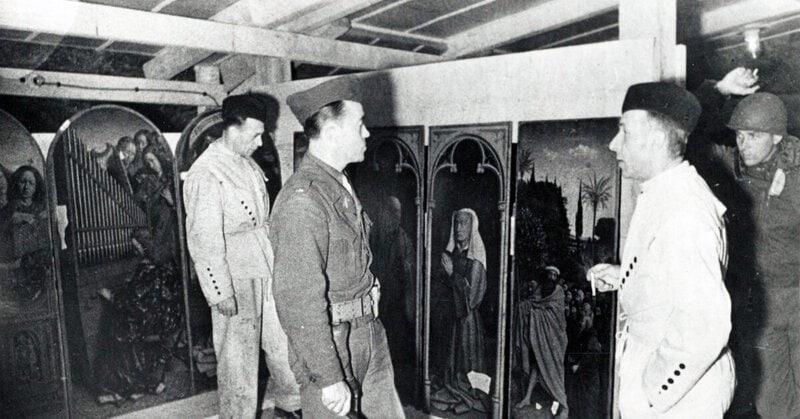
In April 1945, American soldiers crawled through the narrow tunnels of the Altaussee salt mine in the Austrian Alps and emerged into something that shouldn’t have existed: a cathedral of stolen beauty, stacked in near-darkness, waiting. Michelangelo’s Bruges Madonna. Jan van Eyck’s Ghent Altarpiece. Vermeer, Raphael, Rembrandt — thousands of masterpieces pulled from the walls of Europe’s greatest museums and the homes of families who would never see them again, all of it hoarded for a museum that Adolf Hitler never lived to build.
The Largest Art Theft in Recorded History
The scale of what the Nazis attempted — and largely accomplished — strains comprehension even now. An estimated five million cultural objects were looted, hidden, or destroyed across occupied Europe between 1933 and 1945, making it the single largest act of cultural theft in recorded history. Paintings, sculptures, tapestries, manuscripts, Torah scrolls, furniture, and jewelry were systematically stripped from Jewish families, national museums, private galleries, and churches from Paris to Warsaw to Athens. What couldn’t be moved was often burned. What couldn’t be burned was sometimes mined.
At the center of this planned cultural erasure was Hitler’s personal obsession. The dictator had nurtured a vision of a colossal Führermuseum in his hometown of Linz, Austria — a monument to Germanic cultural supremacy that would dwarf the Louvre and shame the British Museum. The looting of occupied Europe was, in a very real sense, a shopping trip conducted at gunpoint. The Einsatzstab Reichsleiter Rosenberg, or ERR, was the Nazi task force formally charged with cataloguing and seizing art across France, the Netherlands, Poland, and beyond, targeting Jewish collections with particular ferocity. Hermann Göring ran a parallel operation for his own enrichment, personally arriving at Parisian art depots ahead of his own staff to cherry-pick Rembrandts and Rubenses for Carinhall, his country estate north of Berlin.
By 1943, the Allies understood that military victory alone would not save what was being stolen and destroyed. Retreating German forces had standing orders to demolish what they couldn’t transport. The clock was ticking on centuries of civilization, and someone had to do something about it.
Curators Go to War: Building the MFAA
The something was the Monuments, Fine Arts, and Archives section — the MFAA — formally established in 1943 under Allied Force Headquarters. The unit’s creation was historically unprecedented. No army in the modern era had ever embedded cultural preservation officers directly into a combat theater. The idea was radical, the resources were minimal, and the men recruited to carry it out were, by military standards, absurd choices for a war zone.
Most of the MFAA officers were in their forties and fifties. They were museum directors, art historians, architects, conservators, and sculptors who received cursory military training and were then handed jeeps, minimal supplies, and orders to keep pace with advancing armored divisions across France, Belgium, and Germany. Their early mandate was protective: issuing off-limits cards to historic buildings, briefing battlefield commanders on monuments to avoid shelling, and distributing printed lists of protected cultural sites — a fragile gesture against the chaos of mechanized warfare, but one that sometimes worked.
The unit’s founding figures were formidable people operating under impossible conditions. George Stout, a Harvard-trained conservator from the Fogg Art Museum, was the operational genius who developed the field protocols the MFAA used to locate, secure, and document repositories. He was the kind of methodical, quietly brilliant man who could walk into an Austrian salt mine and immediately understand what needed to happen next. Art historian James Rorimer cultivated one of the most consequential intelligence relationships of the entire war: his partnership with Rose Valland, a French museum professional who had spent years secretly documenting every crate the Nazis shipped out of the Jeu de Paume in Paris. At enormous personal risk, Valland maintained meticulous records of where the looted art was going — records that would later guide the MFAA directly to the hidden repositories where the treasures were stored. Robert Posey and Lincoln Kirstein, following a chain of clues that sounds more like a spy novel than military history, ultimately led the team that discovered Altaussee.
The Monuments Men Cast: Who Played Whom
George Clooney’s 2014 ensemble film The Monuments Men introduced this story to millions of viewers who had never heard of the MFAA. The film draws on Robert Edsel’s book of the same name and constructs a cast of composite characters, each grounded in one or more real historical figures. Understanding who played whom — and who the real people were — adds a layer of meaning that the film alone cannot provide.
George Clooney as Lt. Frank Stokes. Clooney directs and stars as the unit’s commanding officer, a character modeled primarily on George Stout. The soft-spoken conservator personally oversaw the Altaussee mine evacuation and embodied the unit’s core conviction that art was worth a soldier’s life. Stokes’s quiet authority and institutional credibility in the film mirror what colleagues wrote about Stout in historical accounts.
Matt Damon as Lt. James Granger. Damon’s character is based mainly on James Rorimer. His scenes tracking Rose Valland’s intelligence network are among the most historically grounded in the film. The real Rorimer later became director of the Metropolitan Museum of Art — a biographical detail that underscores how seriously the monuments men took their professional identities even in wartime.
Cate Blanchett as Claire Simone. Blanchett plays the film’s version of Rose Valland — renamed Claire Simone and repositioned as a curator at the Jeu de Paume. The character compresses Valland’s years of clandestine record-keeping into a more cinematically legible arc, but the core truth holds: Valland’s secret documentation was indispensable to the recovery effort, and she deserves recognition that the film, by making her a supporting character, arguably undersells.
Bill Murray as Sgt. Richard Campbell. Murray’s character is a composite figure rather than a direct portrait of a single monuments man. His dry humor provides much of the film’s levity and reflects the unlikely, civilian-minded culture of the MFAA as a whole.
John Goodman as Sgt. Walter Garfield. Another composite character, Garfield is a sculptor by trade — a nod to the real unit’s genuinely cross-disciplinary makeup, which included practicing artists alongside historians and museum administrators.
Jean Dujardin as Jean Claude Clermont. Dujardin’s French officer reflects the MFAA’s multinational character. British, French, and other Allied nationals served alongside Americans throughout the operation, though the film’s American-centric framing inevitably reduces their screen time.
Bob Balaban as Pvt. Preston Savitz. Balaban plays the unit’s somewhat reluctant scholar, a role that captures the bureaucratic absurdity many MFAA officers described in their own letters and diaries — academics suddenly responsible for keeping pace with armored divisions.
Hugh Bonneville as Donald Jeffries. Bonneville’s character is the film’s most dramatically consequential monuments man: a British officer whose death early in the story gives the mission its moral weight. The film honors the real fact that two MFAA officers — Ronald Balfour and Walter Huchthausen — were killed during the campaign, and Jeffries functions as a composite memorial to both.
The full cast and crew listing and the cast breakdown at Rotten Tomatoes provide additional detail on supporting roles. The film’s entry on The Movie Database includes production notes and international release information for those researching the film’s reception alongside its history.
What the Film Gets Right — and What It Compresses
The movie necessarily simplifies the sheer breadth of the real operation. The MFAA ultimately involved more than 350 officers across multiple theaters and years, not a small band on a single pivotal mission. The film’s intimate framing — a tight group of friends racing against time — is a dramatic compression of an effort that unfolded across half a continent over several years. The decision to kill off a monuments man early, while fictional in its specifics, draws on the documented deaths of Balfour and Huchthausen and earns its emotional weight honestly.
What the film does capture authentically is the unit’s fundamental improvisation, its reliance on individual expertise and personal courage, and the genuinely dangerous conditions under which these middle-aged academics worked. It also captures, without editorializing, the institutional skepticism the MFAA faced from military commanders who saw the entire enterprise as a distraction from winning a war. That tension was real, documented in contemporary correspondence, and the film renders it credibly.
The Discoveries: Spring 1945 and the Race Against the Soviets
The spring of 1945 produced a sequence of discoveries so extraordinary they still feel cinematic without embellishment. At the Merkers mine in Germany, American troops stumbled onto not just thousands of artworks but the entire gold reserve of the Reichsbank — a find so staggering that Generals Eisenhower, Patton, and Bradley descended into the mine personally to see it. At Bernterode, soldiers found a sealed chamber containing not only art but the coffins of Prussian military heroes, relocated there for safekeeping. At castle after castle and monastery after monastery, MFAA officers catalogued repositories that revealed the full, staggering geography of Nazi looting.
But the race was not only against time and German demolition orders. The Soviet Red Army operated its own Trophy Brigades with explicit orders to seize art as war reparations — compensation, in the Soviet calculation, for the cultural destruction the Nazis had inflicted on the USSR. Objects that fell into Soviet hands, including vast portions of Berlin’s museum collections, disappeared behind the Iron Curtain for decades. Some remain geopolitically contested today, a dispute the MFAA officers could see forming in real time and were largely powerless to stop.
Five Million Pieces, One Enormous Puzzle
The physical recovery of the art was, in many ways, the easier half of the problem. The restitution effort that followed was staggering in its complexity. Central Collecting Points established in Munich, Wiesbaden, Marburg, and Offenbach processed millions of objects and attempted to match them to their rightful owners or nations of origin. The provenance challenge was almost incomprehensible: many Jewish families had been murdered, leaving no surviving claimants. Records had been destroyed. Some objects had changed hands multiple times under duress, creating legal tangles that persist to this day — museum restitution cases still generate international headlines and courtroom battles decades after the war’s end.
The MFAA’s formal operations wound down in the early 1950s, but the unit’s lasting legacy is the modern legal and ethical framework for cultural property protection. The 1954 Hague Convention for the Protection of Cultural Property in the Event of Armed Conflict drew directly on the principles the MFAA had articulated and practiced. When Iraqi museums were looted in 2003 and when cultural sites in Ukraine came under sustained threat in the 2020s, the arguments made and the methods employed traced a direct line back to those improvised field protocols George Stout developed in 1943.
Thousands of objects from the Second World War remain unaccounted for — some hidden, some destroyed, some quietly absorbed into private collections. New restitutions and new discoveries still make international news, which means the monuments men’s story has never fully ended. It is an open wound in the history of European culture that closes, piece by piece, one painting at a time.
Why the Story Still Matters
Clooney’s decision to make The Monuments Men was a deliberate act of popular history. The unit had been largely forgotten outside specialist circles, and the film sent audiences back to the historical record and sparked renewed public interest in art restitution. It is imperfect as history, as all films inevitably are, but its central moral argument is not sentiment. The conviction that art represents the accumulated record of human civilization — and that its deliberate destruction is a form of violence against memory itself — was not invented by screenwriters. It was the documented reasoning that Allied commanders used in 1943 when they decided, against considerable institutional skepticism, that an army fighting the most destructive war in history should also employ curators.
The Bruges Madonna, carved by Michelangelo around 1501 from a single block of white marble, rode out of the Altaussee mine in an American Army truck in May 1945. It was returned to the Church of Our Lady in Bruges that same year, where it still stands today in a side chapel, slightly worn and entirely intact. Against everything the twentieth century threw at it — ideology, theft, dynamite, war — it came home. The men and women who made that possible were not soldiers by training or temperament. They were people who believed, with a conviction that turned out to be correct, that some things are worth the risk of retrieving.

 English
 Arabic
 French
 Spanish
 Portuguese
 Deutsch
 Turkish
 Dutch
Dutch
 Italiano
 Russian
 Romaian
 Portuguese (Brazil)